
Yellow-throated Warbler Identification Guide
A striking gray-backed warbler with a bright yellow throat, bold black-and-white facial pattern, and a habit of creeping along branches like a nuthatch.
Read the full Yellow-throated Warbler encyclopedia entry →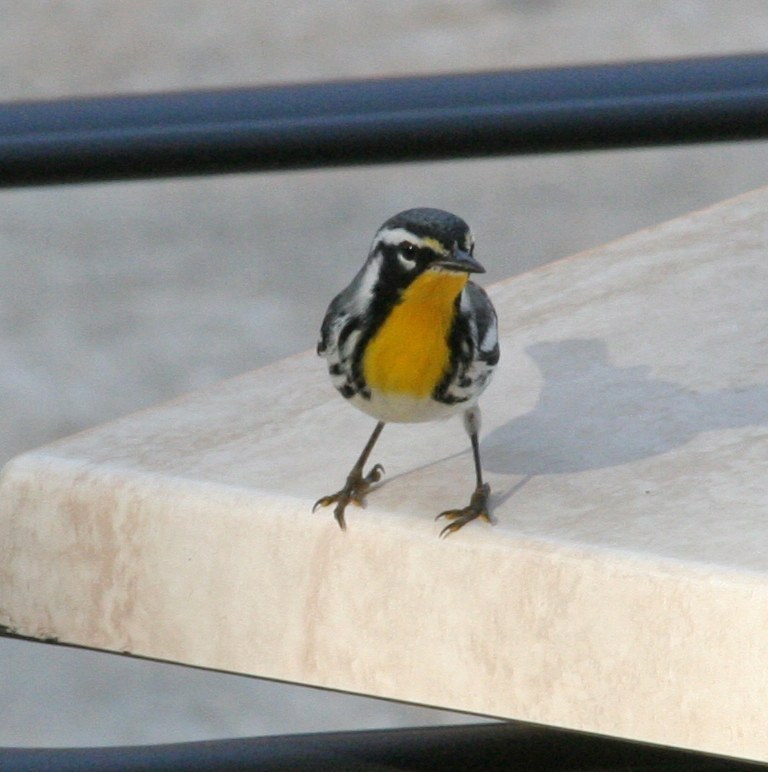
Key Field Marks
- Size & shape: A slender, mid-sized warbler (about 5.25 inches) with a notably long, slightly downcurved bill for a warbler, adapted for probing bark and pine needle clusters.
- Plumage: Clean blue-gray back and wings; bright yellow throat and upper breast sharply set off from a white belly; bold black-and-white face pattern with a black mask through the eye, white supercilium (eyebrow), and a white patch on the side of the neck.
- Wings: Two white wingbars on gray wings; black streaking along the flanks.
- Bill & legs: Long, thin, slightly decurved black bill — longer than most warblers'; dark legs.
- Behavior: Frequently creeps along branches and trunks probing bark crevices and Spanish moss or pine needle clusters, sometimes moving nuthatch-like along limbs — a distinctive foraging style among warblers.
Separating It From Similar Species
- Grace's Warbler: Very similar yellow throat and gray back, but Grace's Warbler has yellow extending onto the supercilium (eyebrow) and is found in western pine forests, not overlapping in range with typical Yellow-throated Warbler habitat.
- Yellow-throated Vireo: Also yellow-throated, but the vireo has a thick hooked bill, yellow spectacles instead of a black mask, and moves far more slowly; the warbler's face pattern is black-and-white, not yellow-spectacled.
- Blackburnian Warbler: Has an orange (not clean yellow) throat and a much more complex black-and-orange face pattern, plus streaked back rather than clean gray.
- Key giveaway: The combination of unstreaked gray back, sharp yellow throat, black-and-white face, and long decurved bill is unique among North American warblers.
Where & When to See It
- Habitat: Southern populations favor pine woods and pine-oak forests; another form is closely tied to bald cypress swamps and stands of Spanish moss along the Gulf Coast and southeastern river bottoms; also found in sycamore-lined riparian corridors in parts of its range.
- Range: Breeds across the southeastern United States, extending north along the Atlantic coastal plain and into the Ohio Valley; some populations are resident/short-distance migrants while others winter in Florida, the Caribbean, and Central America.
- Season: Present on breeding grounds from March through October in most of its range; some southern coastal populations are present year-round.
Voice & Song Cues
- Song is a clear, ringing series of descending, whistled notes that accelerates and often drops in pitch at the end, sometimes ending with an upslurred final note — similar in cadence to an Indigo Bunting or Louisiana Waterthrush but higher and clearer.
- Call note is a sharp, high "chip" or "tsip."
- Often detected first by its habit of singing from high in pines or cypress before it's spotted foraging along a limb.
Frequently asked questions
What makes the Yellow-throated Warbler easy to identify?
Its unstreaked blue-gray back, bright yellow throat, and bold black-and-white face pattern combined with a long, slightly downcurved bill make it distinctive among warblers.
How is it different from Grace's Warbler?
Grace's Warbler has yellow extending into its eyebrow (supercilium) and lives in western pine forests, while Yellow-throated Warbler has a white eyebrow and occupies eastern pine woods and cypress swamps, with essentially no range overlap.
Why does it creep along branches like a nuthatch?
Its unusually long, decurved bill is adapted for probing bark crevices, pine needle clusters, and Spanish moss for insects, leading to nuthatch-like foraging behavior on trunks and limbs.
Where should I look for a Yellow-throated Warbler?
Search pine woods, pine-oak forests, and bald cypress swamps with Spanish moss across the southeastern U.S., especially high in the canopy where it forages and sings.
What does its song sound like?
A clear, ringing series of whistled notes that descends and speeds up, often finishing with a distinct upslurred note at the end.