
Yellow-tailed Black-Cockatoo Identification Guide
A large, long-tailed Australian cockatoo, sooty black with a yellow cheek patch and yellow panels in the tail, known for its far-carrying wailing call in flight.
Read the full Yellow-tailed Black-Cockatoo encyclopedia entry →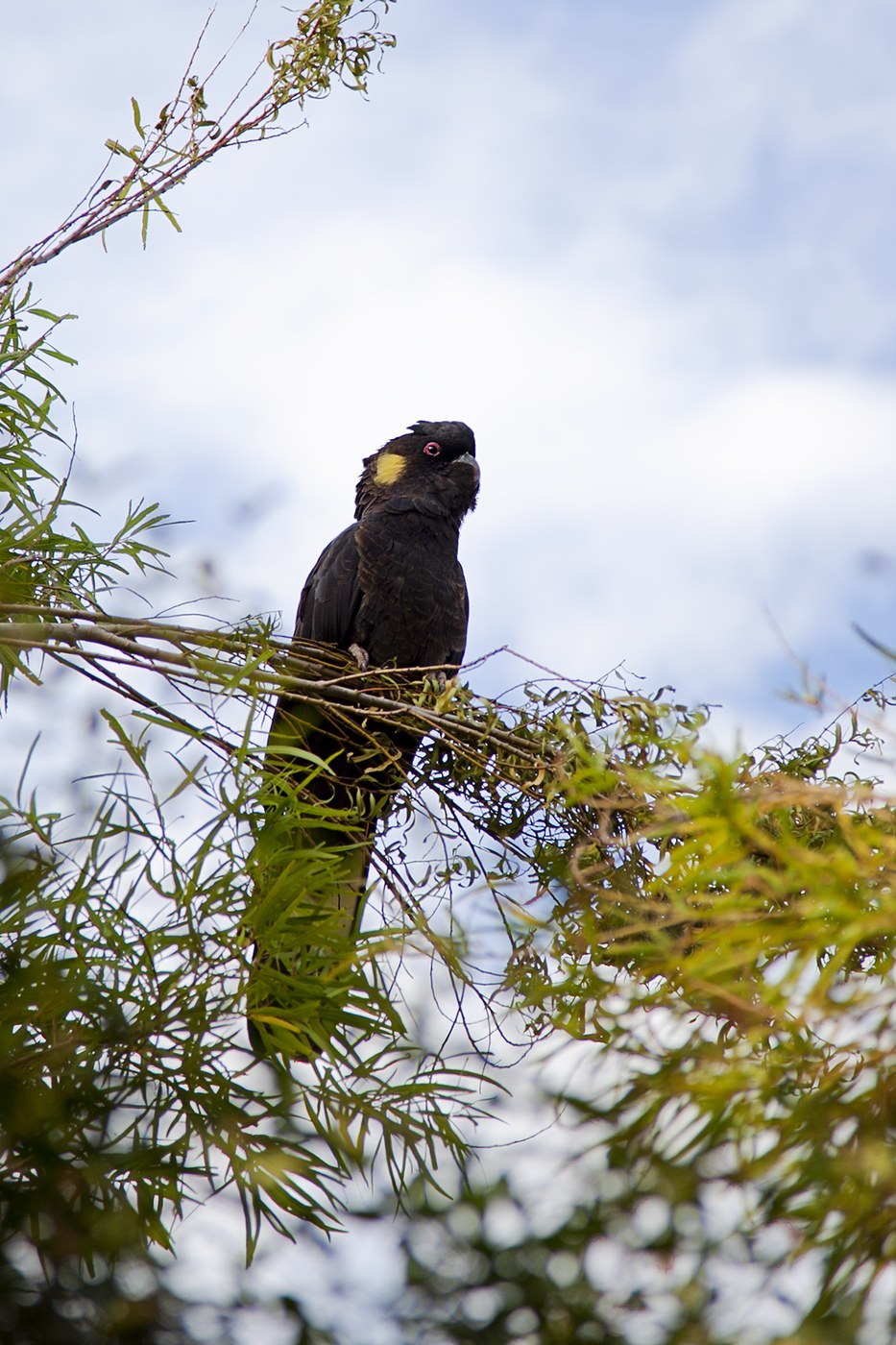
Key Field Marks
- Size and shape: One of the largest cockatoos, about 23-26 inches long including a notably long tail, with a small crest and a relatively slender bill compared to some other black-cockatoos.
- Plumage: Overall sooty brownish-black body with individual feathers finely edged in pale yellow, giving a subtly scalloped look at close range; a bright yellow patch covers the ear coverts (cheek), and broad yellow panels cross the outer tail feathers, conspicuous in flight.
- Sexes differ: Males have a dark blackish bill and a plain dark eye-ring, while females show a bone-colored (pale) bill and a pink to reddish eye-ring, along with brighter yellow spotting on the head and underparts.
- Behavior: Usually seen in pairs or small to large flocks flying with slow, deep, unhurried wingbeats well above the canopy; forages by tearing apart wood and pine cones for grubs and seeds, leaving distinctive shredded debris beneath feeding trees.
Similar Species
- Other black-cockatoos (Glossy, Red-tailed, Short-billed and Long-billed Black-Cockatoos) show red or pinkish tail panels instead of yellow, or in the case of Short-billed/Long-billed, a much larger, differently shaped bill; the combination of yellow tail panels and yellow cheek patch is unique to Yellow-tailed Black-Cockatoo within its eastern Australian range.
- Glossy Black-Cockatoo also has red tail panels (not yellow) and a much heavier bill, further separating the two.
Habitat, Range & Season
- Found along the coast and adjacent ranges of eastern and southeastern Australia, from southeastern Queensland through New South Wales and Victoria to southeastern South Australia and Tasmania, in eucalypt forest, pine plantations, and woodland.
- Largely sedentary, though some local and altitudinal movements occur outside the breeding season in search of food.
Voice
- Gives a far-carrying, mournful, wailing "kee-ow" or "wy-lah" call, often given in flight and audible over long distances, one of the most recognizable cockatoo calls in southeastern Australia.
- Flocks are frequently detected by this loud calling well before they come into view overhead.
Frequently asked questions
How do you tell male and female Yellow-tailed Black-Cockatoos apart?
Males have a dark bill and plain dark eye-ring, while females have a paler, bone-colored bill, a pink to reddish eye-ring, and slightly brighter yellow spotting.
What distinguishes Yellow-tailed Black-Cockatoo from other black-cockatoos?
It is the only eastern Australian black-cockatoo with yellow (rather than red) panels in the tail, combined with a bright yellow cheek patch.
What does the Yellow-tailed Black-Cockatoo's call sound like?
A loud, mournful, wailing "kee-ow" or "wy-lah" call, given especially in flight and carrying over long distances.
What kind of damage do Yellow-tailed Black-Cockatoos leave behind while feeding?
They shred pine cones, banksia seed pods, and rotten wood in search of seeds and wood-boring grubs, often leaving conspicuous litter of torn debris beneath feeding trees.