
Yellow-rumped Warbler Identification Guide
One of North America's most abundant warblers, instantly recognizable by its bright yellow rump patch, flashed in flight and at rest, earning it the nickname "butter-butt."
Read the full Yellow-rumped Warbler encyclopedia entry →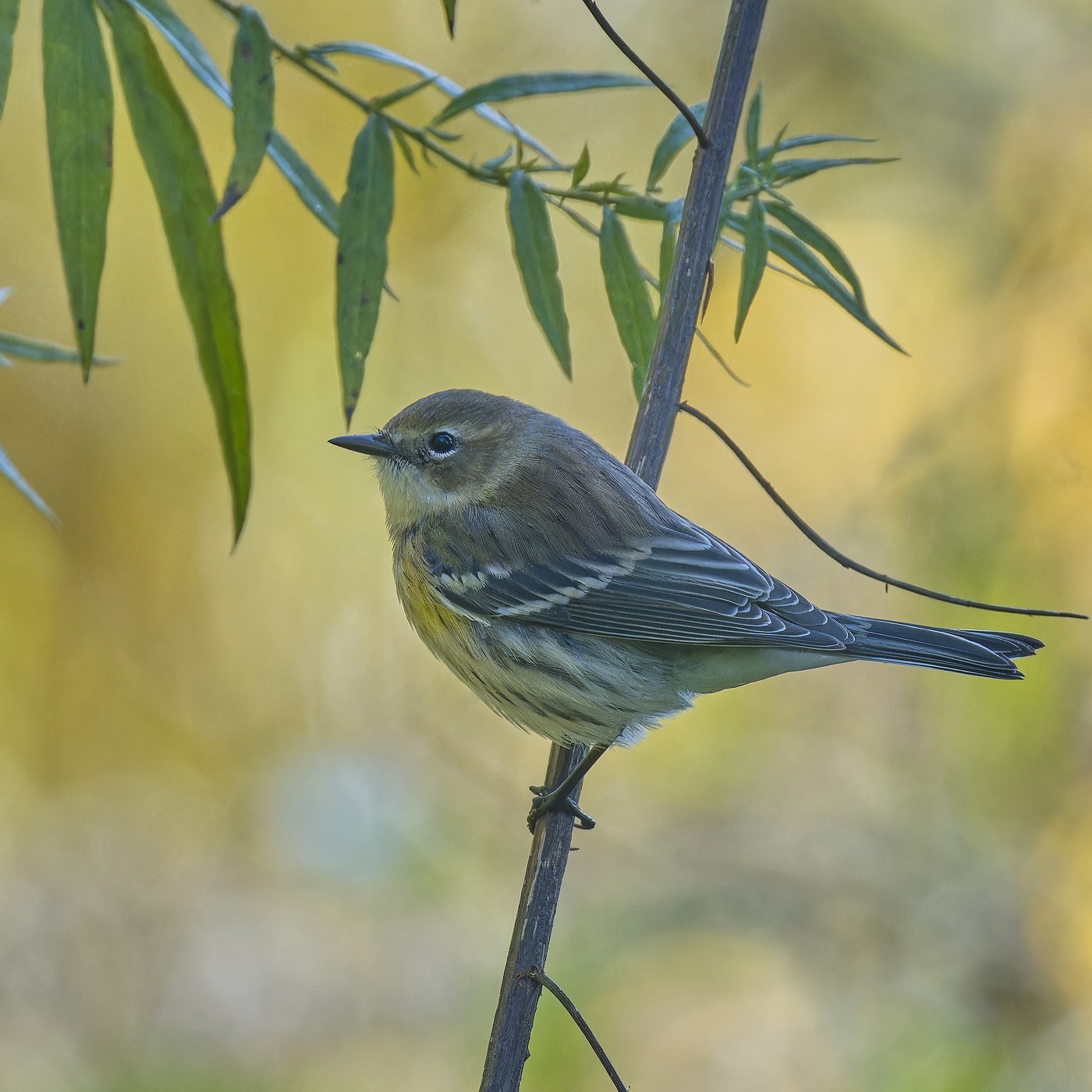
Key Field Marks
- Size and shape: A medium-sized, fairly robust warbler around 5.5 inches long, with a sturdy build and thin, pointed bill.
- Breeding plumage: Blue-gray to gray-brown above with black streaking, a bright yellow rump, yellow patches on the sides of the breast, and often a yellow crown patch; throat color and face pattern differ between the two main forms (see below).
- Nonbreeding/winter plumage: Much duller, brownish overall, but the yellow rump patch remains visible year-round and is the most reliable mark at any season.
- Two distinctive forms: The eastern "Myrtle" Warbler has a white throat and a more contrasting blackish face mask, while the western "Audubon's" Warbler has a yellow throat and a plainer gray face; both share the diagnostic yellow rump, and where their ranges meet in western Canada they interbreed.
- Flight/behavior: Often flocks in large numbers outside the breeding season, flycatching from perches and foraging low in shrubs and on the ground, unusual among warblers for eating berries such as wax myrtle and bayberry in winter, which allows it to winter farther north than most warblers.
Similar Species
- No other North American warbler combines a bright yellow rump with yellow side patches; this rump patch alone separates it from all similar gray or brown warblers, especially in nonbreeding plumage when other marks are muted.
- Audubon's form can suggest Townsend's or other yellow-throated warblers, but the yellow rump and side patches together with a more subdued overall pattern distinguish it.
Habitat, Range & Season
- Breeds across boreal and montane coniferous and mixed forest throughout Canada, Alaska, the northeastern United States, and higher elevations in the western mountains.
- Extremely widespread in migration and winter across nearly all of the United States, Mexico, and Central America, tolerating colder conditions than most warblers because of its varied, berry-inclusive diet.
- Present in the U.S. and southern Canada from spring through fall as a breeder or migrant, and abundant as a wintering bird across the southern and coastal United States.
Voice
- Song is a loose, slightly variable warble or trill, rising and falling, often ending with a slight upward or downward inflection.
- Call note is a sharp, distinctive "check" or "chip," flatter and more emphatic than many other warbler call notes, frequently heard from foraging flocks in winter.
Frequently asked questions
Why is the Yellow-rumped Warbler nicknamed "butter-butt"?
Because its bright yellow rump patch, visible at rest and especially in flight, is its most conspicuous and reliable field mark in every plumage and season.
What is the difference between the Myrtle and Audubon's forms?
The eastern Myrtle form has a white throat and a bolder blackish face mask, while the western Audubon's form has a yellow throat and a plainer gray face; both share the yellow rump.
Why can Yellow-rumped Warblers winter farther north than other warblers?
Unlike most warblers that depend heavily on insects, it can switch to eating berries such as bayberry and wax myrtle in winter, allowing it to survive in colder regions with limited insect availability.
What does a Yellow-rumped Warbler's call sound like?
It gives a sharp, flat "check" or "chip" note, distinctive enough to help pick flocking birds out of mixed foraging groups even without a visual.