
Yellow-crowned Bishop Identification Guide
A small African weaver in which breeding males turn a striking black-and-golden-yellow, while females and nonbreeding birds are streaky brown and sparrow-like.
Read the full Yellow-crowned Bishop encyclopedia entry →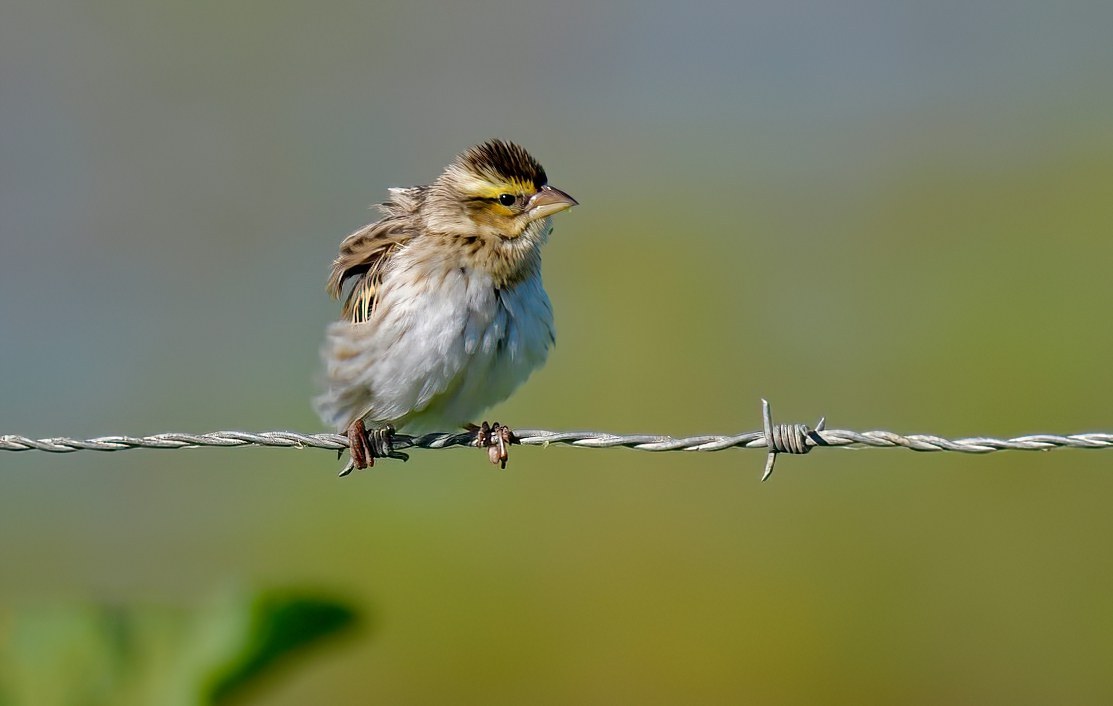
Key Field Marks
- Size and shape: A tiny, stocky weaver-relative, around 4-4.7 inches, with a short, stubby, conical bill and short tail.
- Breeding male: Strikingly patterned, with a golden-yellow crown, nape, mantle, and rump contrasting with black face, throat, and underparts; the yellow can look almost fluorescent in good light.
- Female and nonbreeding male: Dull, streaky brown above and buffy below, closely resembling a small sparrow or female weaver, with a pale buffy eyebrow stripe and streaked flanks.
- Behavior: Gregarious, often in flocks over grassland and marsh vegetation; breeding males perform low, buzzy display flights over territories with fluffed-out plumage.
Similar Species
- Breeding male Yellow-crowned Bishops can be confused with other bishop species (such as Southern Red Bishop or Black-winged Bishop) that show red instead of yellow; check specifically for the golden-yellow (not red or orange) crown and mantle against black underparts.
- Nonbreeding and female bishops are very similar to female weavers and queleas; range, habitat (rank grass and wetland edges), and association with breeding-plumaged males are the best clues.
Habitat, Range & Season
- Widespread across sub-Saharan Africa in seasonally flooded grassland, marsh edges, rank vegetation near water, and cultivated fields.
- Largely resident but shows local nomadic movements tied to rainfall and grass seed availability; some populations are seasonal breeders that molt out of bright male plumage outside the breeding season.
- Introduced and established in some areas outside Africa, including parts of the Caribbean and southern United States, from escaped cage birds.
Voice
- Calls are high, thin buzzy notes and chattering typical of small weavers, often given in flight or during display.
- Not known for an elaborate song; vocalizations are simple and used mainly in flocking and courtship contexts.
Frequently asked questions
What does a male Yellow-crowned Bishop look like when breeding?
Breeding males show a golden-yellow crown, nape, and back set off against black face and underparts, a dramatic transformation from their drab nonbreeding plumage.
How do you identify a female Yellow-crowned Bishop?
Females are streaky brown and buffy, sparrow-like, and are best told from similar small weavers by habitat, flock association with males, and range.
Where does the Yellow-crowned Bishop live?
It is native to sub-Saharan Africa, favoring marshy grassland, flooded fields, and rank vegetation near water, with introduced populations in a few other regions.
Is the Yellow-crowned Bishop the same as the Golden Bishop?
Yes, Yellow-crowned Bishop and Golden Bishop are alternate common names for the same species, Euplectes afer.