
Yellow-billed Cuckoo Identification Guide
A slim, long-tailed cuckoo with rufous flight feathers and a yellow lower bill, often heard giving its slow, guttural call before rain.
Read the full Yellow-billed Cuckoo encyclopedia entry →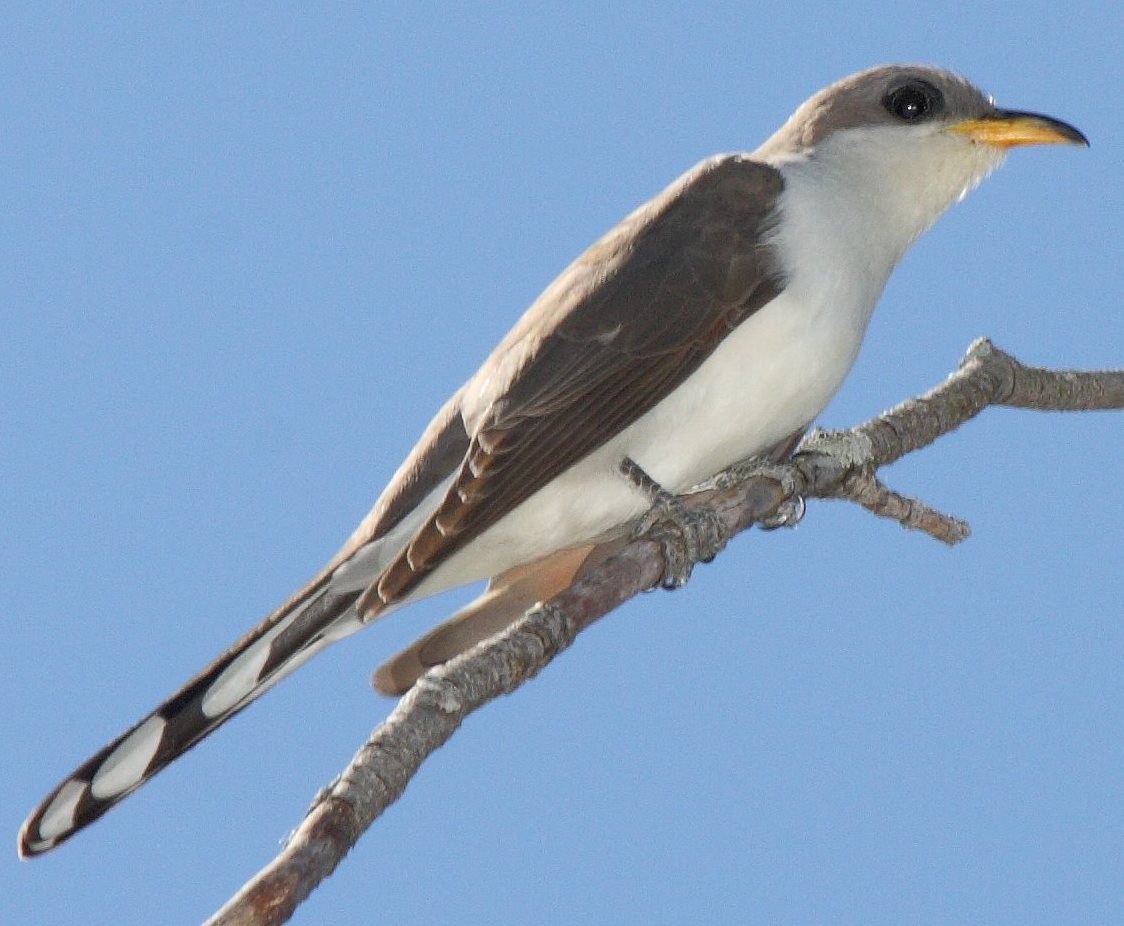
Key Field Marks
- Size & shape: A slender, long-tailed bird about 12 inches long, with a slim body and a long, graduated tail — roughly a third of the bird's total length.
- Plumage: Grayish-brown above and clean white below, with rich rufous (cinnamon) primaries that flash prominently in flight.
- Tail: Underside of the tail is black with large, bold white spots, contrasting strongly with the plain grayish upperside.
- Bill: Fairly long, downcurved bill that is mostly yellow on the lower mandible, giving the species its name.
- Eye: Narrow yellow eye-ring.
- Behavior: Secretive and often sits motionless for long periods in dense foliage; feeds heavily on large caterpillars (including tent caterpillars) and cicadas.
Separating It From Similar Species
- Black-billed Cuckoo: Very similar shape and behavior but has an entirely dark bill, a reddish (not yellow) eye-ring, little to no rufous in the wing, and smaller, less contrasting white tail spots on a duller gray-tipped tail.
- Overall structure separates cuckoos from most other birds, so once a cuckoo shape is confirmed, bill color, eye-ring color, and the amount of rufous in the wing are the key marks between the two similar North American species.
Habitat, Range & Season
- Breeds across much of the eastern and central United States in deciduous woodland, riparian corridors, and overgrown thickets; western populations (e.g., along southwestern rivers) have declined sharply and are federally threatened in parts of their range.
- A long-distance migrant that winters in South America.
- Present on breeding grounds roughly May through September; numbers can fluctuate locally in response to caterpillar or cicada outbreaks, which the species tracks opportunistically.
Voice
- Song is a slow, hollow, knocking series that often starts with an even "ka-ka-ka-ka" and slows into a lower, more resonant "kowlp-kowlp-kowlp."
- Nicknamed the "rain crow" in folklore for reportedly calling more often before summer thunderstorms.
- Often detected by voice well before being seen, since it tends to stay still and hidden in leafy cover.
Frequently asked questions
How do I tell Yellow-billed from Black-billed Cuckoo?
Look at the bill (yellow lower mandible vs. all black), the eye-ring (yellow vs. reddish), the amount of rufous in the wings (bold on Yellow-billed, absent or minimal on Black-billed), and the tail spots (large and bold vs. small and faint).
Why is the Yellow-billed Cuckoo called the 'rain crow'?
Because of a folk belief that it calls more frequently ahead of rain or thunderstorms, a nickname that persists in parts of its range.
What does a Yellow-billed Cuckoo eat?
Primarily large insects, especially caterpillars such as tent caterpillars and fall webworms, as well as cicadas, which it forages for while sitting quietly in foliage.
Where does the Yellow-billed Cuckoo spend the winter?
It migrates long distances to winter in South America.