
Wrentit Identification Guide
A small, plain, long-tailed skulker of Pacific coast chaparral, best known by its pale eye and accelerating, bouncing-ball song.
Read the full Wrentit encyclopedia entry →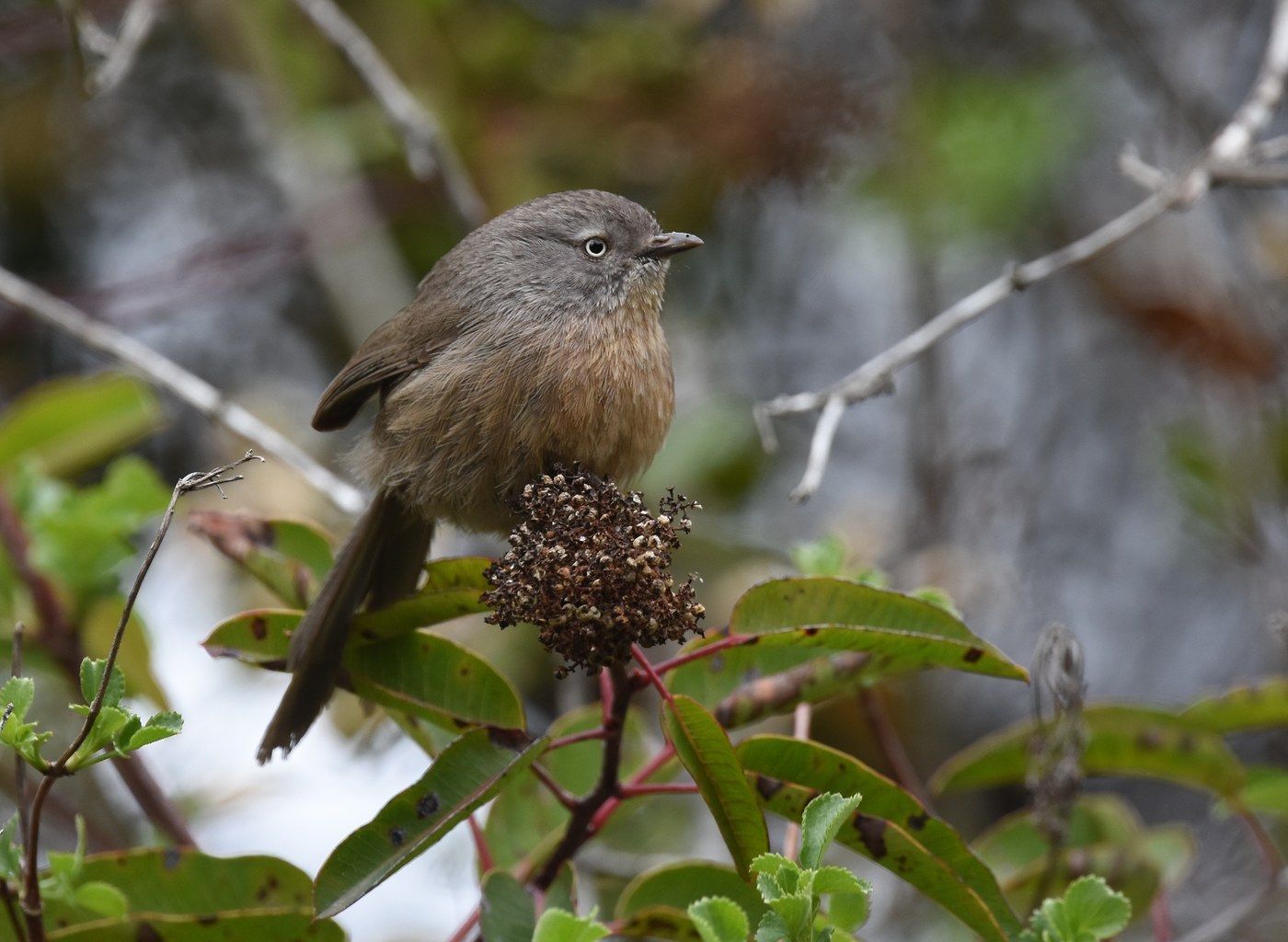
Key Field Marks
- Size & shape: Tiny and chunky (about 6.5 inches, mostly tail), with a long, rounded tail typically held cocked upward, a short stubby bill, and a big-headed, round-bodied silhouette.
- Plumage: Plain grayish-brown to warm rufous-brown overall (color varies geographically — grayer in the north, browner in the south) with no strong markings, wing bars, or streaking.
- Eye: A pale, whitish-to-cream iris that stands out against the plain face — one of the best marks at close range.
- Behavior: Highly sedentary; pairs mate for life and defend the same small territory year-round, rarely straying far or crossing open ground.
Separating It From Similar Species
- Bushtit: Much smaller and more slender with a dark eye, thinner tail, and constant twittering flock behavior; Wrentit is solitary or in pairs and far less social.
- Bewick's Wren: Shows a bold white eyebrow stripe and a barred tail, both absent on the plain-faced, unbarred Wrentit.
- Titmice/chickadees: Both have crests or capped patterns and are more active and visible; Wrentit is drab and stays hidden in dense cover.
Habitat, Range & Season
- Resident year-round along the Pacific coast from southern Oregon through California to northern Baja California, essentially never found far from where it hatched.
- Strongly tied to chaparral, coastal scrub, and dense brushy hillsides, though it also uses riparian thickets and brushy woodland edges.
- Because it is non-migratory, there is no seasonal timing to worry about — it can be found (mostly heard) in the same patch of scrub in any month.
Voice
- The song is highly distinctive: a series of clear, evenly spaced "pip" notes that accelerate into a dry, bouncing trill, often likened to a dropped ping-pong ball coming to rest.
- Calls include a harsh, scolding rattle or chatter, often given from deep within brush when the bird is agitated.
- Because Wrentits are so skulking, the song is usually the first — and often only — clue to their presence.
Frequently asked questions
What does a Wrentit's song sound like?
It's a series of clear notes that speed up into a dry, accelerating trill, often compared to the sound of a ping-pong ball bouncing to a stop.
Why is the Wrentit so hard to see?
It stays low and hidden in dense chaparral and coastal scrub almost all the time, relying on its song and calls rather than visual display, so most encounters are heard-only.
Do Wrentits migrate?
No — they are one of the most sedentary songbirds in North America, with mated pairs holding the same small territory for life.
How is a Wrentit different from a wren?
Despite the name, it's not a true wren; it's plainer, lacks a wren's barring and bold eyebrow, and is best identified by its pale eye, long cocked tail, and bouncing-ball song.