
Wreathed Hornbill Identification Guide
A large Southeast Asian forest hornbill with a ridged, wreath-like bill base and a bare throat pouch that differs in color between the sexes.
Read the full Wreathed Hornbill encyclopedia entry →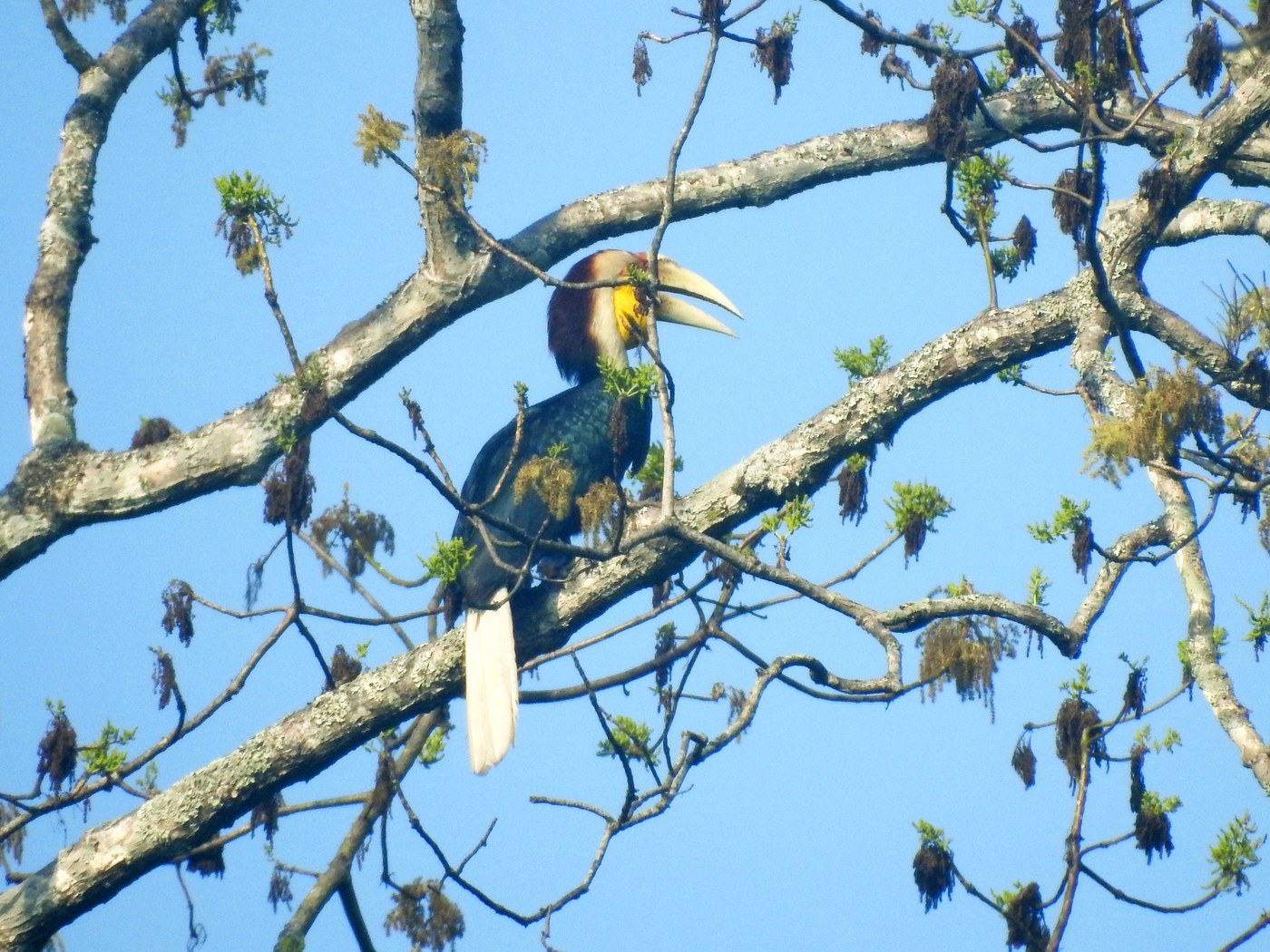
Key Field Marks
- Size & shape: A large hornbill, roughly 75-100 cm long including a long, white-tipped tail; heavy-bodied with broad, deeply fingered wings that produce loud, audible whooshing in flight.
- Bill: Pale ivory-to-yellowish bill with a series of low transverse ridges ("wreaths") at the base — the feature that gives the species its name; it lacks the tall, solid casque of the Great Hornbill.
- Bare skin: Blue skin around the eye in both sexes and an inflatable, bare throat pouch.
- Sex differences: Males have a whitish-cream head and neck with a rufous crown and a yellow throat pouch crossed by a black band; females have an entirely black head and neck with a plain blue throat pouch (no black band).
- Body: Mostly black plumage with a white belly, vent, and tail (the tail may show a dark or plain look depending on light and wear).
- Behavior: Canopy-dwelling and highly frugivorous, especially on figs; travels in flocks, often at dawn and dusk between roost and feeding trees.
Separating It From Similar Species
- Great Hornbill: Much larger, with a tall, solid, boat-shaped yellow-and-black casque, black-and-white banded wings, and a white tail crossed by a bold black band — bigger and more boldly patterned than Wreathed Hornbill.
- Plain-pouched Hornbill: Extremely similar and best separated by pouch pattern — males lack the black band across the throat pouch that Wreathed Hornbill males show — and range (Plain-pouched is largely confined to the Thai-Malay Peninsula).
- Rufous-necked Hornbill: Both sexes show a rufous head and neck (not just the male's crown), and it inhabits higher elevation forest.
Habitat, Range & Season
- Found from northeastern India and Bhutan through mainland Southeast Asia to Sumatra, Java, and Borneo.
- Inhabits primary and tall secondary evergreen and semi-evergreen lowland and hill forest, generally below about 1,500 m, favoring areas with abundant fruiting fig trees.
- Resident and largely non-migratory, though it may make local movements tracking fruit availability; best looked for year-round at fruiting fig trees and forest canopy gaps.
Voice
- Loud, deep, barking or grunting calls, often a repeated "gak" or "kak" series, given in flight or from canopy perches.
- Flight itself is diagnostic even without calls — the deep, resonant whooshing of the wingbeats carries a long distance through the forest.
Frequently asked questions
How can I tell a male from a female Wreathed Hornbill?
Males have a pale cream head and neck with a rufous crown and a yellow throat pouch marked by a black band, while females have an all-black head and neck with a plain blue throat pouch and no black band.
What does 'wreathed' refer to in the name?
It refers to the low, ridged grooves at the base of the bill and casque, which look like a series of wreaths compared to the smoother or taller casques of other hornbills.
How do I separate Wreathed Hornbill from Great Hornbill?
Great Hornbill is larger with a tall, solid yellow-and-black casque and a boldly black-and-white banded tail, while Wreathed Hornbill has a low ridged bill base and a mostly plain white tail.
Where is the best place to see Wreathed Hornbills?
Look in tall lowland and hill evergreen forest across mainland Southeast Asia and the Greater Sundas, especially near fruiting fig trees where flocks gather to feed.