
Worm-eating Warbler Identification Guide
A plain, buffy-olive warbler of eastern hillside forests told by its bold black-striped head and dry, insect-like trill.
Read the full Worm-eating Warbler encyclopedia entry →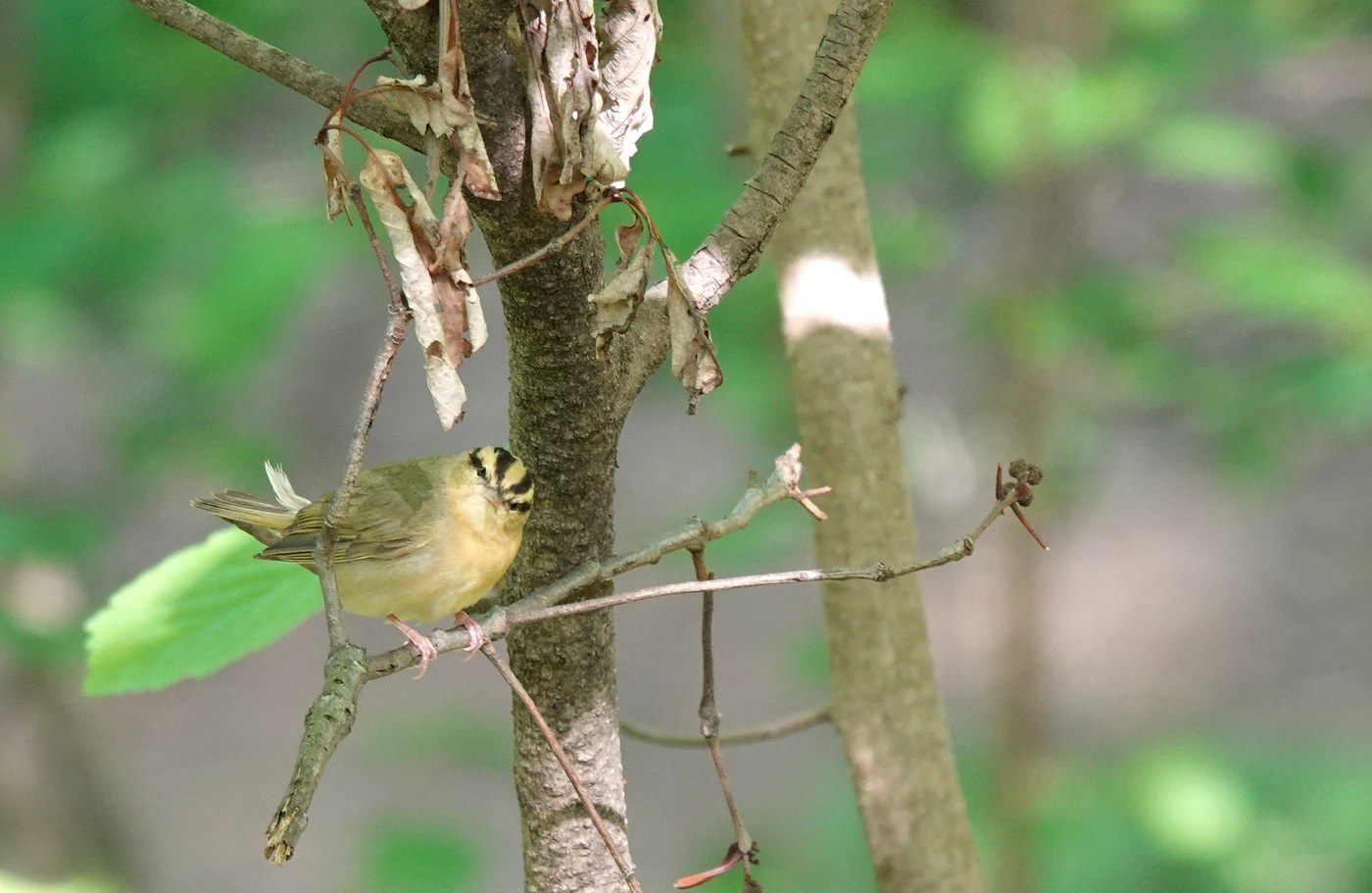
Key Field Marks
- Size & shape: A chunky, short-tailed warbler, roughly 5.5 inches long, with a proportionally large, spike-like bill and a flat forehead.
- Plumage: Overall unstreaked buffy-olive body — olive-green above, warm buff-yellow below with no wing bars and no streaking anywhere.
- Head pattern: The signature mark is a buffy-orange head crossed by four bold black stripes (two through the crown, two through the eyes), giving a striped, almost chipmunk-like face.
- Bill & legs: Long, straight, dagger-like bill (longer than most warblers') and bright pinkish legs.
- Behavior: Forages low, often on or near the ground, probing into curled dead leaf clusters and hanging leaf litter with its long bill; frequently bobs its tail.
Separating It From Similar Species
- Swainson's Warbler: Also plain and skulking with a long bill, but lacks the bold black head stripes — its head is plain brown with only a faint pale eyebrow, and it has a heavier, more robust bill.
- Louisiana Waterthrush: Similarly found on wooded slopes near streams, but is heavily streaked below and constantly teeters its rear end; Worm-eating Warbler is unstreaked and does not bob in the same way.
- Female/immature Pine Warbler: Shows faint wing bars and some blurry streaking, and lacks the crisp black head stripes of Worm-eating Warbler.
Habitat, Range & Season
- Breeds in the eastern United States, especially the Appalachians and Piedmont, favoring steep, dry deciduous hillsides with a dense shrub and sapling understory — often on slopes above streams.
- A long-distance migrant that winters in Mexico, Central America, and the Caribbean, typically in dense forest understory and shade coffee plantations.
- Look for it from late April through September on breeding grounds; passage migrants move through the rest of the eastern U.S. in spring and fall.
Voice
- Song is a dry, rapid, buzzy trill on one pitch, very similar to a Chipping Sparrow's trill but slightly more musical, insect-like, and often given from a low or mid-level perch.
- Call note is a sharp, high "chip."
Frequently asked questions
What is the easiest way to identify a Worm-eating Warbler?
Look for its plain buffy-olive body with no streaking combined with a buffy-orange head marked by four bold black stripes — no other eastern warbler shows that exact combination.
How does the song differ from a Chipping Sparrow's?
Both give a dry one-pitch trill, but the warbler's version is slightly buzzier and more insect-like, and it's typically heard from dense, shrubby hillside forest rather than open habitat.
Where should I look for Worm-eating Warblers?
Check steep, dry deciduous hillsides with thick understory in the eastern U.S., particularly in the Appalachian region, and scan low vegetation and leaf litter where it forages.
Does the Worm-eating Warbler actually eat worms?
Despite the name, its diet is mostly caterpillars and other insects gleaned from curled dead leaves, not earthworms.