
Woodland Kingfisher Identification Guide
A vividly turquoise African kingfisher of open woodland and savanna that hunts insects and small vertebrates far from water, announced by its loud trilling call.
Read the full Woodland Kingfisher encyclopedia entry →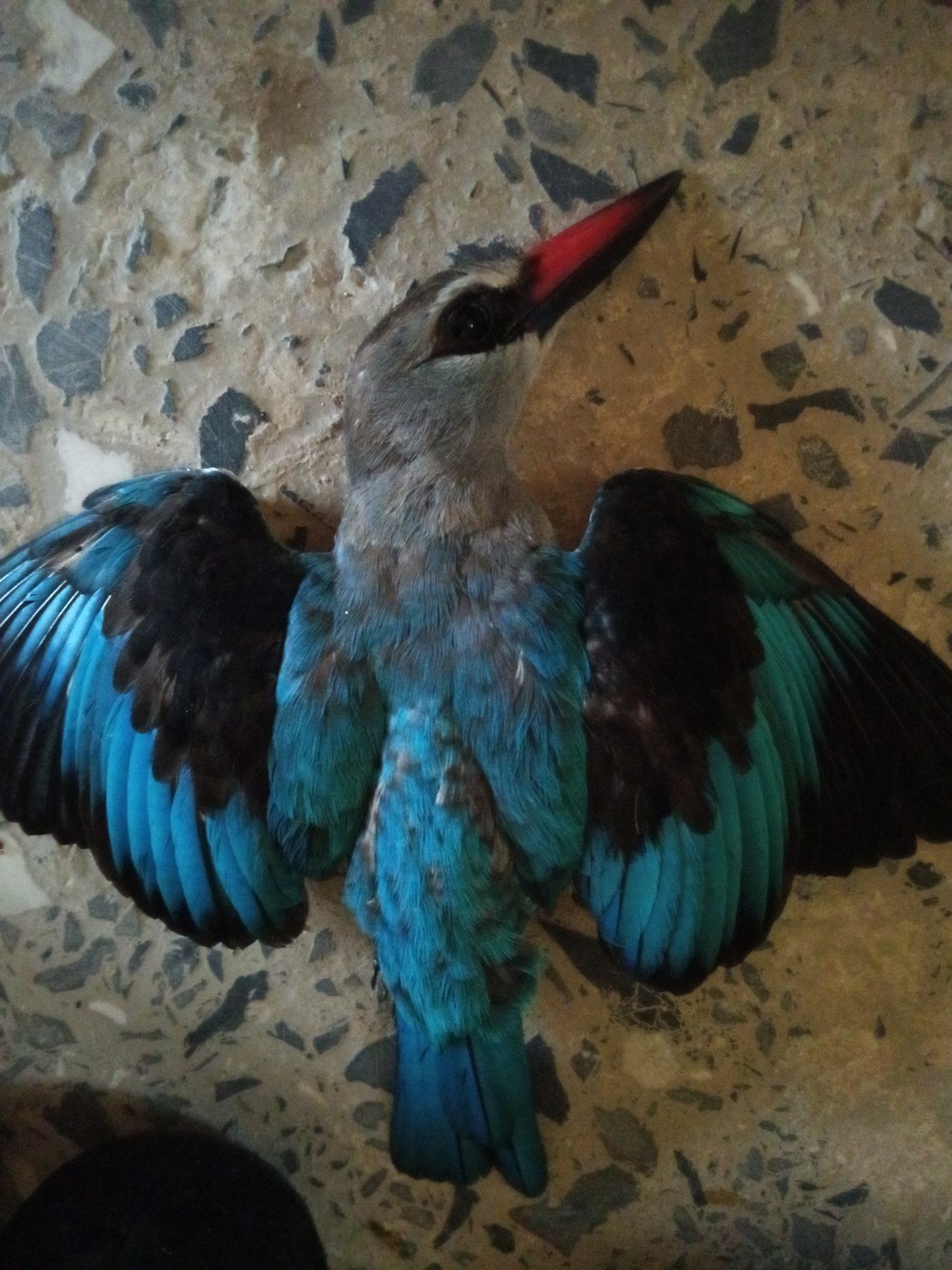
Key Field Marks
- Size & shape: A medium-sized kingfisher (about 20–23 cm) with a large head and heavy, dagger-like bill relative to body size.
- Plumage: Bright turquoise-blue back, wings, and tail; pale grey head and hindneck; black patch on the wing coverts visible at rest; clean white underparts.
- Bill: Bicolored — coral-red on the upper mandible with a black tip, and mostly black lower mandible (pattern can vary slightly by individual/region).
- Behavior: Perches conspicuously on bare branches, wires, or dead snags in open habitat, dropping to the ground to catch large insects, lizards, and occasionally small snakes — unlike many kingfishers, it rarely fishes.
Separating It From Similar Species
- Mangrove Kingfisher is similar in pattern but has an all-red bill (no black tip) and is tied closely to coastal mangroves rather than inland woodland.
- Grey-headed Kingfisher shows a chestnut belly and flanks contrasting with the blue back, unlike the Woodland Kingfisher's clean white underparts.
- Striped Kingfisher is much smaller and duller, with streaked underparts and a mostly dark bill.
- The combination of a grey head, black wing-covert patch, bicolored red-and-black bill, and turquoise back is diagnostic for the Woodland Kingfisher across most of its range.
Where and When to Look
- Habitat: Open woodland, savanna, farmland with scattered trees, and riverine woodland — not tied to water despite being a "kingfisher."
- Range: Widespread across sub-Saharan Africa, from Senegal east to Ethiopia and south to South Africa.
- Season: Many populations are intra-African migrants, arriving in southern Africa for the austral summer breeding season (roughly October to March) and moving north in the dry season; equatorial populations are more sedentary.
- Best viewing: Look for it perched prominently on exposed branches or wires in open country; it is often located by its loud, distinctive call well before being seen.
Voice
- A loud, piercing, trilling call that descends in pitch, often described as a shrill "trrrrrrrr" repeated frequently, especially at dawn and during the breeding season.
- Highly vocal and territorial, calling persistently from exposed perches, making voice one of the best ways to detect its presence.
Frequently asked questions
Does the Woodland Kingfisher eat fish?
Rarely — despite its name, it mainly hunts large insects, lizards, and other small terrestrial prey from perches in open woodland, and is not closely tied to water.
How can you tell a Woodland Kingfisher from a Mangrove Kingfisher?
Woodland Kingfisher has a black-tipped red upper bill and inhabits inland woodland/savanna, while Mangrove Kingfisher has an all-red bill and sticks to coastal mangrove habitats.
What does the Woodland Kingfisher's call sound like?
A loud, shrill, descending trill, often repeated frequently from an exposed perch, especially at dawn — one of the most familiar sounds of African savanna woodland.
Is the Woodland Kingfisher migratory?
Many populations move seasonally within Africa, arriving in southern regions for the breeding season and shifting north during the dry season, while equatorial populations are more sedentary.