
Wood Thrush Identification Guide
A reddish-brown North American forest thrush with bold round black spots on a white breast, famous for its flute-like, echoing song.
Read the full Wood Thrush encyclopedia entry →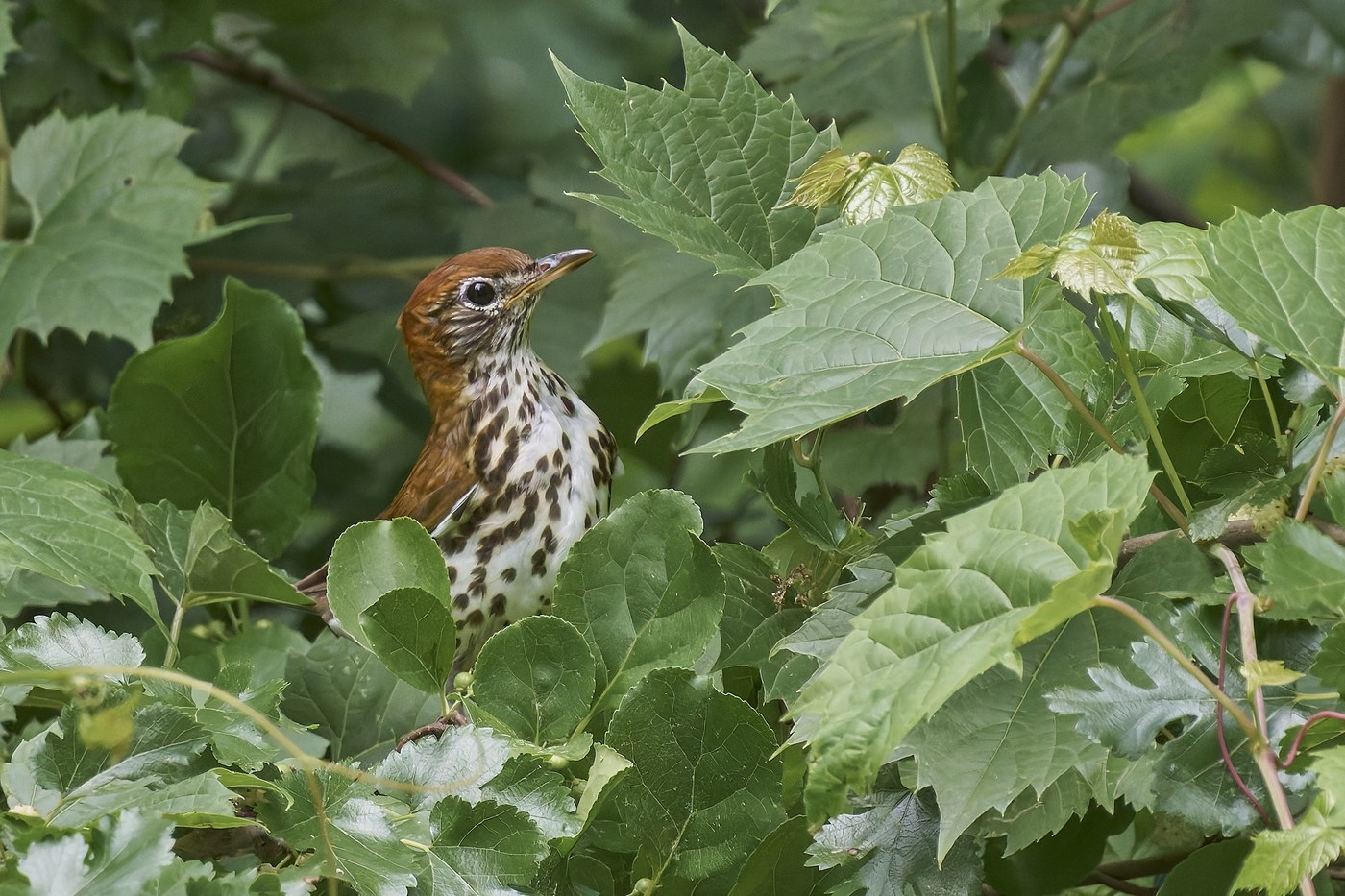
Key Field Marks
- Size & shape: A plump, medium-sized thrush (about 19–21 cm) with a fairly large head, short tail, and upright posture typical of forest thrushes.
- Upperparts: Bright rufous-cinnamon on the crown and nape, gradually shading to warmer brown on the back and tail.
- Underparts: White breast and belly boldly marked with large, rounded black spots that extend from the throat down to the flanks — larger and more distinct than on most other spotted thrushes.
- Face: Bold white eye-ring and a whitish area between the eye and bill.
- Behavior: Forages on the forest floor flipping leaf litter, often staying low and somewhat secretive despite its loud song; hops rather than walks.
Separating It From Similar Species
- Hermit Thrush is smaller with a duller brown back, finer breast spotting, and a reddish tail that contrasts with the browner back — Wood Thrush shows no such tail contrast.
- Swainson's Thrush has a buffy, less bold eye-ring, warmer buffy wash across the breast, and finer, less distinct spotting.
- Veery is almost unspotted below with a uniform tawny back, easily separated from the boldly spotted Wood Thrush.
- Overall, the Wood Thrush's combination of a bright rufous head/nape and large, round, well-defined black spots is the most reliable distinction from its relatives.
Where and When to Look
- Habitat: Mature deciduous and mixed forest with a shaded understorey and moist soil for leaf-litter foraging; sensitive to forest fragmentation.
- Range: Breeds across eastern North America, from the Midwest to the Atlantic coast; winters in the lowlands of Central America, from southern Mexico to Panama.
- Season: Spring through summer on breeding grounds (roughly April to September in most of its range), migrating south for winter.
- Best viewing: Listen at dawn or dusk along forest interior trails in large tracts of eastern deciduous woodland; the bird itself often stays low and can be hard to see well despite loud singing.
Voice
- A rich, flute-like song often rendered as "ee-oh-lay," delivered in short phrases with a haunting, ringing quality, frequently ending in a trilled flourish.
- Considered one of the most beautiful songs among North American birds, partly because the thrush can sing two pitches simultaneously using its syrinx.
Frequently asked questions
What makes the Wood Thrush's song so distinctive?
Its flute-like "ee-oh-lay" phrases are produced using two independent voice sources in the syrinx, letting it sing harmonizing notes simultaneously — a quality widely regarded as one of the most beautiful bird songs in North America.
How do you tell a Wood Thrush from a Hermit Thrush?
Wood Thrush has a brighter rufous head/nape and large, bold, round black spots on the breast; Hermit Thrush is duller brown overall with finer spotting and a reddish tail that contrasts with a browner back.
Where does the Wood Thrush breed and winter?
It breeds in mature deciduous forest across eastern North America and winters in lowland forests of Central America, from southern Mexico to Panama.
Why is the Wood Thrush considered sensitive to habitat change?
It requires large tracts of mature forest with intact understorey for nesting and foraging, so it is vulnerable to forest fragmentation and edge-related nest predation/parasitism.