
Wood Sandpiper Identification Guide
A slim, delicately marked Eurasian wader with long yellow-green legs and fine pale spotting, found on freshwater marshes and flooded fields.
Read the full Wood Sandpiper encyclopedia entry →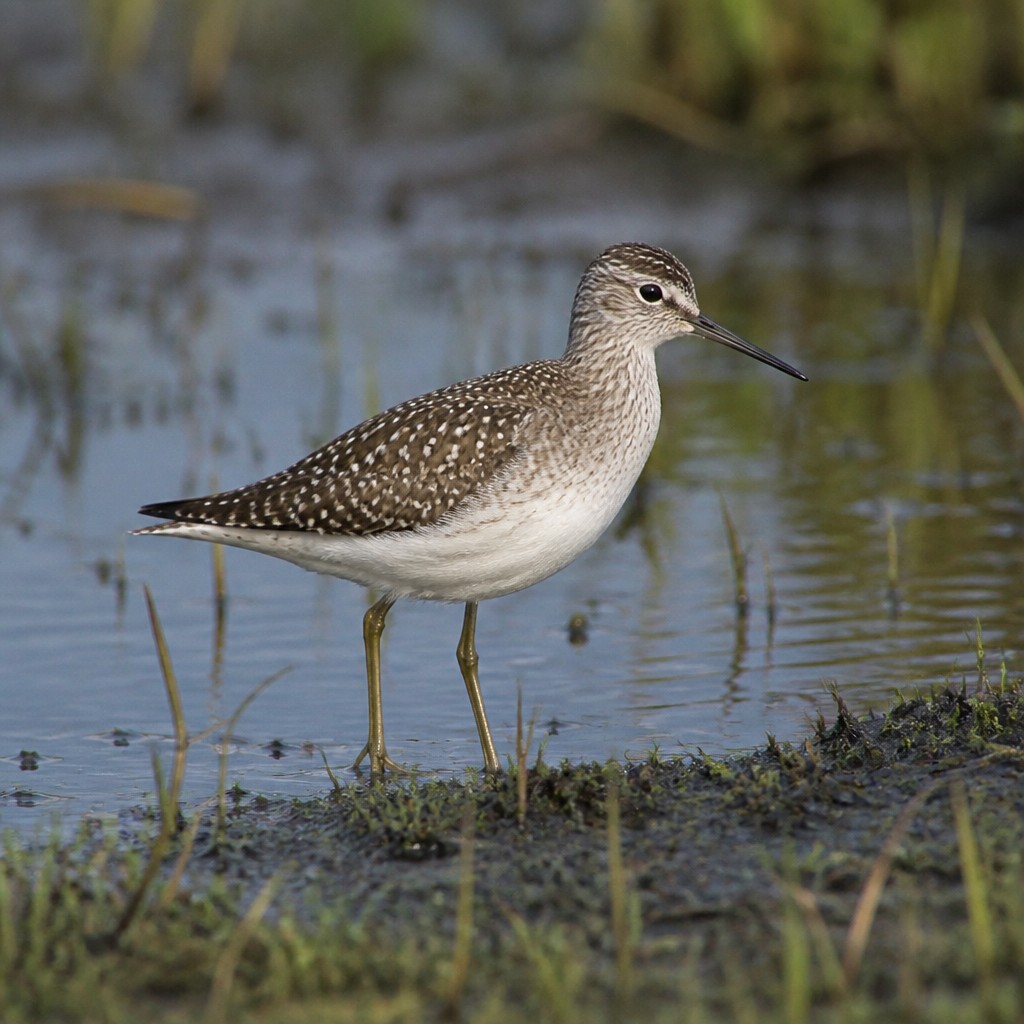
Key Field Marks
- Size & shape: A small, elegant sandpiper (about 19–21 cm), slimmer and more delicate than a Redshank, with a fairly long neck and slender straight bill.
- Plumage: Brown upperparts finely spotted with buff/white, giving a speckled appearance; underparts white with light streaking on the breast.
- Face: A clear pale supercilium (eyebrow stripe) extends well behind the eye, giving an open-faced expression.
- Legs: Long, yellowish-green legs — a key feature separating it from several similar waders.
- In flight: Shows a white rump and finely barred tail, with no obvious wing bar; toes project slightly beyond the tail.
- Behavior: Feeds actively picking at the water's surface and mud, often in small loose groups, bobbing its rear end gently like other Tringa sandpipers.
Separating It From Similar Species
- Green Sandpiper is darker above with much less spotting, shows a sharply contrasting white rump against blackish upperparts and underwings, and has shorter, darker olive legs.
- Common Redshank is bulkier with bright orange-red legs and a longer, straighter bill with a red base.
- Common Sandpiper has a shorter neck, constant teetering motion, and a distinctive white shoulder wedge, with brief flicking wingbeats in flight.
Where and When to Look
- Habitat: Shallow freshwater wetlands — marshes, flooded fields, muddy pool edges, and sewage works — rather than open coastal mudflats.
- Range: Breeds across the boreal zone of northern Europe and Asia; winters broadly across sub-Saharan Africa, South Asia, Southeast Asia, and Australia.
- Season: A passage migrant through much of temperate Europe and Asia in spring and especially autumn, when juveniles pass through freshwater sites in numbers.
- Best viewing: Check the muddy, vegetated margins of small pools and flooded grassland rather than large open mudflats, where Green Sandpiper and Redshank are more typical.
Voice
- A distinctive sharp, rising three-note flight call, often rendered as "chiff-iff-iff" or "chip-chip-chip," given frequently when flushed.
- Softer and higher-pitched than the calls of Green Sandpiper or Redshank.
Frequently asked questions
How do you separate a Wood Sandpiper from a Green Sandpiper?
Wood Sandpiper is paler and more finely spotted above with longer yellow-green legs, while Green Sandpiper is darker with a sharply contrasting white rump, blacker underwings, and shorter, darker legs.
What habitat should I check for Wood Sandpipers?
Shallow freshwater wetlands such as marshes, flooded fields, and muddy pool edges — it favors freshwater over open coastal mudflats.
When is the best time to see Wood Sandpipers on migration?
Autumn passage, especially August through September, typically brings the largest numbers of juveniles through temperate wetlands.
What does a Wood Sandpiper's call sound like?
A sharp, rising three-note call often written as "chiff-iff-iff," usually given as the bird takes flight.