
Wonga Pigeon Identification Guide
A plump, ground-loving pigeon of eastern Australian rainforests, identified by its white V-spotted underparts and monotonous booming call.
Read the full Wonga Pigeon encyclopedia entry →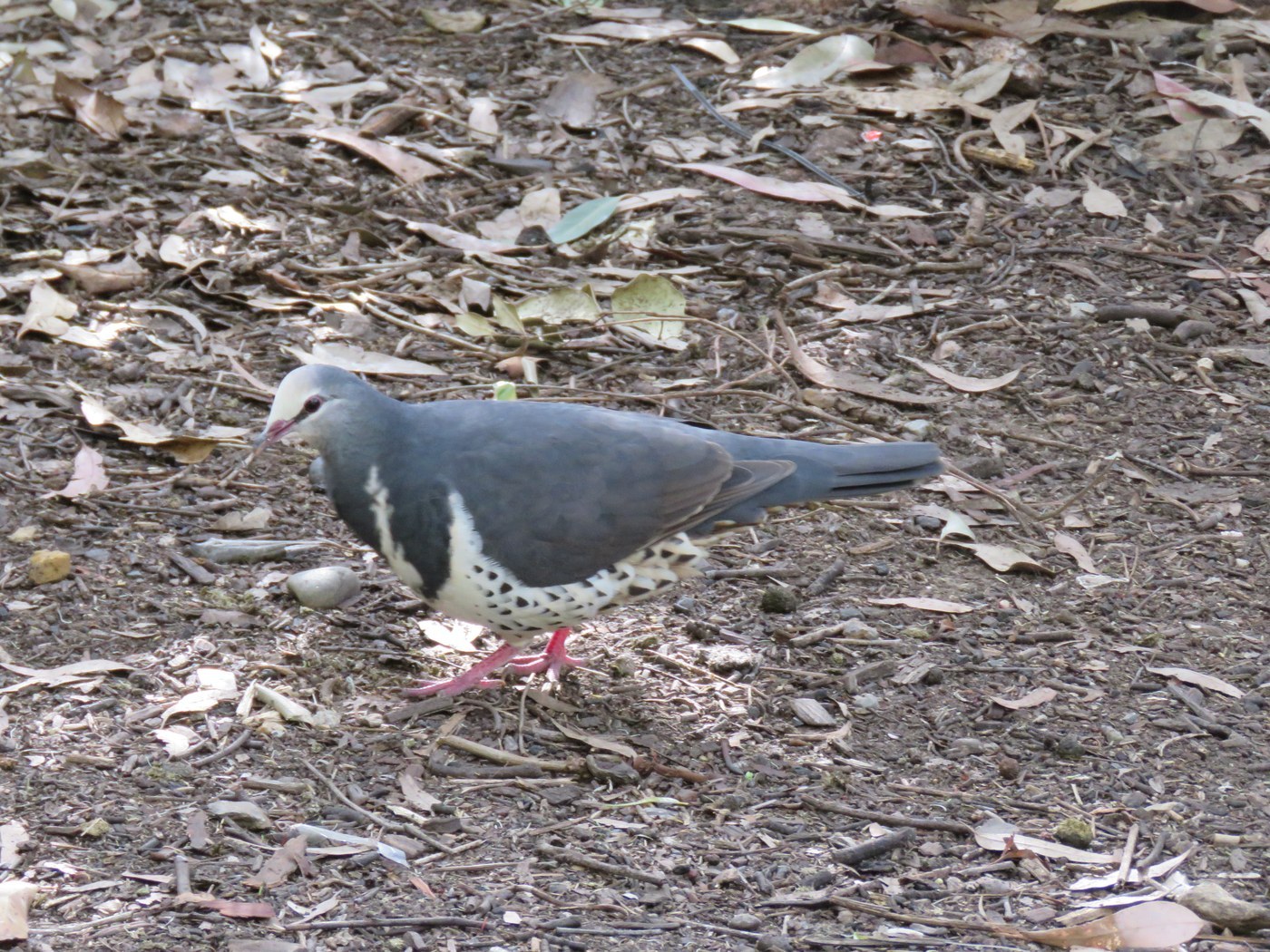
Key Field Marks
- Size & shape: A stout, medium-large pigeon (about 35–40 cm) with a small head, full chest, and relatively short tail.
- Upperparts: Uniform slate-grey back, wings, and crown.
- Underparts: White throat and breast marked with bold black V- or arrowhead-shaped spots forming a distinctive pattern down the belly and flanks.
- Bare parts: Bright red skin around the eye (orbital ring) stands out against the grey head; dark bill and pinkish-red legs.
- Behavior: Highly terrestrial — walks and forages on the forest floor for fallen seeds and fruit, bobbing its head as it walks, and typically flushes explosively at close range rather than being seen approaching.
Separating It From Similar Species
- Brown Cuckoo-Dove is slaty-brown overall with a long, wedge-shaped tail and lacks the black V-markings on white underparts.
- Bar-shouldered Dove is much smaller, sandy-brown, and shows a scaled neck patch rather than a spotted white belly.
- No other eastern Australian pigeon combines grey upperparts with black-spotted white underparts and red orbital skin, making adult Wonga Pigeons unmistakable once seen well.
Where and When to Look
- Habitat: Rainforest and moist eucalypt forest, especially shaded gullies with a dense understorey, from lowlands into highland forest.
- Range: Eastern Australia, from southeastern Queensland down through New South Wales into eastern Victoria.
- Season: Resident year-round; more often heard than seen due to its shy, ground-dwelling habits.
- Best viewing: Walk quietly along rainforest tracks at dawn or dusk and watch the leaf litter ahead rather than the canopy; birds often walk away rather than fly, so patience helps.
Voice
- A deep, monotonous, repeated "wonk-wonk-wonk" or "wong…wong…wong," delivered at a slow, steady pace for long periods, often from a low perch or the ground.
- The call carries well through dense forest and is frequently the first — and sometimes only — clue to the bird's presence.
Frequently asked questions
What is the easiest way to identify a Wonga Pigeon?
Look for a grey-backed pigeon with bold black V-shaped spots on a white breast and belly, plus red skin around the eye — no other eastern Australian pigeon shows this combination.
Does the Wonga Pigeon spend time on the ground?
Yes, it is highly terrestrial, walking through rainforest leaf litter to feed and often flushing suddenly underfoot rather than being seen approaching.
What does the Wonga Pigeon's call sound like?
A slow, deep, repetitive "wonk-wonk-wonk," delivered steadily for long stretches, often before the bird itself is located.
Where in Australia can I find Wonga Pigeons?
In rainforest and wet eucalypt forest gullies along the eastern seaboard, from southeastern Queensland through New South Wales to eastern Victoria.