
Wompoo Fruit Dove Identification Guide
A large, jewel-colored rainforest pigeon of eastern Australia and New Guinea, best known for its deep, booming five-note call.
Read the full Wompoo Fruit Dove encyclopedia entry →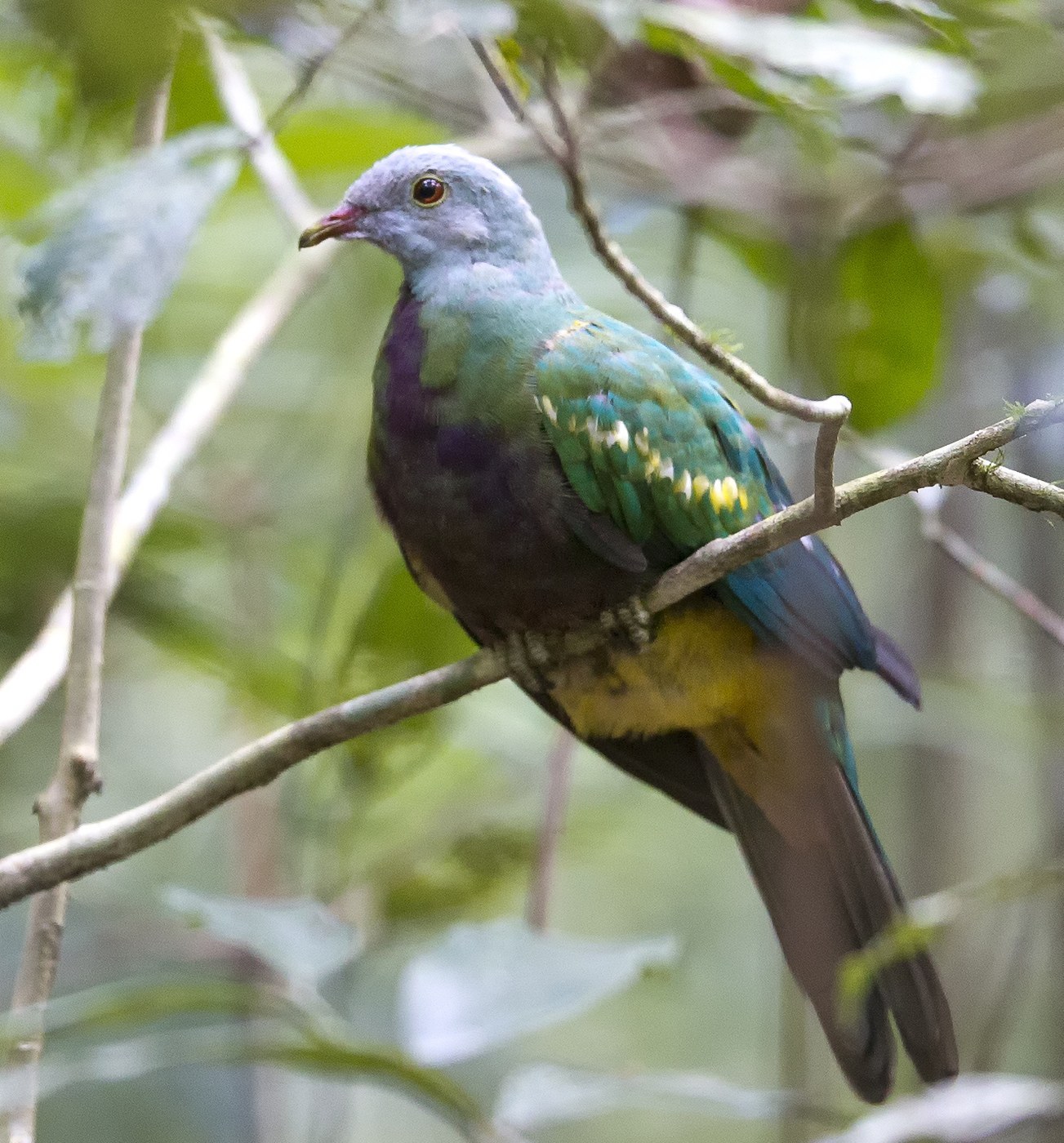
Key Field Marks
- Size & shape: A big, chunky fruit dove, roughly 35–45 cm long — noticeably larger and longer-tailed than most other fruit doves.
- Head & underparts: Soft blue-grey head and breast fading to a striking rich magenta-purple throat patch, with a bright yellow belly and undertail.
- Upperparts: Dark olive-green back and wings marked with bold yellow spots and bars across the wing coverts, giving a scaled look in good light.
- Bill & eye: Short, stubby orange-yellow bill typical of fruit doves; dark eye.
- Behavior: Quiet, often sits motionless high in the fruiting canopy, making it easy to overhear but hard to see; flies with quick, direct wingbeats between fruiting trees.
Separating It From Similar Species
- Superb Fruit Dove and Rose-crowned Fruit Dove are both noticeably smaller, with brighter crown patches (purple or rose-pink caps) and lack the Wompoo's grey head/purple throat combination.
- Banded Fruit Dove and other regional fruit doves show orange or chestnut breast bands rather than the Wompoo's grey-to-magenta throat gradient.
- Overall size is the quickest clue: the Wompoo dwarfs every other Australian fruit dove.
Where and When to Look
- Habitat: Subtropical and tropical rainforest, gallery forest, and dense wet eucalypt forest with fig trees and other fruiting canopy species.
- Range: Coastal and near-coastal eastern Australia from Cape York Peninsula south to central New South Wales, plus lowland and hill forests of New Guinea.
- Season: Resident year-round in most of its range, though some southern populations shift locally in response to fruit availability.
- Best viewing: Scan fruiting fig trees at forest edges or along rainforest walking tracks; birds often reveal themselves by the sound of falling fruit skins or their call before they're seen.
Voice
- A deep, resonant, far-carrying call often rendered as "wollack-a-woo" or "wompoo," with a booming, almost mammalian quality.
- The call is repeated at intervals and can be heard well before the bird is located in the canopy — listen for it as the primary detection cue in dense forest.
Frequently asked questions
What does a Wompoo Fruit Dove's call sound like?
A deep, booming, far-carrying call often written as "wollack-a-woo" — it gives the species its onomatopoeic name and is usually heard well before the bird is seen.
How can I tell a Wompoo Fruit Dove from other fruit doves?
Its large size (35–45 cm), grey head fading into a magenta-purple throat, and yellow-spotted olive wings are distinctive; smaller fruit doves like the Superb and Rose-crowned have brightly colored crown patches instead.
Where is the best place to see a Wompoo Fruit Dove?
Look in rainforest and wet eucalypt forest canopy along the eastern Australian coast from Cape York to central New South Wales, especially around fruiting fig trees.
Is the Wompoo Fruit Dove easy to spot?
Not usually — it sits still high in dense foliage and is often detected by voice or the sound of dropped fruit before it is actually seen.