
Wilson's Plover Identification Guide
A stocky coastal plover of Atlantic and Gulf beaches, distinguished from similar plovers by its notably large, heavy black bill.
Read the full Wilson's Plover encyclopedia entry →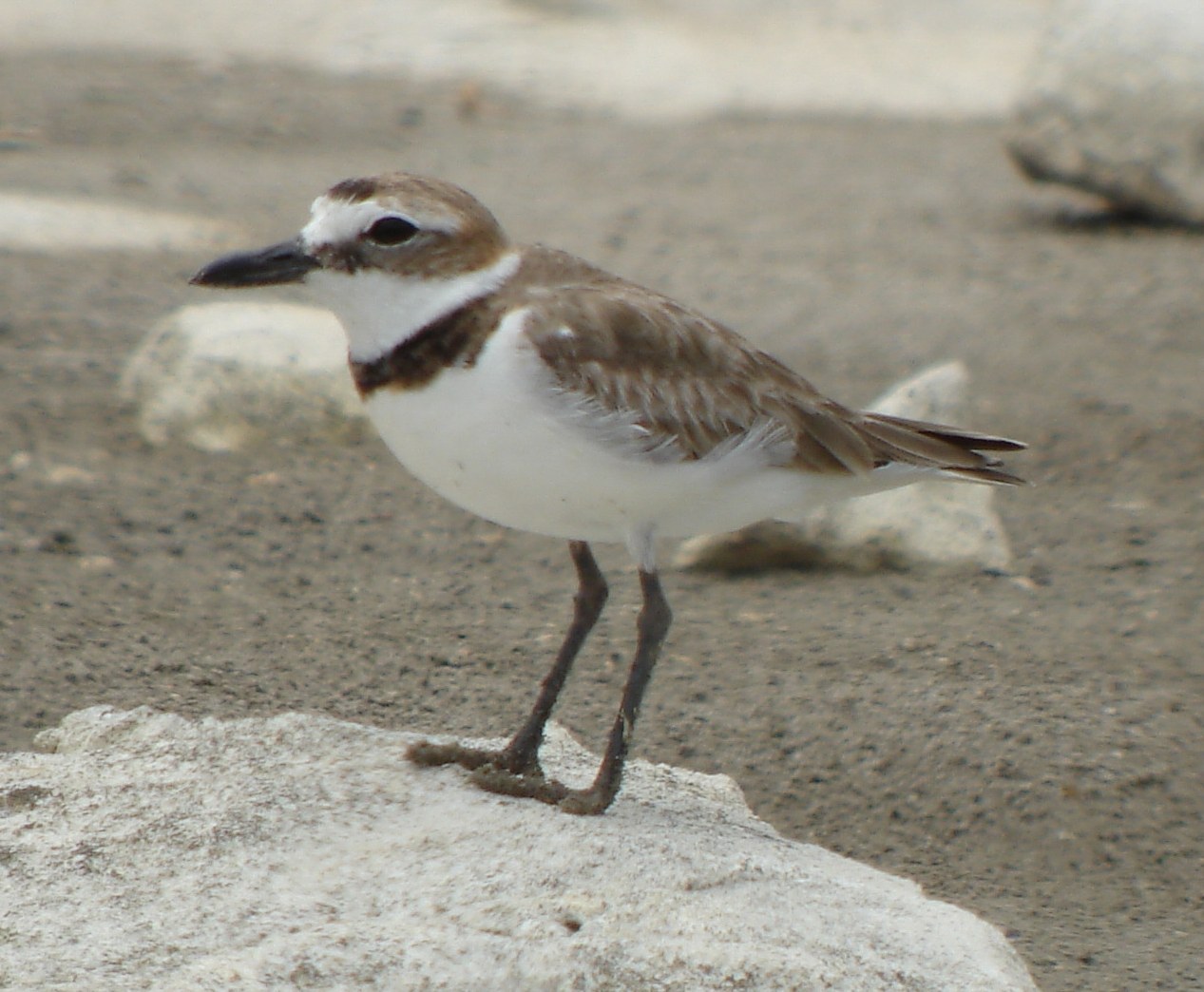
Key Field Marks
- Medium-sized plover (17-19 cm) with sandy-brown upperparts, white underparts, and a single, fairly broad dark breast band (black in males, brownish in females).
- The standout feature is the bill: much larger, longer, and thicker than other "ringed" plovers, giving a distinctly heavy-headed, big-billed look.
- Pale pinkish to flesh-colored legs, duller and less bright than the orange legs of Semipalmated Plover.
- White forehead patch and a dark band through the eye connecting to the ear coverts; lacks the bright orange bill base seen in Semipalmated Plover.
- Sexes are similar but males typically show a more solidly black breast band and dark face mask; females and non-breeding birds are browner overall.
Similar Species
- Semipalmated Plover is smaller with a much smaller, mostly orange-and-black bill, brighter orange legs, and a shorter overall bill-to-head ratio.
- Piping Plover is paler, sandier overall, with an orange bill (black-tipped) and orange legs, and usually shows an incomplete breast band.
- Killdeer is larger with two breast bands (not one) and a much longer tail.
- The oversized, all-dark, heavy bill is the single best mark separating Wilson's Plover from all similarly patterned small plovers.
Habitat & Range
- Breeds locally along the Atlantic and Gulf coasts of the United States, the Caribbean, and both coasts of Mexico and Central America south to parts of South America.
- Strictly coastal: favors sandy and shell-covered beaches, sparsely vegetated dunes, sand flats, and coastal lagoon edges, rarely straying inland.
- Northern populations are migratory, wintering along the Gulf Coast, Florida, the Caribbean, and Central/South America, while southern populations tend to be resident.
Voice
- A sharp, whistled "wheet" or "whit," and a rolling "querrp" alarm call, generally louder and harsher than the softer calls of Semipalmated Plover.
Behavior Notes
- Forages with the classic plover run-stop-peck technique, taking crabs (especially fiddler crabs), insects, and other invertebrates from sand and mud.
- Nests in a simple scrape on open, sparsely vegetated sand, making eggs and chicks vulnerable to beach disturbance and predation.
Frequently asked questions
What is the easiest way to identify a Wilson's Plover?
Look for its oversized, entirely dark, heavy bill - noticeably larger and thicker than that of any similar small plover such as Semipalmated Plover or Piping Plover.
How is Wilson's Plover different from Semipalmated Plover?
Wilson's Plover is larger-billed with a solid black (not orange-based) bill and duller pinkish legs, while Semipalmated Plover has a small orange-and-black bill and bright orange legs.
What does Wilson's Plover eat?
It feeds mainly on fiddler crabs and other small invertebrates picked from sand and mudflats using its stout bill, which is well suited to handling crabs.
Where do Wilson's Plovers nest?
They nest in a shallow scrape directly on open sandy beaches or shell-strewn dunes along the Atlantic and Gulf coasts and the Caribbean, making them sensitive to beach disturbance.