
Wilson's Phalarope Identification Guide
A slender North American shorebird with reversed sexual dimorphism, best known for the brightly colored breeding female and its habit of spinning on the water while feeding.
Read the full Wilson's Phalarope encyclopedia entry →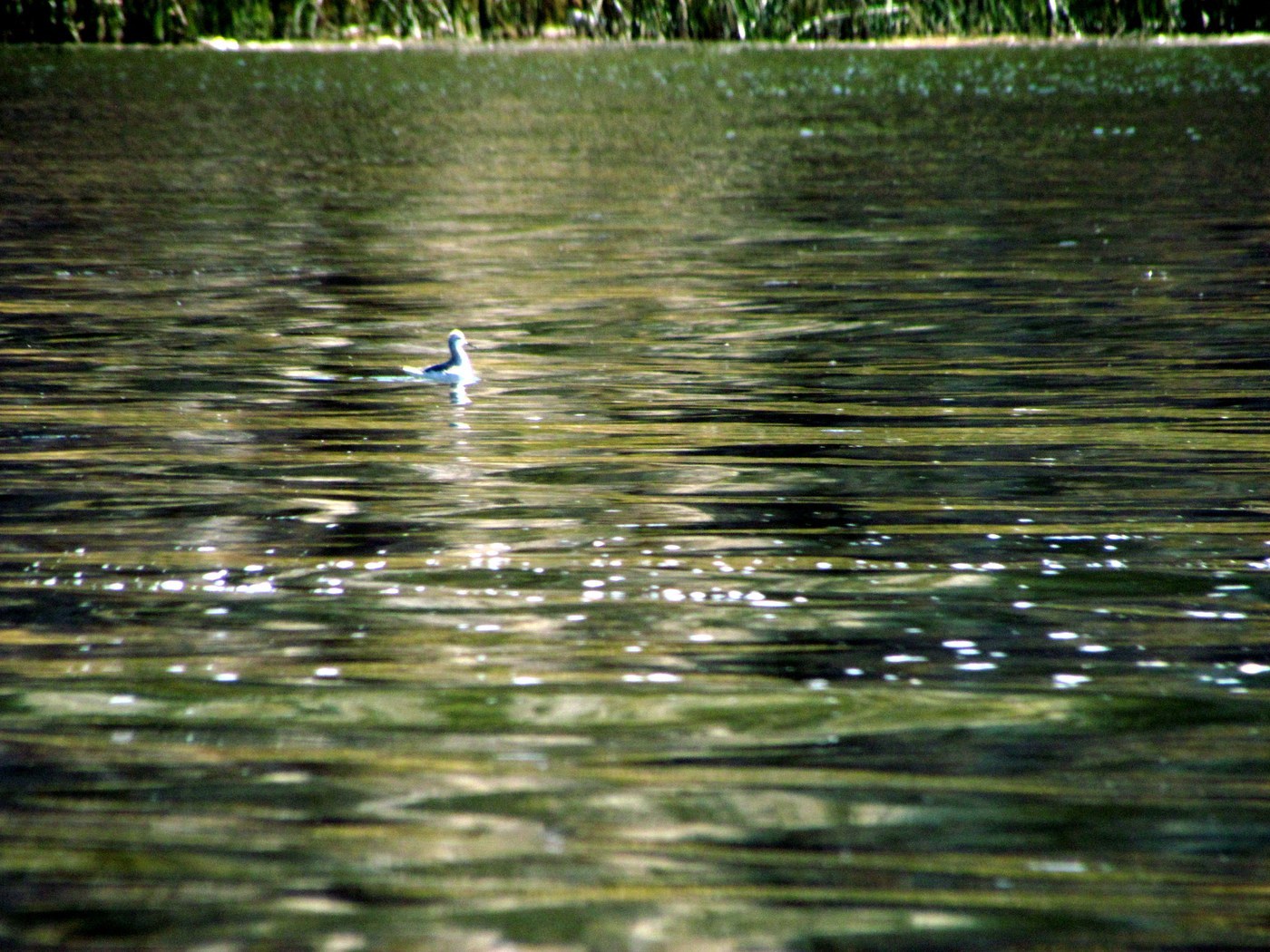
Key Field Marks
- Slim, long-necked, long-legged shorebird (22-24 cm) with a very thin, needle-like straight black bill.
- Breeding female: gray crown, broad black stripe through the eye extending down the neck and blending into rich chestnut on the sides of the neck and back, pale gray breast washed with peach - the most colorful plumage among phalaropes.
- Breeding male: much duller than the female, with a similar but muted pattern in soft gray-brown and buff tones (typical of phalaropes, where females are the more brightly colored, courting sex).
- Non-breeding (winter) birds of both sexes are pale gray above and white below with a plain face, distinguished from other phalaropes by the thin bill, longer legs, and lack of a dark eye patch.
- In flight, shows no obvious wing stripe (unlike Red-necked and Red Phalarope) and has a plain rump with a white uppertail area.
Similar Species
- Red-necked Phalarope is smaller with a shorter, thinner bill (though still fine), a bold white wing stripe in flight, and a dark eye patch retained even in winter plumage - Wilson's lacks a wing stripe and typically shows a plainer winter face.
- Red Phalarope has a thicker, shorter bill and a bold wing stripe, and in breeding plumage the female is deep rusty-red overall, unlike Wilson's chestnut-striped pattern.
- Lesser and Greater Yellowlegs are superficially similar in shape but have thicker bills, yellow legs, and do not swim or spin on water.
Habitat & Range
- Breeds in shallow freshwater wetlands, wet meadows, and prairie potholes across the interior of western North America (western Canada through the northern-central and western United States).
- Almost entirely a freshwater/inland species during migration and breeding, unlike the more pelagic Red and Red-necked Phalaropes.
- Undertakes a remarkable migration, staging in huge numbers at hypersaline lakes such as Mono Lake and the Great Salt Lake before continuing to wintering grounds on high-altitude lakes in the Andes of South America.
Voice
- Relatively quiet; gives soft, low grunting or nasal "wuk" or "aank" notes, mostly during breeding season interactions.
Behavior Notes
- Frequently swims in tight circles ("spinning") on the water surface to stir up aquatic invertebrates, then picks them off the surface with rapid bill jabs.
- Exhibits polyandry and reversed sex roles: females compete for and court males, and males take on most incubation and chick-rearing duties.
Frequently asked questions
Why is the female Wilson's Phalarope more colorful than the male?
Phalaropes show reversed sexual dimorphism and sex-role reversal - females compete for mates and are the brighter, more strikingly patterned sex, while males incubate the eggs and are duller for camouflage.
How can I tell Wilson's Phalarope from Red-necked Phalarope?
Wilson's Phalarope has a thinner, longer bill, longer legs, no white wing stripe in flight, and a plainer face in non-breeding plumage, whereas Red-necked Phalarope shows a bold wing stripe and retains a dark eye patch even in winter.
Why does Wilson's Phalarope spin in circles on the water?
Spinning creates a small vortex that stirs invertebrates up from the water column, making them easier for the phalarope to pick off the surface with its thin bill.
Where does Wilson's Phalarope winter?
After staging at large saline lakes in the western United States, most Wilson's Phalaropes winter on high-altitude saline and alkaline lakes in the Andes of South America.