
Wilson's Bird-of-paradise Identification Guide
A dazzling, tiny bird-of-paradise endemic to two small Indonesian islands, famous for the male's iridescent turquoise crown, red-and-yellow back, and curled violet tail wires.
Read the full Wilson's Bird-of-paradise encyclopedia entry →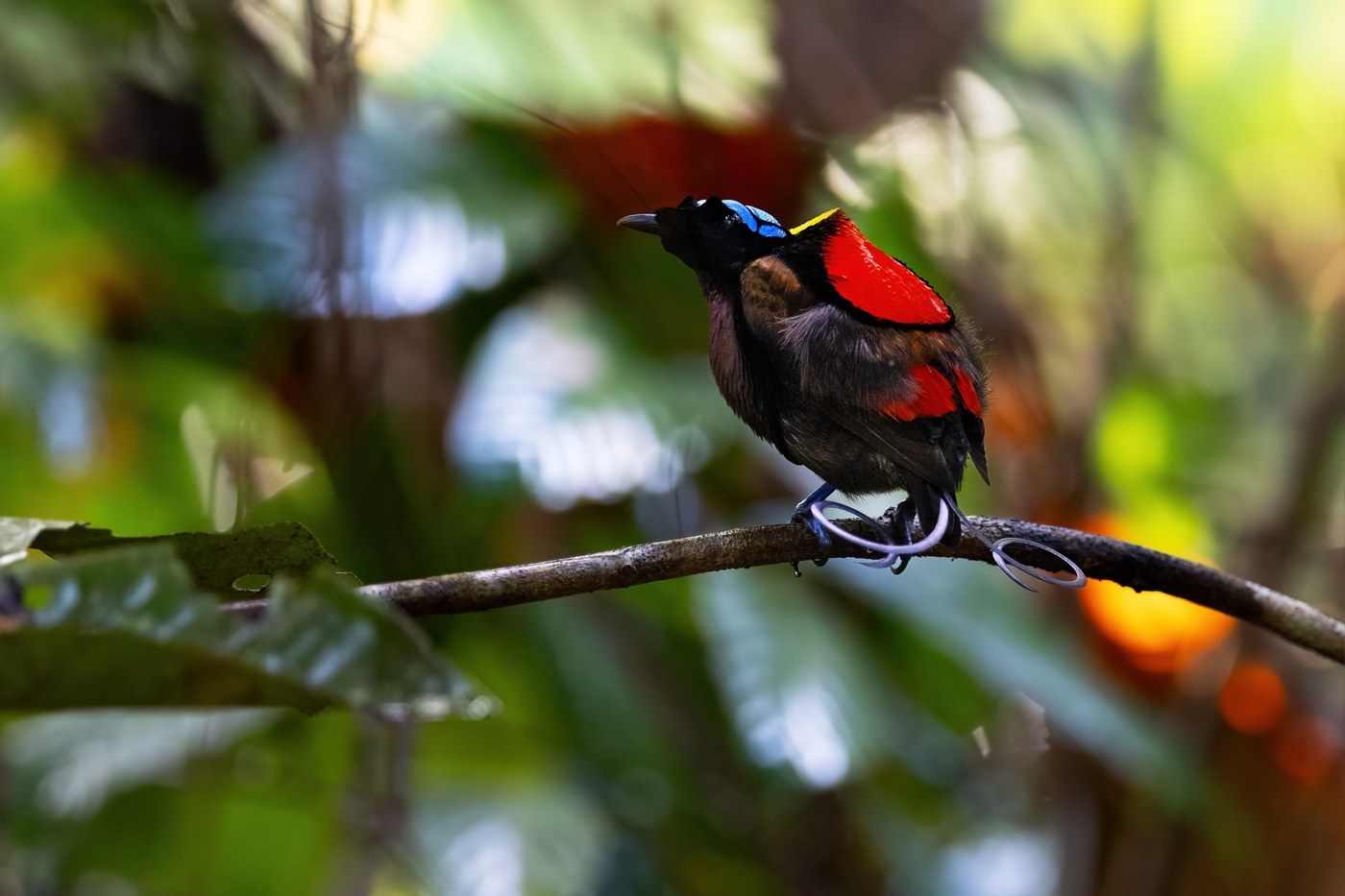
Key Field Marks
- Very small bird-of-paradise (about 16 cm to the tip of the body, with curled tail wires adding length) with striking, saturated colors in adult males.
- Male: bright crimson-red back and wings, a golden-yellow cape across the nape, a bare, iridescent turquoise-blue crown crossed by fine black lines, an emerald-green breast shield, and two glossy violet-blue tail wires that curl into distinctive spiral loops.
- Female and immature males are far plainer: dull brownish-olive overall with a blue-tinged bare crown patch, lacking the ornate plumes and tail wires of the adult male.
- Short tail (aside from the male's wire feathers), stout body, and a fairly short, slightly decurved bill typical of fruit-eating birds-of-paradise.
Similar Species
- No other bird-of-paradise shares its tiny size combined with a bare turquoise crown and curled violet tail wires; King Bird-of-paradise (found on the same islands and nearby New Guinea) is similarly small and red but has a white breast, red curled tail wires (not violet-blue), and lacks the bare turquoise crown.
- Female/immature Wilson's can be confused with female King Bird-of-paradise or other plain female birds-of-paradise; range (restricted to Waigeo and Batanta) and the pale blue crown patch help confirm identity.
Habitat & Range
- Endemic to just two small islands in the Raja Ampat archipelago, off the western tip of New Guinea, Indonesia: Waigeo and Batanta.
- Inhabits lowland and hill tropical rainforest, favoring dense understorey where males maintain and display at cleared "display courts" on the forest floor.
- Non-migratory resident restricted entirely to its tiny island range, making it a major target for birders visiting Raja Ampat.
Voice
- Calls include a variety of harsh, nasal, and buzzing notes given from the canopy or near the display court; not known for elaborate song, relying instead on visual display for courtship.
Behavior Notes
- Adult males clear a small patch of forest floor, removing leaves and debris to create a stage, then perform an elaborate courtship dance for visiting females, flashing the iridescent crown and erecting the breast shield.
- Feeds mainly on fruit and some arthropods, typically foraging alone or in pairs within the forest mid-story and understorey.
Frequently asked questions
Where can Wilson's Bird-of-paradise be seen?
It is found only on the small Indonesian islands of Waigeo and Batanta in the Raja Ampat archipelago, making it one of the most range-restricted birds-of-paradise.
What makes the male so distinctive?
Adult males have a bare, iridescent turquoise-blue crown, a red back, a yellow nape cape, and two curled violet tail wires - a color and shape combination unlike any other bird.
Do female Wilson's Birds-of-paradise look like the males?
No, females are plain olive-brown with only a hint of the bare blue crown patch, typical of the strong sexual dimorphism seen throughout the bird-of-paradise family.
How does the male attract a mate?
He clears a patch of forest floor into a display court and performs a choreographed dance there, showing off his iridescent crown and breast shield to visiting females.