
Willow Warbler Identification Guide
A common Palearctic leaf-warbler almost identical to Chiffchaff in plumage but told apart by its sweet, descending song and typically pale legs.
Read the full Willow Warbler encyclopedia entry →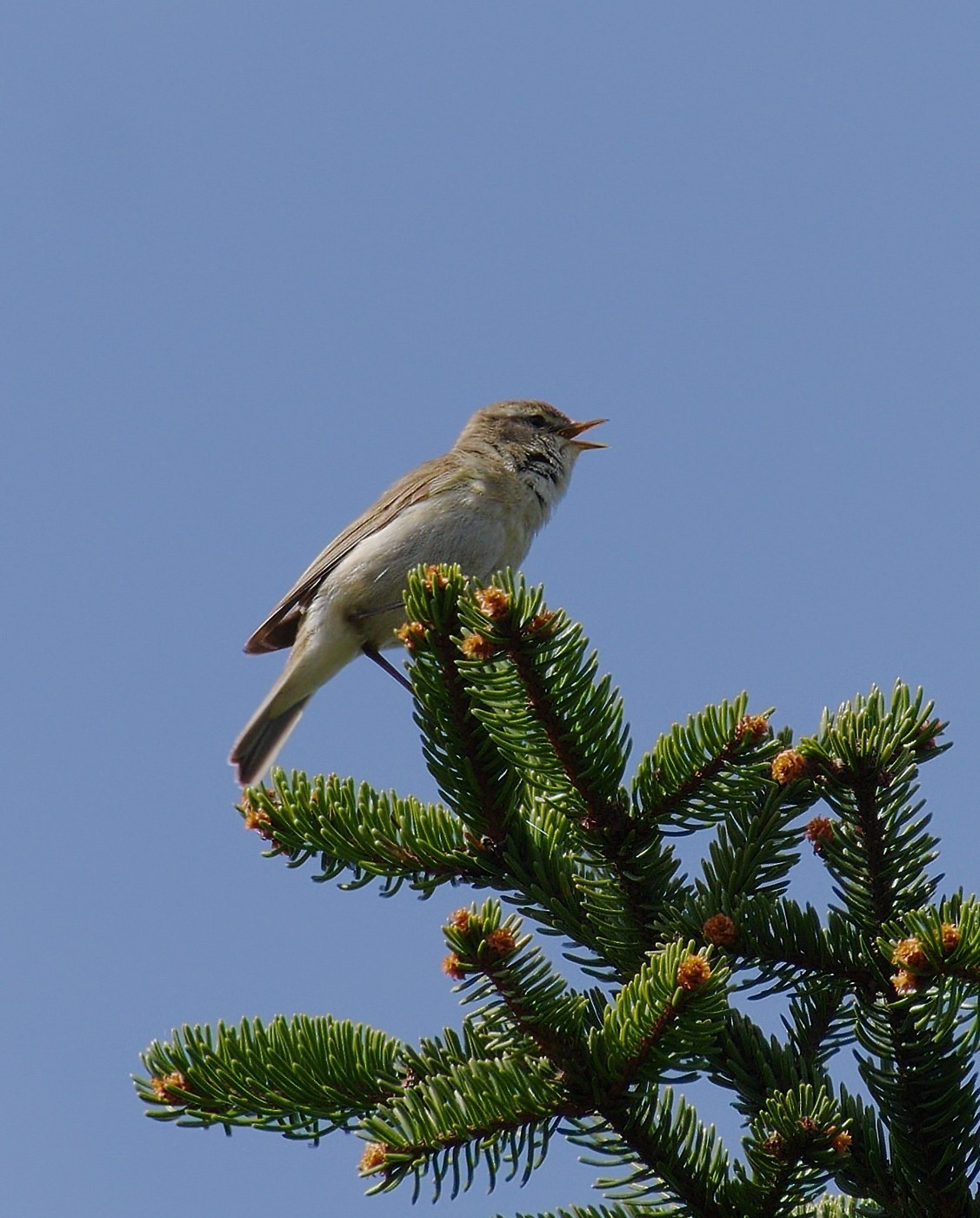
Key Field Marks
- Small (11-12.5 cm), slim leaf-warbler, olive-green above and pale lemon-yellow to whitish below, with a clear pale supercilium (eyebrow stripe).
- Legs are usually pale pinkish-brown (though some show darker legs, reducing reliability of this mark alone).
- Longer wings and primary projection than Chiffchaff, giving a slightly more elongated, attenuated shape - an adaptation for its long-distance migration.
- Plumage brightness varies with age and wear: fresh autumn birds can look quite yellow, while worn spring adults look duller and grayer-green.
- Bill fine and pointed, typical of Phylloscopus warblers.
Similar Species
- Chiffchaff is nearly identical in plumage but has dark blackish legs (usually), a shorter, more rounded wing, and a distinctive, monotonous "chiff-chaff-chiff-chaff" song rather than Willow Warbler's descending, melodic cadence.
- Wood Warbler is brighter yellow-green above with a cleaner white belly and a sharply demarcated yellow breast, plus a very different trilling song.
- Silent birds are best separated by call note: Willow Warbler gives a soft disyllabic "hoo-eet," while Chiffchaff's call is a simpler "hweet."
Habitat & Range
- Breeds across almost all of Europe and northern Asia in open woodland, scrub, birch and willow thickets, heathland edges, and forest clearings with a shrub layer.
- One of the most abundant and widespread long-distance migrant songbirds in the Western Palearctic; winters almost entirely in sub-Saharan Africa.
- Passage migrants can turn up in almost any scrub or woodland habitat well outside the breeding range.
Voice
- Song: a sweet, gently descending cascade of notes that trails off toward the end, often likened to a wistful, falling cadence - quite different from Chiffchaff's repetitive two-note song.
- Call: a soft "hoo-eet."
Behavior Notes
- Actively gleans insects from foliage, often flicking wings and tail, and hovers briefly to pick prey from leaf tips.
- Builds a domed nest on or near the ground in low vegetation, unlike Chiffchaff's similar but often better-concealed nest site choices.
Frequently asked questions
What is the best way to tell Willow Warbler from Chiffchaff?
Song is the most reliable cue: Willow Warbler sings a sweet, descending series of notes, while Chiffchaff repeats its own name, 'chiff-chaff-chiff-chaff.' Leg color (pale in Willow Warbler, dark in Chiffchaff) helps but is not always consistent.
Are Willow Warbler and Chiffchaff closely related?
Yes, both are Phylloscopus leaf-warblers and extremely similar in plumage, which is why voice and structure (longer wings and primary projection in Willow Warbler) are used for identification.
Where does the Willow Warbler spend the winter?
Nearly the entire population migrates to sub-Saharan Africa, making it one of the longest-distance migrants among small European songbirds.
Can leg color alone identify a Willow Warbler?
Not reliably on its own - most Willow Warblers have pale legs and most Chiffchaffs have dark legs, but exceptions occur, so leg color should be combined with song, call, and structure.