
Willow Tit Identification Guide
A drab Eurasian tit almost identical to Marsh Tit, reliably separated mainly by voice, a duller cap, and a paler wing panel.
Read the full Willow Tit encyclopedia entry →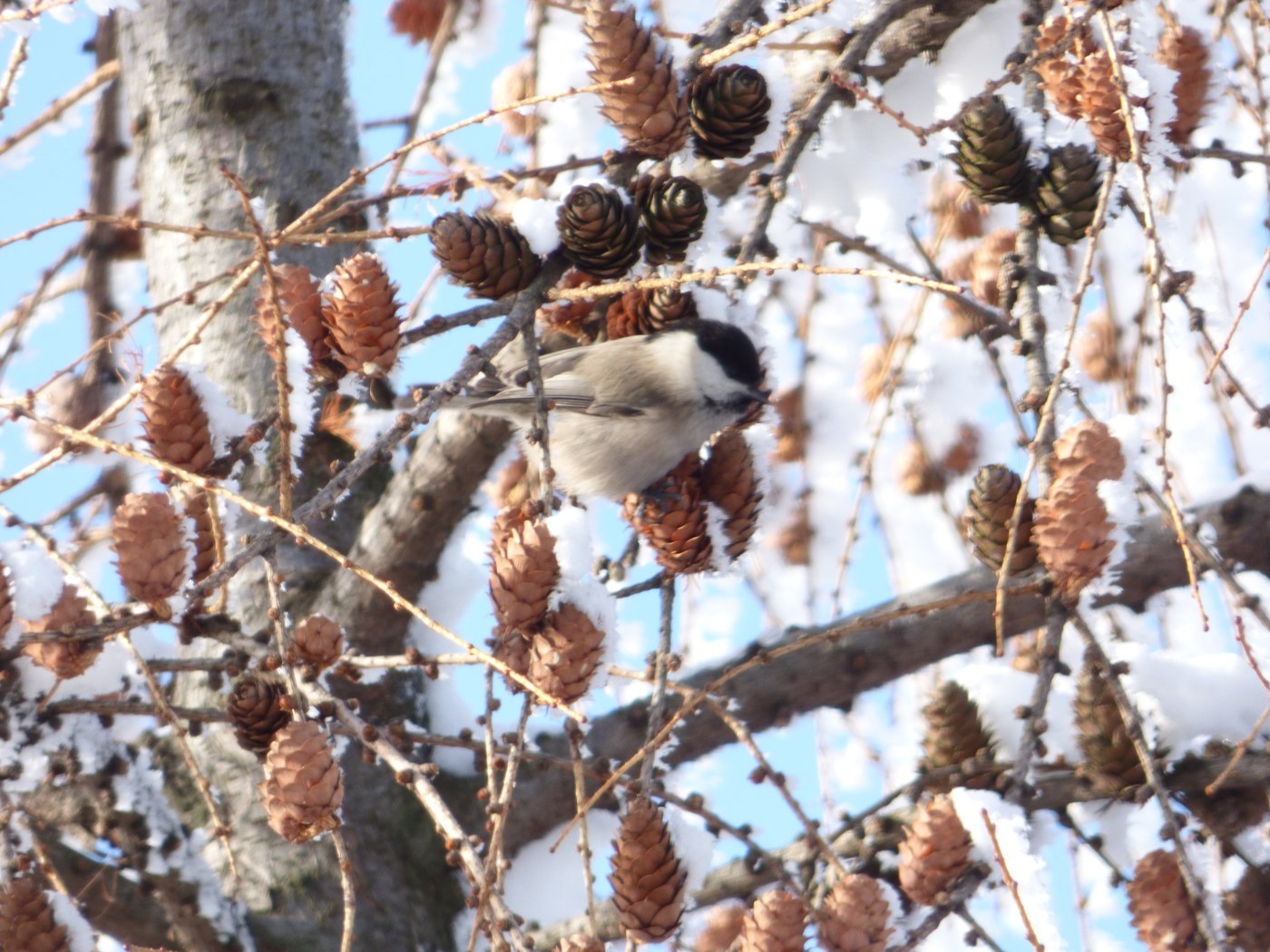
Key Field Marks
- Small (11.5-12.5 cm) tit with a matte (not glossy) black cap extending further down the nape, a small black bib, and pale buffy-white cheeks.
- Pale panel on the closed wing formed by pale fringes to the secondaries - often the single most useful plumage feature versus Marsh Tit.
- Slightly bull-necked, large-headed appearance with a stubby bill.
- Underparts buffy-white to pale gray-brown, unmarked; flanks often washed warm buff.
- Bib is usually larger and more diffuse-edged than the neat, small bib of Marsh Tit, though this overlaps.
Similar Species
- Marsh Tit is extremely similar but has a glossy blue-black cap (vs. matte/sooty in Willow Tit), a small neat bib, no obvious pale wing panel, and a distinctive sneezy "pitchou" call.
- Willow Tit's call is a nasal, buzzy "tchay-tchay-tchay" or "zi-zi-chair-chair-chair," quite different from Marsh Tit's explosive "pitchou."
- Best separated with confidence by voice; in the hand, Willow Tit has a larger black bib base and different skull/wing formula measurements used by ringers.
- Coal Tit has a white nape patch and double wing bars, quickly ruling it out.
Habitat & Range
- Breeds across temperate and boreal Eurasia, from Britain and Fennoscandia east through Russia to Japan; in Britain it has undergone a severe decline and is now scarce and local.
- Favors damp woodland, willow and alder carr, birch scrub, and wet woodland edges - habitat with soft, rotten wood suitable for excavating its own nest hole.
- Non-migratory resident through most of its range, forming small flocks and joining mixed tit flocks in winter.
Voice
- Song: a series of slow, plaintive, descending piping notes, "tyu-tyu-tyu-tyu."
- Call: nasal, buzzy "eez-eez-eez" or "chair-chair-chair," distinct from the sharper calls of Marsh Tit and Coal Tit.
Behavior Notes
- One of the few European tits that excavates its own nest cavity, typically in soft, decaying willow, birch, or alder stumps, rather than using existing holes.
- Forages low in scrub and understorey more often than the canopy-loving Marsh Tit, and frequently hoards food for winter.
Frequently asked questions
What is the easiest way to separate Willow Tit from Marsh Tit?
Voice is most reliable: Willow Tit gives a nasal, buzzy 'zi-zi-chair-chair' call, while Marsh Tit gives an explosive 'pitchou' sneeze; plumage clues include Willow Tit's duller, matte black cap and pale wing panel versus Marsh Tit's glossy cap and plain wing.
Does Willow Tit have a pale wing panel?
Yes, pale fringes on the secondary feathers create a visible pale panel on the closed wing, a feature Marsh Tit lacks or shows only faintly.
Why is Willow Tit declining in Britain?
Loss of damp, scrubby woodland with dead and rotting wood for nest excavation, along with competition and predation pressures, has driven a steep decline in the UK.
Does Willow Tit use nest boxes?
Rarely - it typically excavates its own cavity in soft, rotten wood such as a decaying willow or birch stump rather than using an existing hole or nest box.