
Willow Flycatcher Identification Guide
A notoriously plain Empidonax flycatcher of North American willow thickets that is best identified by its sneezy 'fitz-bew' song rather than plumage.
Read the full Willow Flycatcher encyclopedia entry →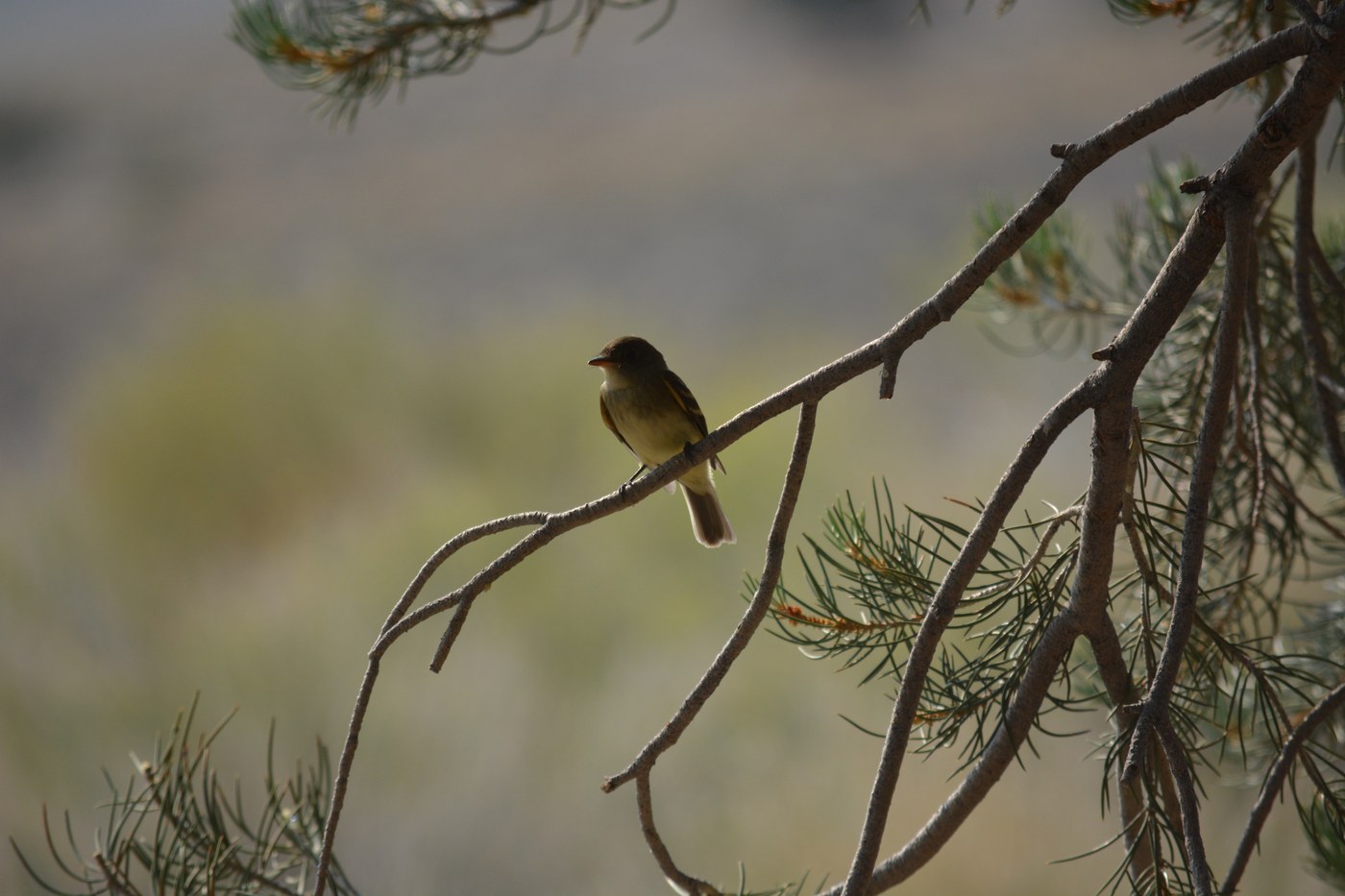
Key Field Marks
- Small (13-15 cm) olive-brown to olive-gray flycatcher with a fairly large, flat-topped head and a relatively long, wide-based bill with a pale/orange lower mandible.
- Faint, often nearly absent, whitish eye-ring - one of the plainer-faced Empidonax species.
- Two whitish to buffy wing bars on otherwise dusky wings; underparts pale with a faint olive wash on the breast and a pale yellowish tinge on the belly, especially in fall.
- Short primary projection compared to some other Empidonax; tail slightly notched.
- Upright posture with frequent tail-flicking (a slower, less exaggerated flick than some relatives) while perched on low, exposed twigs.
Similar Species (Empidonax Complex)
- Willow Flycatcher is virtually inseparable from Alder Flycatcher by plumage alone; voice is the only reliable field mark - Willow gives a sneezy, burry "FITZ-bew," while Alder gives a more even "free-BEER."
- Least Flycatcher is smaller, grayer, with a bolder white eye-ring and a snappy "che-BEK" call.
- Acadian Flycatcher is brighter olive-green above with a more obvious eye-ring and prefers shaded forest interiors rather than open shrubby wetlands.
- Outside the breeding season and away from singing birds, silent Willow/Alder Flycatchers are usually left unidentified as "Traill's Flycatcher" (the old combined name) unless call notes ("whit" for Willow vs. "pip" for Alder) are heard.
Habitat & Range
- Breeds across most of the United States and southern Canada in shrubby, often wet habitats: willow and alder thickets, brushy pastures, streamside scrub, and regenerating clearcuts.
- Several subspecies breed in the arid Southwest along riparian willow corridors, including the endangered Southwestern Willow Flycatcher.
- Winters in Mexico, Central America, and northern South America.
- A late spring migrant and one of the last songbirds to arrive on the breeding grounds.
Voice
- Song: a burry, sneezing "FITZ-bew" (sometimes rendered "fitz-BEW"), repeated frequently from an exposed perch.
- Call note: a liquid "whit," useful for separating silent birds from Alder Flycatcher's flatter "pip."
Behavior Notes
- Perches on low, exposed dead twigs in shrubby vegetation, sallying out to catch flying insects and returning to the same or a nearby perch.
- Builds a compact cup nest low in a shrub, often a willow, close to water.
Frequently asked questions
How do you tell a Willow Flycatcher from an Alder Flycatcher?
Plumage is essentially identical; the reliable way is voice - Willow sings a sneezy 'FITZ-bew' and gives a 'whit' call, while Alder sings a more even 'free-BEER' and gives a 'pip' call.
Does the Willow Flycatcher have an eye-ring?
It usually has only a faint, incomplete whitish eye-ring, much less obvious than in Least or Acadian Flycatchers, which helps rule those species out.
What habitat should I search for Willow Flycatchers in?
Look in shrubby wetlands, willow and alder thickets, brushy old fields, and riparian scrub near water, where males sing from low exposed perches.
Why is this species hard to identify?
Willow Flycatcher belongs to the genus Empidonax, a group of small flycatchers that look nearly identical; safe identification usually depends on hearing the distinctive song or call rather than relying on plumage alone.