
Whooping Crane Identification Guide
North America's tallest bird, a critically rare, pure-white crane with black wingtips and a red crown, best distinguished from egrets and Sandhill Crane by its size, neck posture, and bugling call.
Read the full Whooping Crane encyclopedia entry →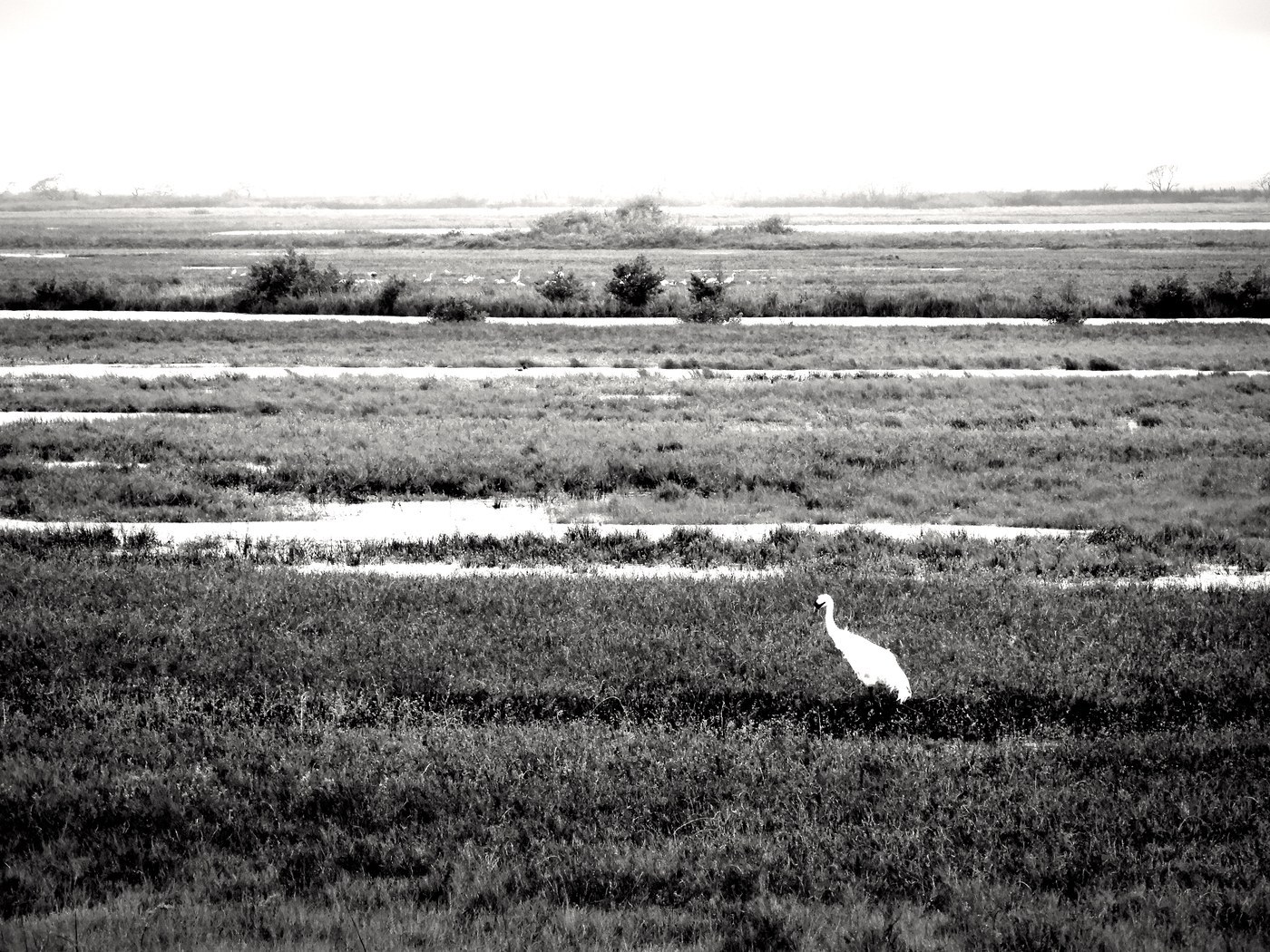
Overview
The Whooping Crane (Grus americana) is one of North America's rarest birds and its tallest, an iconic conservation success story that has rebounded from fewer than two dozen individuals in the 1940s to a few hundred today through intensive management. It breeds in the remote wetlands of Wood Buffalo National Park in Canada and winters primarily on the Texas Gulf Coast, with additional reintroduced populations elsewhere.
Key Field Marks
- Size & shape: Very large and tall, standing about 5 feet, with a long neck, long black legs, and a long, straight, dagger-like bill.
- Plumage: Adults are entirely snow white except for black primary (wingtip) feathers, visible mainly in flight; a bare patch of red skin covers the crown and extends toward the face.
- Bill and face: Long, olive-gray to yellowish bill; a black "mustache" mark near the base of the bill in some views.
- Flight: Flies with neck and legs fully extended (unlike herons, which fold the neck), showing the contrast of white body and wing coverts against black wingtips.
- Behavior: Forages by probing and picking in shallow water and marsh for crabs, fish, and other prey; performs elaborate bugling and dancing displays during pair bonding.
Separating It From Similar Species
- Sandhill Crane: Overall gray plumage (not white) with a red crown patch; where white morphs or leucistic individuals occur they still lack the crisp black wingtip pattern of Whooping Crane. Sandhill is also notably smaller.
- Great Egret: All white but much smaller, with a yellow bill, black legs, and — critically — flies with its neck folded back in an S-shape, unlike the outstretched neck of a crane in flight.
- Snow Goose: White with black wingtips like Whooping Crane, but far smaller, with a shorter neck, pink bill, and flies in large flocks with faster wingbeats, not the slow, deep wingbeats of a crane.
- American White Pelican: Also large and white with black wing markings, but has a massive orange bill/pouch and a stockier body, with soaring flight on flat wings rather than a crane's flapping flight with extended neck.
Where and When to Find One
The primary wild migratory population breeds in Wood Buffalo National Park, Alberta/Northwest Territories, Canada during summer, and migrates roughly 2,500 miles south to winter on the Texas Gulf Coast, especially Aransas National Wildlife Refuge and surrounding bays, present from about October through April. A reintroduced non-migratory population exists in Louisiana, and an eastern migratory population (aided historically by ultralight-led migration) moves between Wisconsin and the southeastern US. Because the total wild population remains only in the low hundreds, sightings anywhere are notable and should be reported to local wildlife authorities.
Voice
Gives loud, far-carrying, trumpet-like bugling calls, often in duet between paired birds, audible over long distances across open marsh and prairie — the source of its common name. Calls are lower and more resonant than the rolling, rattling call of Sandhill Crane.
Frequently asked questions
How can I tell a Whooping Crane from a Great Egret?
Whooping Crane is much larger, flies with its neck extended straight out, and has black wingtips, while Great Egret is smaller, has an all-white wing, and flies with its neck folded back in an S-curve.
What is the difference between a Whooping Crane and a Sandhill Crane?
Whooping Crane is white with black wingtips, while Sandhill Crane is gray overall; Whooping Crane is also taller and considerably rarer.
Where is the best place to see wild Whooping Cranes?
The Texas Gulf Coast, particularly Aransas National Wildlife Refuge, is the most reliable wintering location for the main wild migratory population, typically October through April.
Why are Whooping Cranes so rare?
The species was reduced to fewer than two dozen birds by the mid-20th century due to habitat loss and hunting; intensive conservation efforts have since helped the population recover to a few hundred, but it remains critically endangered.