
Whooper Swan Identification Guide
A large, all-white Eurasian swan with a long, straight neck held upright and a wedge-shaped yellow-and-black bill, known for its loud, bugling calls.
Read the full Whooper Swan encyclopedia entry →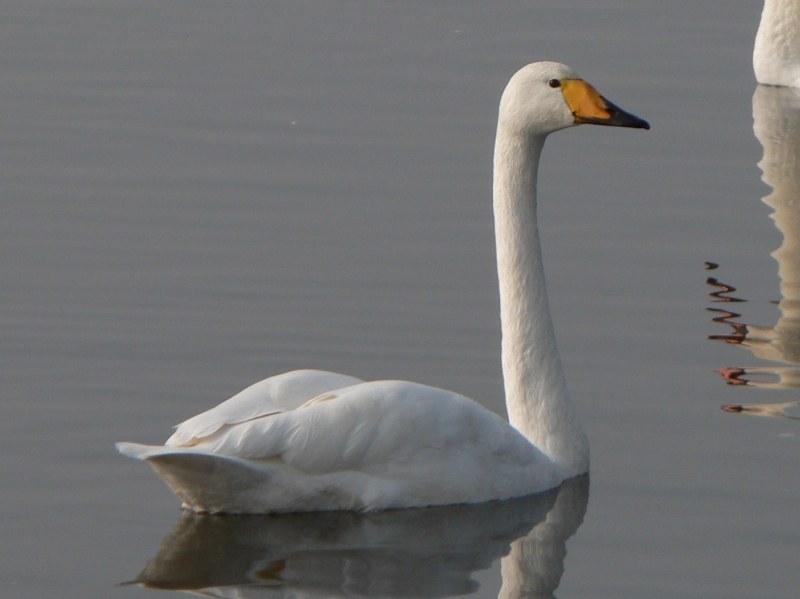
Overview
The Whooper Swan (Cygnus cygnus) is a large, powerful swan breeding across subarctic Eurasia and wintering farther south in milder wetlands, lakes, and estuaries. It is a rare but regular visitor to parts of North America, primarily Alaska and occasionally the Northeast, and is one of the loudest and most vocal of the swans.
Key Field Marks
- Size & shape: A very large swan with a long, straight neck typically held erect (not curved into an S-shape), and a flat, wedge-shaped head-bill profile.
- Plumage: Entirely white in adults; immatures are dusky grayish-brown, gradually whitening over the first year or two.
- Bill: The key field mark — a large, mostly yellow bill with a black tip, the yellow extending forward in a point beyond the nostril, more extensive yellow than on Tundra Swan.
- Legs: Black legs and feet.
- Behavior: Often forages by dabbling and up-ending in shallow water and grazing on land in fields; highly vocal, especially in flocks, with much bugling and honking during social interactions.
- Flight: Neck extended straight out, with steady, powerful wingbeats; often in family groups or larger flocks.
Separating It From Similar Species
- Tundra Swan: Smaller with a shorter neck, and the yellow on the bill (when present) is a small patch near the eye rather than a large triangular area extending toward the nostril; Tundra Swan's calls are higher-pitched and more yelping.
- Trumpeter Swan: Bill is entirely black (no yellow) with a reddish line on the lower mandible, and the head profile is more sloping; Trumpeter's call is a lower, more nasal trumpeting compared to Whooper's bugling.
- Mute Swan: Has an orange bill with a black basal knob, typically holds its neck in a graceful S-curve, and is usually rather silent (hence the name), unlike the vocal Whooper.
Where and When to Find One
Whooper Swan breeds across subarctic and boreal Eurasia from Iceland east through Scandinavia and Russia to far eastern Siberia, nesting on tundra pools and northern lakes. It winters farther south on ice-free lakes, rivers, and coastal wetlands in Europe and East Asia. In North America it is a scarce but regular visitor, most often found in western and southwestern Alaska (including the Aleutians), with occasional vagrants recorded in the northeastern US and eastern Canada, typically in fall through spring.
Voice
One of the most vocal swans, giving loud, resonant, bugling or trumpet-like calls — a bisyllabic "whoop-whoop" or "ahng-ahng" often repeated — used in flight and during social displays, and the source of both its common name and scientific epithet.
Frequently asked questions
How do you distinguish a Whooper Swan from a Trumpeter Swan?
Whooper Swan has a yellow-and-black bill, while Trumpeter Swan's bill is entirely black; their calls also differ, with Whooper's being a more bugling 'whoop' and Trumpeter's a lower, nasal trumpet.
What is the difference between Whooper Swan and Tundra Swan?
Whooper Swan is larger with a longer neck and more extensive yellow on the bill reaching toward the nostril, while Tundra Swan is smaller with only a small yellow spot near the eye, if any.
Where might I see a Whooper Swan in North America?
It is a rare but regular visitor mainly to western and southwestern Alaska, with occasional vagrant records in the northeastern United States and eastern Canada.
Why is it called the Whooper Swan?
The name comes from its loud, far-carrying, bugling or 'whooping' calls, which are among the loudest of any swan species.