
White-winged Dove Identification Guide
A common southwestern dove readily told from Mourning Dove by its squared tail with bold white corners, broad white wing stripe, and orange eye with blue eye-ring.
Read the full White-winged Dove encyclopedia entry →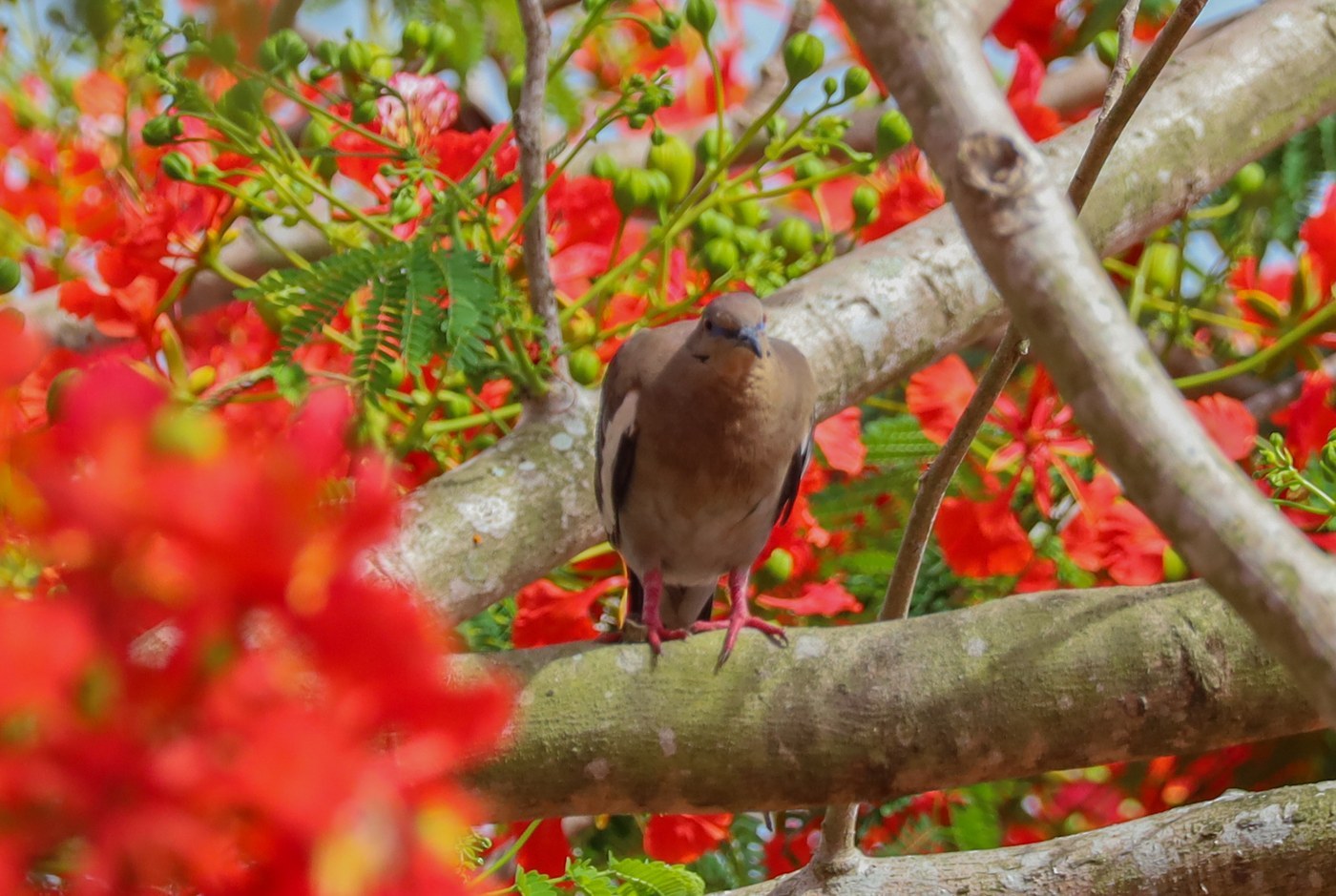
Overview
The White-winged Dove (Zenaida asiatica) is a robust, medium-large dove of the arid Southwest, expanding steadily northward and eastward in recent decades and now common in cities and towns as well as desert scrub and citrus groves.
Key Field Marks
- Size & shape: Stockier and slightly larger than a Mourning Dove, with a shorter, squared (not pointed) tail.
- Wing pattern: The signature field mark is a bold, white stripe running along the edge of the folded wing, clearly visible at rest and forming a broad white band across the wing in flight.
- Tail: Squared tail shows a black band near the tip followed by broad white corners on the outer feathers, very conspicuous in flight or when fanned.
- Head and eye: Grayish-brown overall with a small black crescent mark below and behind the eye; the eye is orange-red surrounded by a bright blue, bare eye-ring — striking at close range.
- Bill and legs: Thin dark bill; pinkish-red legs.
- Behavior: Often perches conspicuously on wires, saguaros, and rooftops; forms large flocks at feeders and fruiting trees; strong, direct flight.
Separating It From Similar Species
- Mourning Dove: Slimmer with a long, pointed tail edged in white spots (not a solid white band) and lacks the white wing stripe; overall paler and more uniformly colored.
- White-tipped Dove: Lacks the white wing stripe entirely, has a plain, unbanded tail with white corners only at the very tip, and shows a pale forehead rather than the blue eye-ring.
- Rock Pigeon: Larger and bulkier with variable plumage, iridescent neck patch, and lacks the clean white wing stripe and squared white-cornered tail.
Where and When to Find One
White-winged Dove is common and increasingly widespread across the southwestern United States — Arizona, Texas, New Mexico — and has expanded into the southeastern states and even further north in recent decades, often found in urban and suburban areas as well as desert scrub, mesquite thickets, and agricultural areas. Many populations are migratory, moving south into Mexico for winter, though resident, non-migratory populations have become established in many U.S. cities year-round. Spring and summer are peak times to find and hear them across their range, especially around backyard feeders offering seed.
Voice
The song is a rhythmic, hooting series often rendered as "who cooks for you" or "who-COOKS-for-YOU," with a distinctive cadence quite different from the softer, descending coo of the Mourning Dove. It is frequently given from an exposed perch, especially in early morning.
Frequently asked questions
What is the fastest way to identify a White-winged Dove?
Look for the bold white stripe along the edge of the closed wing and the squared tail with white corners — both are absent in Mourning Dove.
How do White-winged and Mourning Doves differ in shape?
White-winged Dove is stockier with a short, squared tail, while Mourning Dove is slimmer with a long, pointed tail.
Where has the White-winged Dove's range expanded?
Originally a bird of the arid Southwest, it has expanded significantly into the southeastern and even parts of the central and northern United States in recent decades, especially in urban areas.
What does a White-winged Dove sound like?
Its call is often described as sounding like "who cooks for you," a distinctive rhythmic hooting different from the mournful coo of a Mourning Dove.