White-winged Crossbill Identification Guide
A boreal finch with a distinctively crossed bill and bold white wing bars, wandering irregularly across northern conifer forests in search of spruce and tamarack cone crops.
Read the full White-winged Crossbill encyclopedia entry →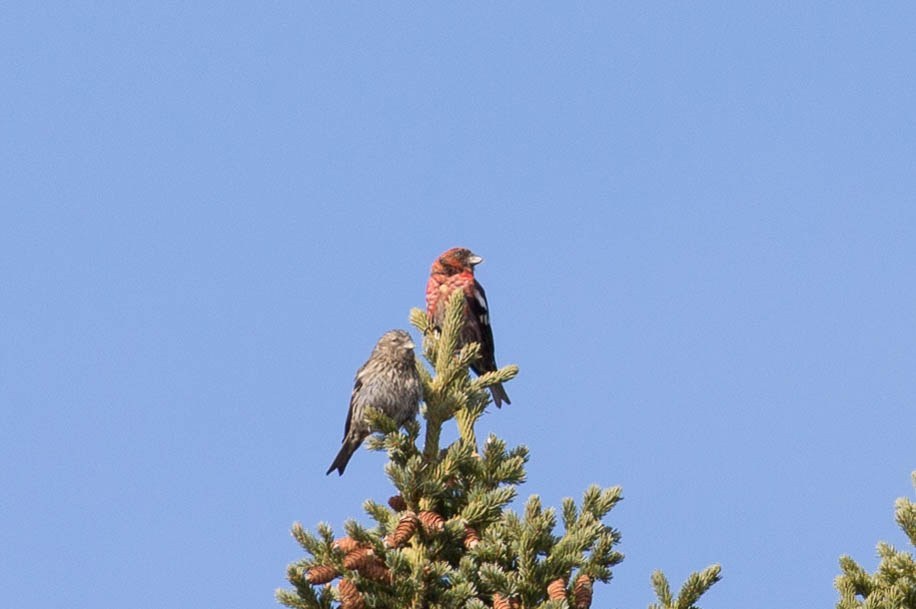
Overview
The White-winged Crossbill (Loxia leucoptera) is an irruptive finch of the boreal and subarctic conifer forests of North America and Eurasia (where it is called Two-barred Crossbill). Like other crossbills, its uniquely crossed mandibles are specialized for prying seeds from conifer cones, and its movements are driven almost entirely by cone crop abundance rather than a fixed migration schedule.
Key Field Marks
- Size & shape: A medium-small finch with a notched tail, and a distinctively crossed bill tip visible at close range.
- Male plumage: Bright pink to raspberry-red overall, with black wings and tail.
- Female/immature plumage: Olive-yellow to grayish with streaking, and the same black wings.
- Wing bars: Two bold, broad white wing bars are the key mark separating this species from the plainer-winged Red Crossbill — visible at rest and in flight, and diagnostic even on streaky immatures.
- Bill: Thinner and more finely crossed than Red Crossbill's heavier bill, an adaptation for extracting seeds from the smaller, softer cones of spruce and tamarack rather than pine.
- Behavior: Highly social and nomadic, often in flocks, clambering parrot-like over cones, and frequently detected first by flight calls overhead.
Separating It From Similar Species
- Red Crossbill: The single most reliable difference is the wing bars — Red Crossbill lacks white wing bars (or shows at most faint, thin ones), while White-winged Crossbill shows two broad, bold white bars. Red Crossbill also has a proportionally heavier, more robust bill suited to pine cones.
- Pine Grosbeak: Much bulkier and larger with a stubby, uncrossed bill; male Pine Grosbeaks are also rosy-red but far bigger, with a shorter, thicker bill and different flight call.
- Common Redpoll: Smaller, streakier, with a small yellow-based bill (not crossed) and a red cap rather than overall pink/red body.
Where and When to Find One
White-winged Crossbills breed across the boreal spruce-fir and tamarack forests of Canada and Alaska, and locally in the northern United States. Because their food supply (conifer seed crops) varies year to year and place to place, they are irruptive: in years of poor cone crops in the core range, flocks push south into the northern and even central United States in fall and winter, sometimes in large numbers, while in good cone years they may stay put or wander unpredictably. They favor spruce, tamarack, and hemlock stands, often in the same areas as Red Crossbills but with some preference for spruce/tamarack over pine.
Voice
The flight call is a dry, rapid, chattering series of notes, often rendered as a rattling "chif-chif-chif" — distinct in cadence and tone from Red Crossbill's flight call once learned, though both require careful listening. The song is a varied, warbling series of trills and buzzy notes given from a treetop perch, often incorporating call-like elements.
Frequently asked questions
What is the best mark to separate White-winged Crossbill from Red Crossbill?
The two bold white wing bars are diagnostic — White-winged Crossbill shows them clearly while Red Crossbill's wings are essentially plain black.
Why do White-winged Crossbills show up far south of their breeding range some winters?
They are irruptive, moving south in large numbers during years when spruce and tamarack cone crops fail in the boreal forest, searching for food elsewhere.
What color are male and female White-winged Crossbills?
Males are bright pink to raspberry-red with black wings; females and immatures are olive-yellow to grayish and streaky, both showing the white wing bars.
What conifers does the White-winged Crossbill prefer?
It favors spruce and tamarack (larch) cones most, thanks to its finer, more delicate crossed bill compared to the heavier-billed Red Crossbill, which favors pine.
White-winged Crossbill identified by the community
Recent White-winged Crossbill sightings identified with Bird Identifier.