
White-tipped Dove Identification Guide
A stocky, ground-loving dove of the southern Texas brushlands and tropics, told from other doves by its pale forehead, dark eye patch, and low, owl-like hooting call.
Read the full White-tipped Dove encyclopedia entry →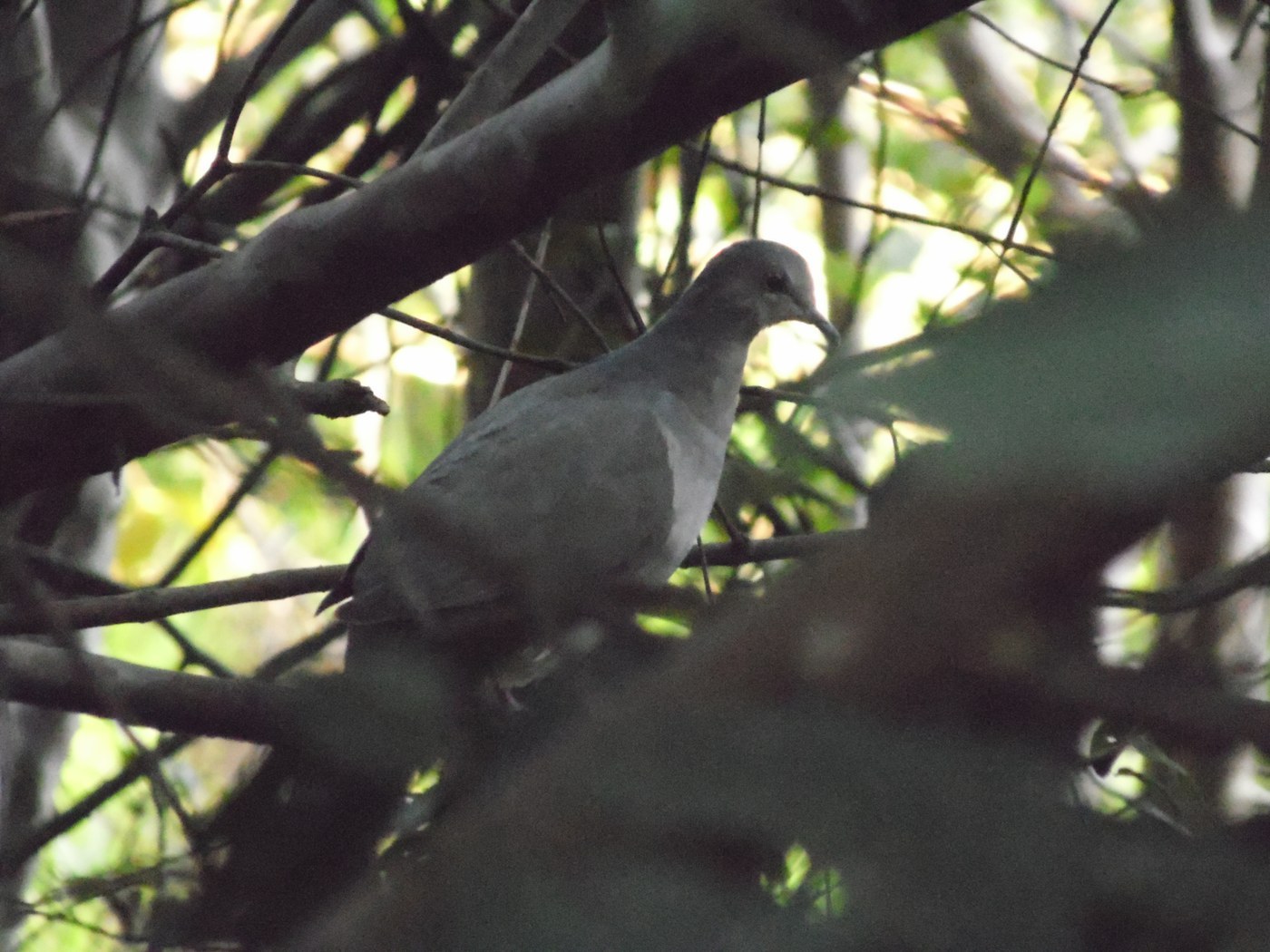
Overview
The White-tipped Dove (Leptotila verreauxi) is a plump, short-tailed dove of dense brush, woodland edge, and tropical forest understory, ranging from the southernmost tip of Texas through Mexico, Central America, and much of South America. It is a shy, largely terrestrial bird, more often heard than seen as it walks quietly through leaf litter.
Key Field Marks
- Size & shape: A chunky, round-bodied dove, slightly larger and stockier than a Mourning Dove, with a notably short, squared-off tail.
- Plumage: Overall soft grayish-brown to olive-brown above, with a warm pinkish-buff wash on the breast fading to whitish on the belly and undertail coverts.
- Head pattern: Pale, almost whitish forehead and forecrown contrasting with a duskier crown and nape; a dark patch behind and below the eye gives a subtly masked look.
- Eye and skin: Reddish to orange eye-ring and iris; the bare skin around the eye is often bluish or purplish.
- Bill and legs: Bill is thin and dark; legs and feet are dull red to pinkish.
- Tail: Broad white tips to the outer tail feathers show clearly in flight or when the tail is fanned — the source of the species' name — otherwise not obvious on a folded tail from behind.
- Behavior: Walks on the ground with a bobbing, deliberate gait, often solitary or in pairs; flushes low and fast into cover when disturbed, with a whirring wingbeat.
Separating It From Similar Species
- Mourning Dove: Slimmer, longer-tailed with a pointed tip (not white-tipped and squared), lacks the pale forehead and dark eye patch, and has black spots on the wing coverts that White-tipped Dove lacks.
- Inca Dove: Much smaller and slimmer, with scaly-looking plumage overall and rufous wing patches in flight; White-tipped Dove is notably bulkier and plain-backed.
- Common Ground Dove: Tiny by comparison, with a scaly breast and short tail; White-tipped Dove is far larger and unmarked below.
- White-winged Dove: Shows an obvious white wing stripe in flight and a squared tail with a black-and-white band, unlike the plain wings and white-cornered tail of White-tipped Dove.
Where and When to Find One
In the United States, White-tipped Dove is essentially restricted to the Lower Rio Grande Valley of extreme southern Texas, where it is a fairly common permanent resident in native thornscrub, resacas, and wooded refuges such as Santa Ana and Bentsen-Rio Grande Valley State Park. It favors dense, brushy understory and forest edges rather than open fields, and is present year-round with no strong migratory movement in this range. Farther south it is a widespread resident from Mexico to Argentina in a variety of wooded and semi-open habitats.
Voice
The song is a low, resonant, far-carrying series of hollow hoots, often rendered as a mournful "who, who-who-who" or likened to blowing across the top of a bottle. It is distinctive from the Mourning Dove's higher, more melancholy cooing and can be heard at a distance through dense brush where the bird itself stays hidden.
Frequently asked questions
What is the easiest way to tell a White-tipped Dove from a Mourning Dove?
Look at the tail and head: White-tipped Dove has a short, squared tail with white corners and a pale forehead with a dark eye patch, while Mourning Dove has a long, pointed tail and a plain grayish head.
Where in the US can I see a White-tipped Dove?
The only reliable US location is the Lower Rio Grande Valley of southern Texas, in brushy woodlands and refuges near the Mexican border.
What does a White-tipped Dove sound like?
Its call is a low, hollow, owl-like hooting, often described as sounding like someone blowing across an empty bottle, quite different from the softer cooing of a Mourning Dove.
Does the White-tipped Dove migrate?
No, it is a non-migratory permanent resident throughout its range, including in South Texas.