
White-throated Swift Identification Guide
A fast-flying black-and-white swift of western North American cliffs and canyons, identified by its crisp white throat, belly stripe, and flank patches.
Read the full White-throated Swift encyclopedia entry →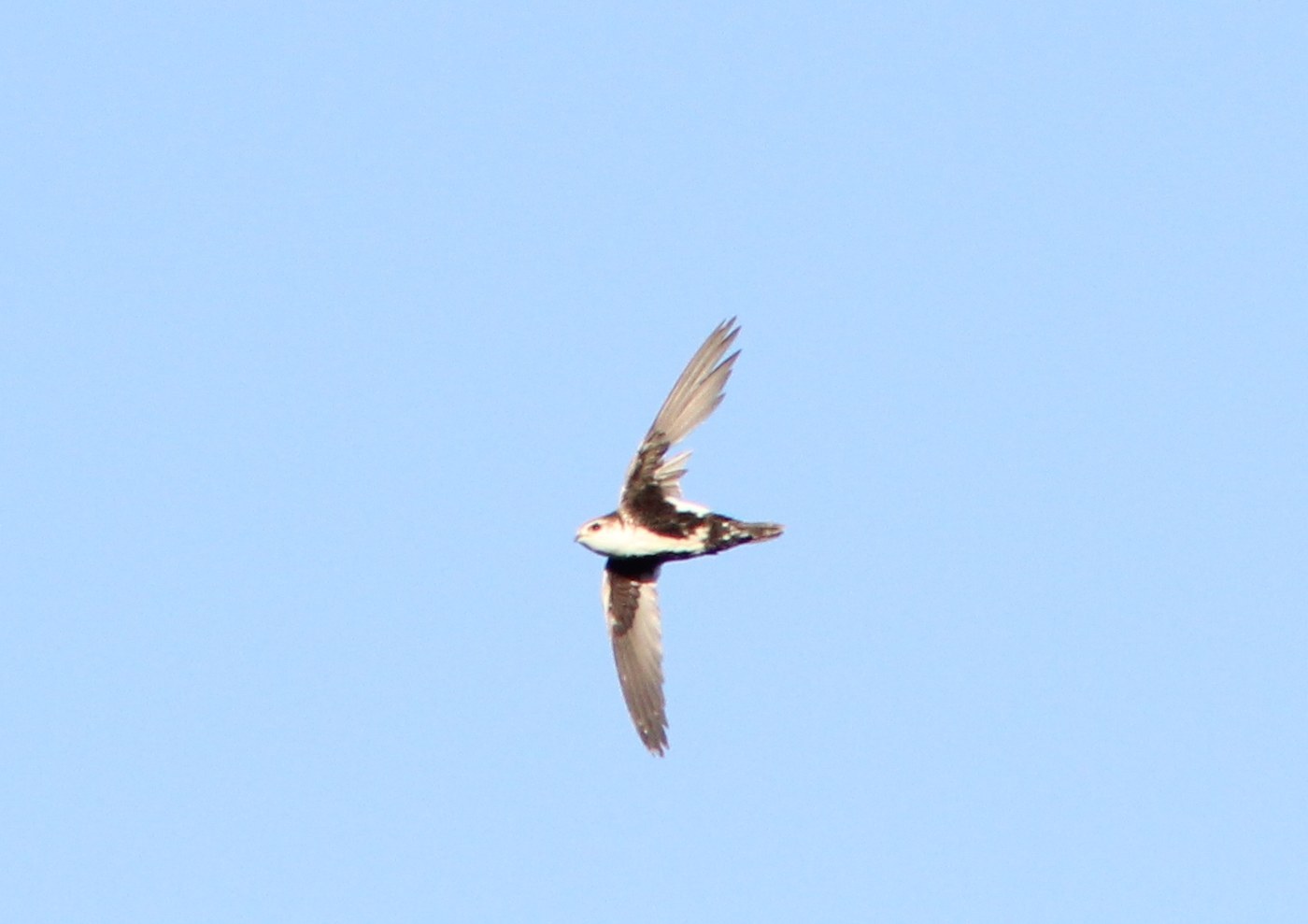
Key Field Marks
- Small, slender swift (15-18 cm) with long, swept-back, pointed wings and a notably forked tail
- Blackish upperparts contrasting with a white throat, central belly stripe, and white patches on the flanks
- Extremely fast, direct flight with rapid, shallow wingbeats interspersed with glides
- Often seen in tight flocks racing along cliff faces and canyon walls
Similar Species
- Violet-green Swallow: also shows white flank patches, but has a slower, more fluttering flight, a different overall shape (broader wings, shorter tail), and perches readily, unlike swifts
- Vaux's Swift and Chimney Swift: both are uniformly dark/sooty with no white pattern on the underparts, easily separated by the White-throated Swift's bold black-and-white markings
- No other regularly occurring North American swift shows this crisp black-and-white pattern, making adult White-throated Swift essentially unmistakable when seen well
Behavior & Habitat
An aerial specialist that spends nearly all its time on the wing, foraging for flying insects at great speed, often high overhead or racing low along cliff faces. It roosts and nests colonially in crevices of steep cliffs, canyon walls, and occasionally tall buildings or bridges, and can tolerate cold spells by entering torpor in bad weather.
Where & When to See It
Found across western North America from southern British Columbia and the western United States south through Mexico and into Central America, closely tied to rugged cliff and canyon habitat in mountains, foothills, and desert escarpments. Northern populations are migratory, moving south for winter, while southern populations are largely resident.
Voice
A high-pitched, descending, twittering chatter, often given in flight by groups racing along cliffs.
Frequently asked questions
What field marks distinguish White-throated Swift from other swifts?
Its crisp white throat, central belly stripe, and flank patches against black upperparts are unique among North American swifts, which are otherwise uniformly dark.
Where is the best habitat to look for White-throated Swift?
Steep cliffs, canyons, and rock escarpments in the mountains and foothills of the western U.S. and Mexico, where it nests and roosts in crevices.
How can I tell it apart from Violet-green Swallow?
White-throated Swift has a faster, more scything flight with narrower swept-back wings and a forked tail, while Violet-green Swallow flies more slowly and perches readily, which swifts rarely do.
Is White-throated Swift migratory?
Northern populations migrate south for winter, while populations in the southern part of the range, including Mexico, are largely year-round residents.