
White-throated Kingfisher Identification Guide
A large, vividly colored Asian kingfisher with a chocolate-brown head and belly, a clean white throat and breast, turquoise-blue back and wings, and a dagger-like red bill.
Read the full White-throated Kingfisher encyclopedia entry →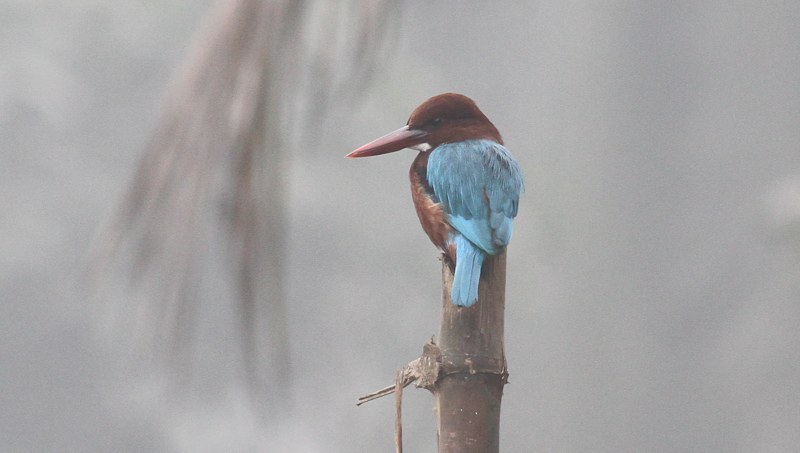
Key Field Marks
- Large kingfisher (about 27-28 cm)
- Rich chocolate-brown head, neck, breast sides, and belly
- Bright white throat and central breast patch, sharply contrasting with the brown
- Brilliant turquoise-blue back, wings, and tail, flashing conspicuously in flight
- Large, heavy, coral-red bill and red-orange legs
- In flight shows a white wing patch at the base of the primaries
Similar Species
- Common Kingfisher: much smaller, with an all blue-and-orange body and no brown head or white breast patch
- Black-capped Kingfisher: has a black cap rather than a brown head, and a more purplish-blue back
- Stork-billed Kingfisher: larger still, with a massive orange-red bill and a different, more uniform body color pattern lacking the crisp white breast bib
- The unique combination of a brown head/belly, white throat/breast bib, and turquoise back separates White-throated Kingfisher from all other regularly overlapping kingfishers
Behavior & Habitat
Unlike many kingfishers, this species is often found well away from water, perching conspicuously on wires, fence posts, and bare branches in open country, farmland, gardens, and urban areas. It is a generalist predator, taking large insects, small reptiles, rodents, and even other small birds, typically dropping onto prey from an elevated perch.
Where & When to See It
Widespread and often common resident across South and Southeast Asia, from Turkey and the Middle East through the Indian subcontinent to China and the Philippines. Non-migratory, and easy to find due to its conspicuous perching habits and loud vocalizations.
Voice
Very vocal, especially around dawn, giving a loud, descending, laughing or trilling call often rendered as a rolling ki-ki-ki-ki-ki, frequently delivered from an exposed perch.
Frequently asked questions
Does White-throated Kingfisher need to live near water?
No — unlike many kingfishers, it is a habitat generalist often found far from water in farmland, gardens, and urban areas, hunting large insects and small vertebrates.
How do I tell it apart from Black-capped Kingfisher?
White-throated Kingfisher has an all-brown head, while Black-capped Kingfisher shows a solid black cap contrasting with a white collar.
What is the most reliable field mark for this species?
The combination of a chocolate-brown head and belly with a crisp white throat/breast patch and a turquoise-blue back is diagnostic.
What time of day is White-throated Kingfisher most vocal?
It is especially vocal around dawn, giving its loud, rolling, laughing call from prominent perches.