
White Tern Identification Guide
A small, entirely white, buoyant seabird of tropical oceans with a black bill and huge dark eyes, famous for balancing its single egg on a bare branch.
Read the full White Tern encyclopedia entry →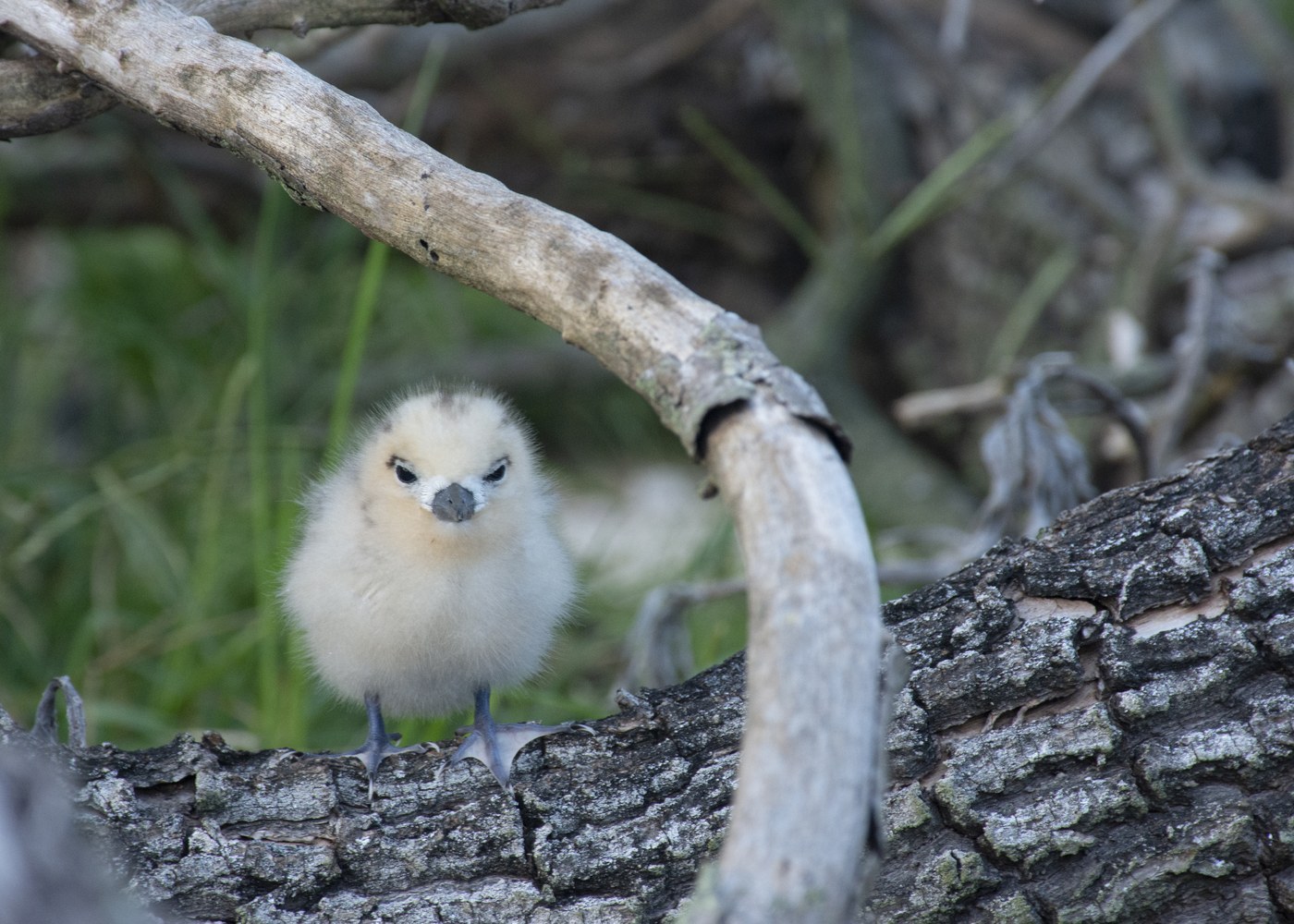
Key Field Marks
- Small tern (28-33 cm) with entirely white plumage, including the underwing, which can look faintly translucent in flight
- Black bill, slightly upturned at the tip
- Large, dark eye surrounded by a narrow black eye-ring, giving a big-eyed, almost delicate appearance
- Black legs and feet
- Light, buoyant flight with fluttering wingbeats, often hovering directly overhead when curious about observers
Similar Species
- No other tern in its range is entirely white; white or pale morphs of other seabirds (such as some noddies or storm-petrels) differ in shape, bill color, and flight style
- Overall combination of small size, pure white body, black bill, and oversized dark eye is essentially unmistakable within its tropical oceanic range
Behavior & Habitat
White Tern is famous for laying its single egg directly on a bare tree branch, rock ledge, or building without building any nest structure, relying on the chick's strong grasping feet to avoid falling. It is a highly pelagic species outside the breeding season, feeding on small fish and squid caught by plunge-diving or dipping at the sea surface, often far from land. It is notably tame and curious, sometimes hovering just above people's heads.
Where & When to See It
Breeds on tropical and subtropical islands across the Pacific, Atlantic, and Indian Oceans, including Hawaii (where it is known as the Manu-o-Kū and is the official bird of the city of Honolulu, nesting even in urban trees), the Seychelles, and many remote atolls. Present year-round at many breeding colonies, with birds ranging widely over open ocean between breeding attempts.
Voice
Harsh, grating chattering and buzzy calls given at breeding colonies and roosts, quite different from its delicate appearance.
Frequently asked questions
What makes White Tern's nesting behavior unusual?
It lays its single egg directly on a bare branch, ledge, or other flat surface without building any nest, and the chick has unusually strong feet to grip its precarious perch.
How is White Tern distinguished from other white seabirds?
Its small size, uniformly white plumage, black bill, and oversized dark eye with a black eye-ring are distinctive and not matched by other terns in its tropical range.
Where is a good place to see White Tern up close?
In Honolulu, Hawaii, where it nests in city trees and parks and is the official city bird, known locally as Manu-o-Kū.
Is White Tern found near shore or far out at sea?
Both — it breeds on tropical islands but forages widely over open ocean, sometimes far from land, between breeding duties.