
White-tailed Kite Identification Guide
A small, pale gray-and-white raptor with black shoulder patches and red eyes that hovers kestrel-like over grasslands while hunting rodents.
Read the full White-tailed Kite encyclopedia entry →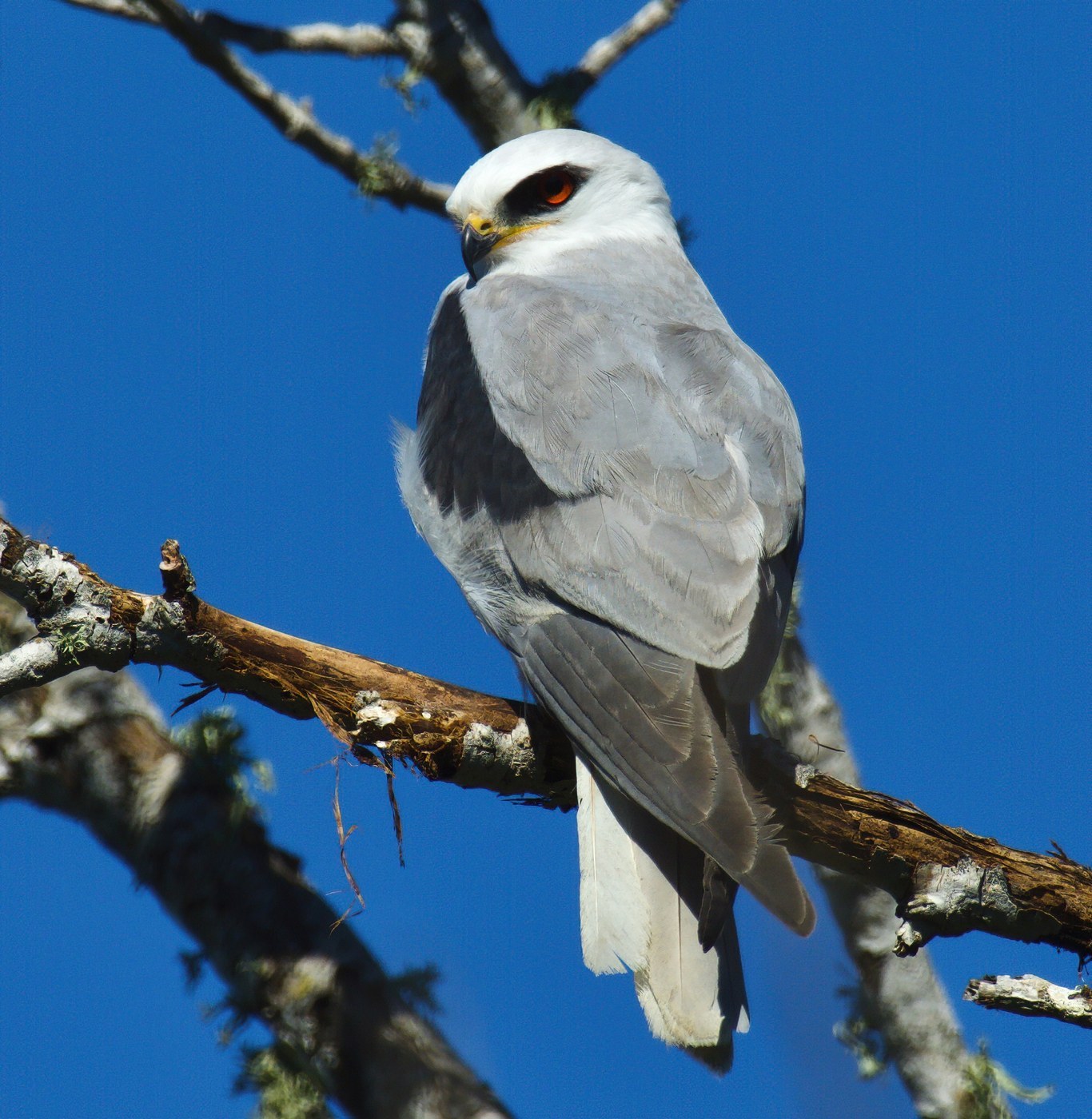
Key Field Marks
- Small, falcon-like raptor (35-41 cm) with pointed wings and a medium-length white tail
- Pale gray upperparts and clean white underparts, head, and tail
- Bold black patch on the shoulder (lesser wing coverts), obvious both perched and in flight
- Red eyes and a small black bill
- Frequently hovers on rapidly beating wings, body near-vertical, while scanning the ground for prey — a highly distinctive behavior
Similar Species
- Mississippi Kite: overall dark gray with no black shoulder patch, pointed wings, different flight style, and largely a bird of the central/southeastern U.S. rather than sharing exact habitat
- Northern Harrier: shows a white rump patch rather than an all-white tail, flies low over the ground with wings in a V, and has a longer tail and owl-like facial disk
- Swallow-tailed Kite: strikingly different, with a deeply forked black-and-white tail and much more black in the plumage
- The combination of pale gray-and-white plumage, black shoulder patches, and persistent hovering flight is essentially diagnostic
Behavior & Habitat
Hunts small rodents over open grasslands, farmland, and marsh edges, characteristically hovering in place with rapid wingbeats before dropping onto prey feet-first. Often perches on isolated trees, poles, or wires at habitat edges, and may roost communally outside the breeding season.
Where & When to See It
Found locally but often reliably in open country across the Americas, including California, Texas, and Florida in the U.S., and widely through Mexico, Central America, and South America. Many populations are resident, though numbers and distribution can shift seasonally in response to prey abundance.
Voice
Gives thin, whistled kee-kee or keep-keep calls, typically around the nest site or when interacting with other kites.
Frequently asked questions
What behavior best identifies White-tailed Kite in the field?
Its habit of hovering in place on rapidly beating wings while hunting over open ground is one of its most distinctive and easily recognized behaviors.
How do I separate White-tailed Kite from Mississippi Kite?
White-tailed Kite is pale gray and white with bold black shoulder patches, while Mississippi Kite is uniformly darker gray without shoulder patches.
What color are White-tailed Kite's eyes?
Adults have distinctive red eyes, visible at close range or through binoculars/scope.
What habitat should I check for this species?
Open grasslands, agricultural fields, and marsh edges with scattered trees or poles for perching.