
White-tailed Eagle Identification Guide
A massive Eurasian sea eagle with huge plank-like wings, a short white wedge-shaped tail, and a heavy pale bill, found along coasts, lakes, and rivers.
Read the full White-tailed Eagle encyclopedia entry →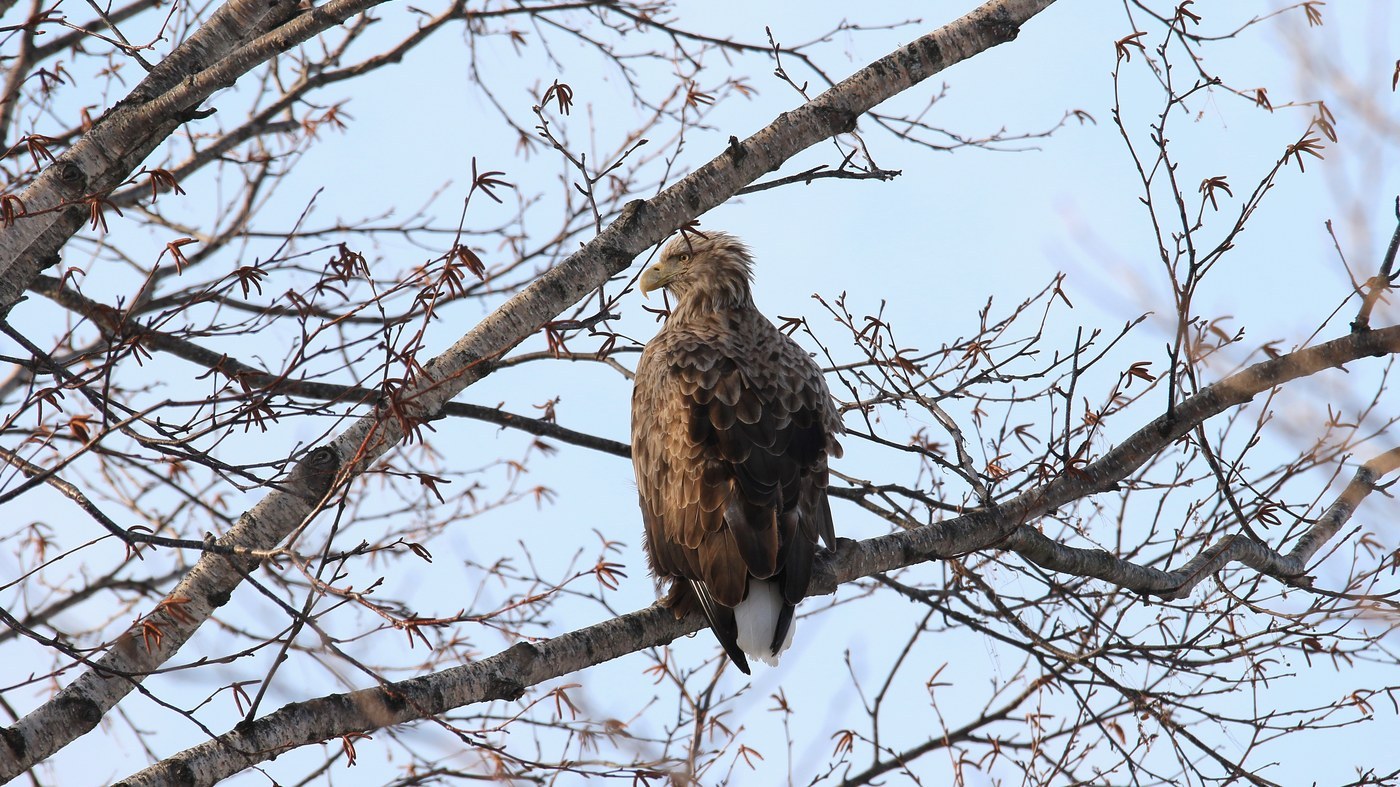
Key Field Marks
- Enormous raptor (76-92 cm long, wingspan up to 2.4 m), among the largest eagles in the world
- Broad, rectangular "flying-door" wings held flat or slightly bowed in flight
- Short, white wedge-shaped tail in adults, contrasting with the brown body
- Massive, pale yellow bill and yellow eye and legs
- Adults have a paler, buffy-white head and neck that can look almost hooded against the darker brown body
- Immatures are largely dark brown with mottled underwing coverts and a dark tail, gradually acquiring the white tail and pale head over 4-5 years
Similar Species
- Golden Eagle: has a longer, more rounded tail, fully feathered legs down to the toes, a golden nape patch, and narrower wings often held in a shallow V (dihedral) while soaring
- Bald Eagle: in areas of range overlap (e.g., far eastern Russia, occasionally Aleutians), adult Bald Eagle also has a white head and tail, but its tail is squarer (not wedge-shaped) and its bill is proportionately smaller and deeper yellow
- Overall structure — huge, barn-door wings plus a stubby wedge tail — separates White-tailed Eagle from all other regularly occurring Eurasian raptors
Behavior & Habitat
A powerful predator and scavenger of coasts, large lakes, and rivers, taking fish (often snatched from the surface with a low, direct flight), waterbirds, and carrion, including winter carcasses. It often perches conspicuously on shoreline trees, cliffs, or ice, and soars for long periods on flat wings.
Where & When to See It
Breeds across northern and central Eurasia from Greenland and Iceland through Scandinavia, Central Europe, Russia, and east to Japan and Korea, always near water. Northern populations are migratory or partially migratory, with wintering concentrations forming at ice-free lakes, rivers, and coasts, including well-known wintering sites in Japan (Hokkaido) and Central Europe.
Voice
A loud, far-carrying series of yelping barks, often rendered as klee-klee-klee or a shrill kri-kri-kri, given especially near the nest and during display flights.
Frequently asked questions
How can I tell White-tailed Eagle from Golden Eagle?
Look at the tail and wing shape: White-tailed Eagle has a short white wedge-shaped tail and broad rectangular wings, while Golden Eagle has a longer rounded tail, feathered legs, and narrower wings held in a shallow V.
How long does it take for a White-tailed Eagle to get its white tail?
About 4 to 5 years — juveniles are dark brown all over and gradually molt into the adult pattern of a whitish tail and paler head.
What habitat should I search for White-tailed Eagle?
Coastlines, large lakes, and major rivers, since fish and waterbirds make up much of its diet.
Are White-tailed Eagles migratory?
Northern and inland breeders often move south or to ice-free waters in winter, while some coastal populations are largely resident.