
White Stork Identification Guide
A very large, unmistakable white bird with black flight feathers, a long red bill and red legs, famous for its rooftop stick nests across rural Europe.
Read the full White Stork encyclopedia entry →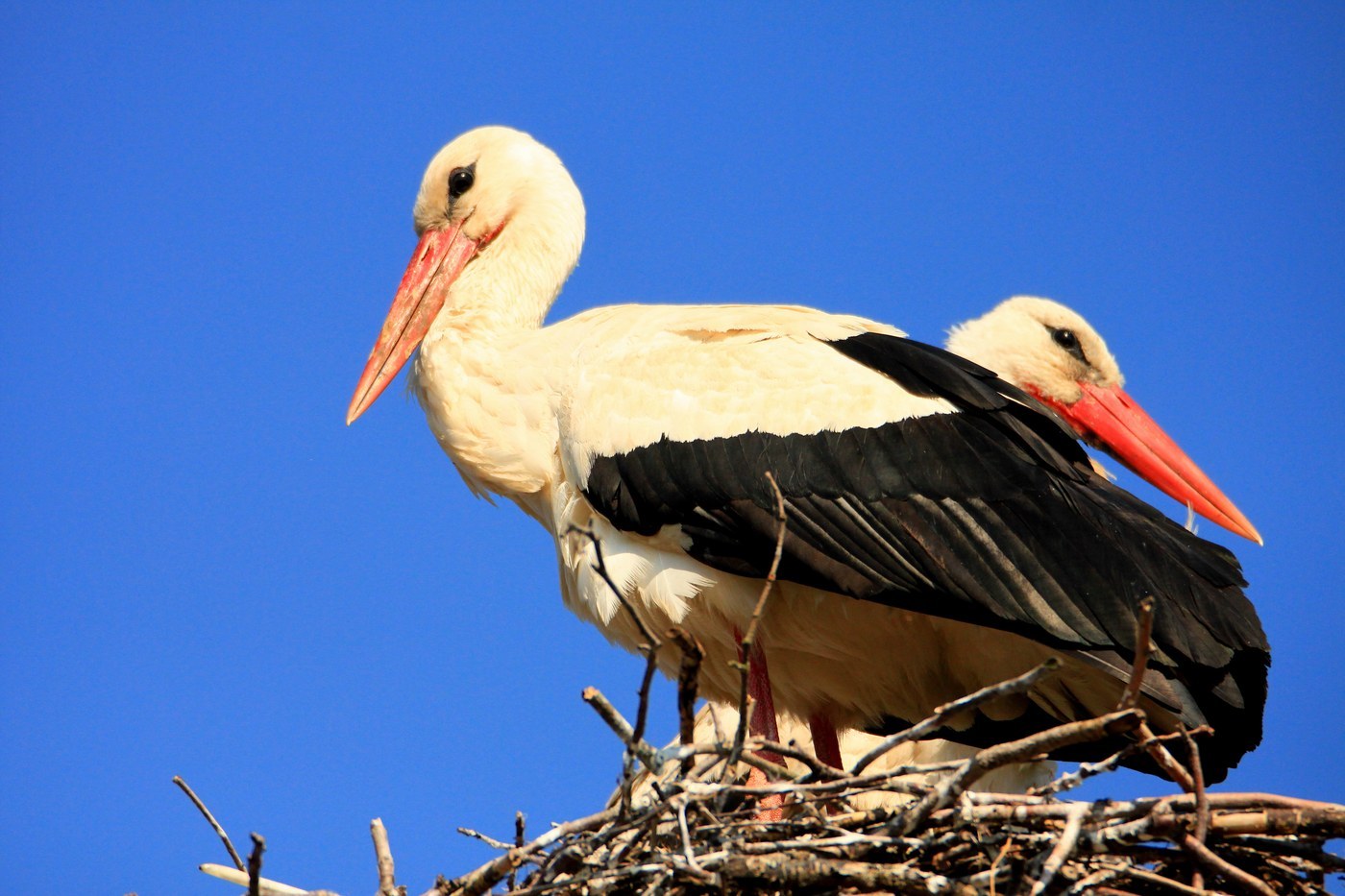
Key Field Marks
- Very large (100-115 cm tall, wingspan over 2 m), overall white body plumage
- Black flight feathers (primaries and secondaries) contrasting sharply with white coverts and body, most obvious in flight
- Long, straight, pointed red bill
- Long red legs, often visible as the bird wades or walks in fields
- Flies with neck and legs fully extended, not tucked in like a heron
Similar Species
- Black Stork: essentially the reverse pattern — mostly glossy black body with a white belly and undertail — and far less common near people
- Herons and egrets: white egrets are smaller, fly with the neck retracted in an S-curve, and have thinner, often yellow or dark bills rather than a stout red one
- Other storks (e.g., Yellow-billed Stork in Africa) have differently colored bills and more restricted ranges
- The combination of huge size, black-and-white wing pattern, and red bill/legs is unmistakable within its range
Behavior & Habitat
White Storks favor open country: wet meadows, farmland, marshes, and grasslands where they walk deliberately while probing for frogs, insects, small mammals, and other prey. They are strongly associated with humans, frequently nesting in large stick nests on rooftops, chimneys, utility poles, and purpose-built platforms in villages and towns. They are superb soaring migrants, riding thermals in large flocks on migration and largely avoiding long open-water crossings.
Where & When to See It
Breeds across much of Europe (especially Spain, Poland, Germany, and the Balkans), parts of the Middle East, and Central Asia. Nearly all populations are long-distance migrants, wintering in sub-Saharan Africa, with some birds now short-stopping in Iberia year-round due to milder winters and food availability. Look for breeding birds on nests from spring through summer, and for large migrating flocks moving through bottleneck points like the Bosphorus and Strait of Gibraltar in spring and autumn.
Voice
Adults are largely mute apart from hissing; the main sound produced is a loud bill-clattering display given at the nest, used in greeting and courtship between mates.
Frequently asked questions
What is the easiest way to tell White Stork from a white egret?
Size and flight posture: White Stork is much larger, flies with its neck outstretched rather than tucked in, and has a straight red bill instead of a thin yellow or dark one.
Does White Stork make any vocal sounds?
Adults rarely vocalize; instead they communicate mainly by loudly clattering their bills at the nest.
Where do European White Storks spend the winter?
Most migrate to sub-Saharan Africa, though a growing number now winter in Spain and Portugal, often near landfill sites and rice fields.
Where do White Storks build their nests?
On large stick platforms placed on rooftops, chimneys, utility poles, and specially erected nest platforms, often reused and enlarged year after year.