
White-plumed Honeyeater Identification Guide
A lively, olive-grey Australian honeyeater told from its close relatives by the crisp white plume behind the eye and its strong association with rivers and waterways.
Read the full White-plumed Honeyeater encyclopedia entry →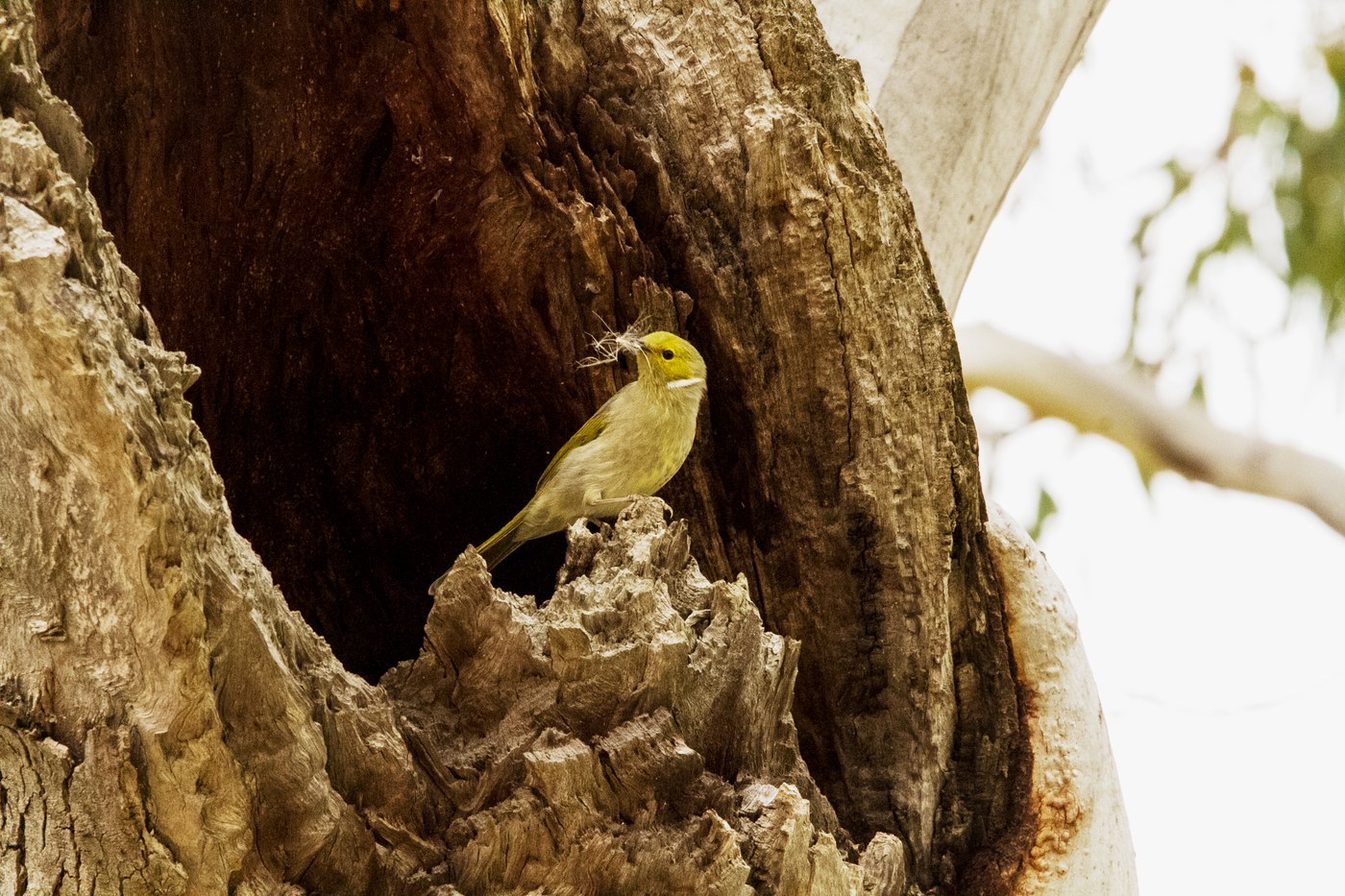
Key Field Marks
- Medium-sized honeyeater (about 18-21 cm)
- Olive-grey to olive-brown upperparts, paler yellowish-grey underparts
- Diagnostic narrow white plume, edged in black, running from behind and below the eye along the side of the neck
- Small yellow crescent of bare skin below the eye
- Slim, slightly downcurved black bill
Similar Species
- Yellow-plumed Honeyeater: the neck plume is yellow rather than white, and it favors drier mallee/woodland habitats further west and inland
- Grey-fronted Honeyeater: shows a grey forehead and lacks the crisp white plume
- Fuscous Honeyeater: overall duller, plain-faced, with no obvious neck plume
- The bright white ear/neck plume against olive-grey plumage separates this species from all other regularly overlapping honeyeaters
Behavior & Habitat
An active, often noisy honeyeater that forages at all levels from canopy to shrub layer for nectar, insects, and lerp. It has a strong affinity for watercourses, floodplain woodlands, and riverine River Red Gum forest, but also uses parks, gardens, and orchards, especially in inland areas — hence its old nickname "Riverina" bird in parts of its range.
Where & When to See It
Widespread across inland and eastern Australia, from southeastern Queensland through New South Wales, Victoria, and into South Australia, generally following major river systems and woodland belts. It is resident in many areas but can be locally nomadic, moving in response to flowering and water availability.
Voice
A loud, ringing, and variable song often rendered as "chick-o-wee" or repeated "witchy-witchy" phrases, along with sharp chattering contact calls given while foraging in groups.
Frequently asked questions
How do I tell White-plumed from Yellow-plumed Honeyeater?
Check the color of the neck plume: white in White-plumed Honeyeater, yellow in Yellow-plumed Honeyeater. Habitat also helps, as Yellow-plumed favors drier mallee country.
What habitat is most reliable for finding this species?
Riverine woodland and River Red Gum stands along inland waterways are the classic habitat, though it also visits parks and gardens.
Is White-plumed Honeyeater migratory?
It is mostly sedentary but can show local nomadic movements tied to flowering plants and water levels.
What does its call sound like?
A loud, ringing, variable song, often described as a bright 'chick-o-wee' or chattering 'witchy-witchy' series.