
White-necked Puffbird Identification Guide
A large, big-headed Neotropical puffbird with bold black-and-white plumage, often seen perched motionless for long periods on high, exposed branches.
Read the full White-necked Puffbird encyclopedia entry →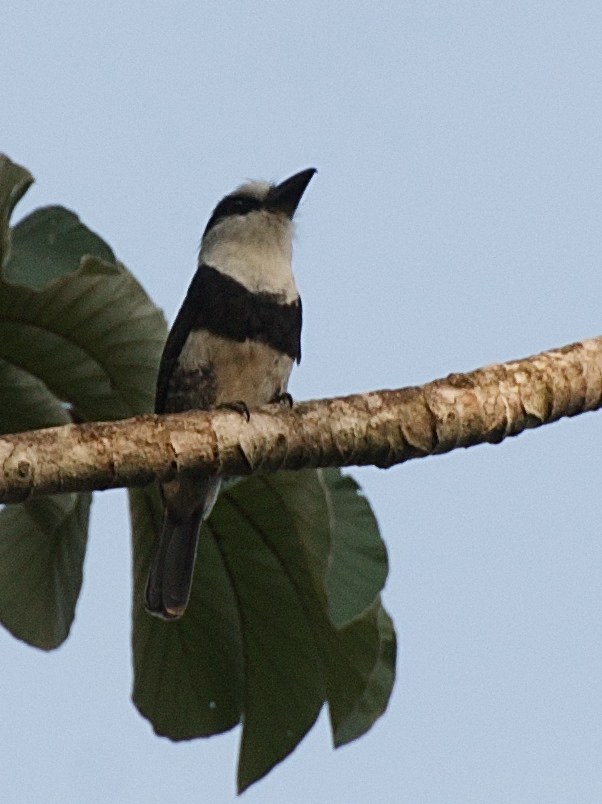
Key Field Marks
- Size & shape: A large puffbird, about 24-27 cm (9.5-10.5 in) long, with a notably large head, a heavy, hooked bill, and a stocky, big-headed, short-tailed silhouette typical of puffbirds.
- Plumage: Bold black-and-white pattern; glossy black upperparts, crown, and a black band across the upper breast, contrasting with a white forehead, collar, throat, and underparts.
- Face: White forehead and a broad white collar around the nape and sides of the neck give the species its name.
- Bill: Heavy, black, and hooked at the tip, well suited for capturing large insects.
- Posture: Often sits bolt upright and motionless for extended periods, a hallmark puffbird behavior.
Similar Species
- Pied Puffbird: Much smaller with a shorter bill and different proportions, lacking the bold white collar of White-necked Puffbird.
- Black-breasted Puffbird: Similar black-and-white pattern but generally smaller and with a narrower breast band; ranges may overlap in parts of Central America.
- Buff-bellied Puffbird: Has warm buffy underparts rather than crisp white, and a browner overall tone, distinguishing it from the cleaner black-and-white White-necked Puffbird.
Behavior
- A classic "sit-and-wait" predator, perching motionless on an exposed high branch for long stretches while scanning for prey, then sallying out to catch large insects, lizards, or even small vertebrates.
- Often returns to the same favored perch repeatedly after a successful or unsuccessful sally.
- Generally solitary or in pairs, and can be inconspicuous despite its bold plumage due to its still, quiet habits.
Habitat & Range
- Ranges from southern Mexico through Central America into much of South America, including Amazonia.
- Found in forest edges, gallery forest, savanna with scattered trees, and semi-open woodland, typically favoring the canopy and high exposed perches rather than deep forest interior.
Voice
- Gives a distinctive, far-carrying, mournful whistled song, often a series of clear whistled notes; relatively vocal at dawn.
- Also gives shorter chattering or grating calls.
Seasonal Notes
- Resident throughout its range without significant migratory movement.
- Because of its still, statue-like perching habit, it is often detected first by voice or by scanning high dead or bare branches at forest edges and clearings rather than by movement.
Frequently asked questions
What is the best way to identify a White-necked Puffbird?
Look for a large-headed, black-and-white bird with a white forehead and broad white collar, typically perched motionless on a high exposed branch.
How does the White-necked Puffbird differ from the Pied Puffbird?
White-necked Puffbird is noticeably larger with a heavier bill and a bold white collar, while Pied Puffbird is smaller and lacks that collar.
Why is the White-necked Puffbird hard to spot despite its bold pattern?
It perches motionless for long periods, often high in the canopy, so despite its contrasting plumage it can blend into the scene until it moves or calls.
What does the White-necked Puffbird eat?
Large insects, and occasionally small lizards or other small vertebrates, caught by sallying from a perch.
What habitat does the White-necked Puffbird prefer?
Forest edges, gallery forest, and semi-open woodland with scattered tall trees, from southern Mexico through much of South America.