
White-necked Jacobin Identification Guide
A striking Neotropical hummingbird, males showing a deep blue head, white belly and tail, and a broad white nape band, while females display more variable plumage.
Read the full White-necked Jacobin encyclopedia entry →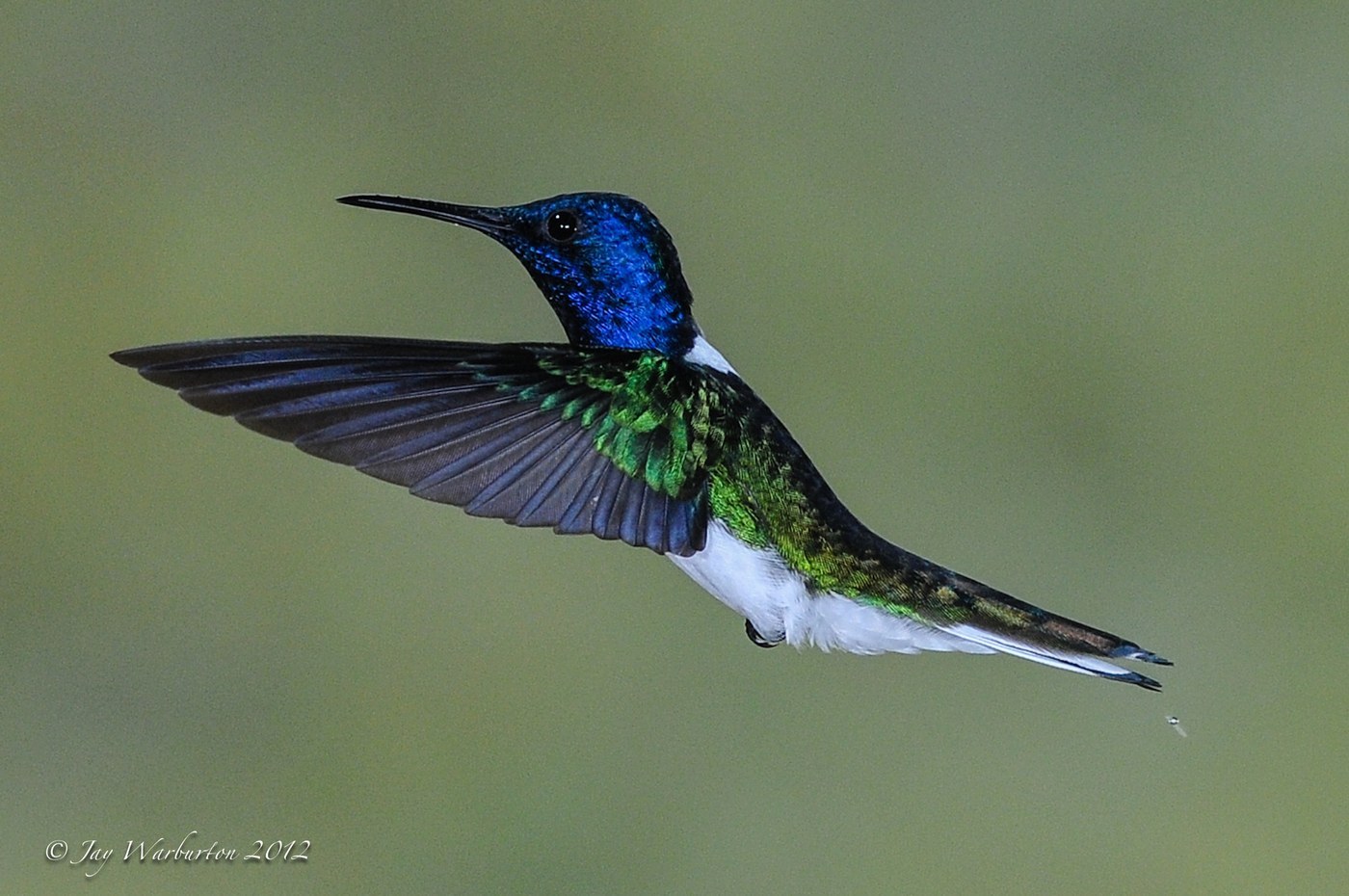
Key Field Marks
- Size & shape: A relatively large, robust hummingbird about 11-12 cm (4.5 in) long, with a fairly straight, medium-length bill.
- Adult male: Rich deep blue-violet head and throat, a bold white band across the back of the neck (the "jacobin" collar), a white belly, and a mostly white tail with a dark central band.
- Adult female: More variable; typically green above with a scaly green-and-white throat and breast, and a white-cornered tail, though some females can show male-like plumage (a form of polymorphism unusual among hummingbirds).
- Wings: Relatively long and pointed for a hummingbird, contributing to fast, direct flight.
Similar Species
- Male White-necked Jacobins are fairly distinctive within range due to the combination of blue head, white nape band, and white belly/tail; few other hummingbirds combine all these features.
- Female/immature birds can resemble other green-backed hummingbirds with scaled underparts, such as certain mango or emerald species, but the white-cornered tail and relatively large size help distinguish them.
- Female-plumaged males: Some adult male White-necked Jacobins retain female-like plumage even as adults, a genuine identification pitfall; behavior (dominance at flowers) and structural size can help but definitive identification may require close observation.
Behavior
- Aggressive and dominant at flowering trees and feeders, often chasing off smaller hummingbird species.
- Feeds at a wide variety of flowering trees, shrubs, and vines, as well as visiting hummingbird feeders in gardens.
- Frequently forages higher in the canopy of flowering trees compared to some understory hummingbird species, though it also readily visits lower flowers and feeders.
Habitat & Range
- Found from southern Mexico through Central America and into South America as far as Brazil and Bolivia, generally in lowland and foothill regions.
- Inhabits forest edges, clearings, second growth, plantations, and gardens; generally avoids deep, unbroken interior forest.
Voice
- Calls include high, thin squeaky and chattering notes typical of hummingbirds, given especially during aggressive interactions at feeding sites.
Seasonal Notes
- Resident across most of its range, without strong long-distance migration, though local movements may track flowering seasons.
- Because of its aggressive nature and habitat use, it is often one of the most conspicuous and frequently observed hummingbirds at flowering trees and feeders within its range.
Frequently asked questions
What is the key field mark for a male White-necked Jacobin?
A deep blue head and throat, a bold white band across the back of the neck, and a mostly white belly and tail.
Do all White-necked Jacobins look the same?
No, females are more variable and typically green with a scaly throat, though some adult females can show male-like blue-and-white plumage, an unusual trait among hummingbirds.
Where does the White-necked Jacobin live?
Lowland and foothill regions from southern Mexico through Central America to Brazil and Bolivia, in forest edges, clearings, and gardens.
Is the White-necked Jacobin aggressive at feeders?
Yes, it is known for being dominant and often chases smaller hummingbirds away from flowers and feeders.
Does the White-necked Jacobin migrate?
It is largely resident, though it may shift locally in response to flowering patterns.