
White-naped Crane Identification Guide
A large, elegant East Asian crane with a gray body, a red-and-white face, and a striking white stripe running down the back of the neck.
Read the full White-naped Crane encyclopedia entry →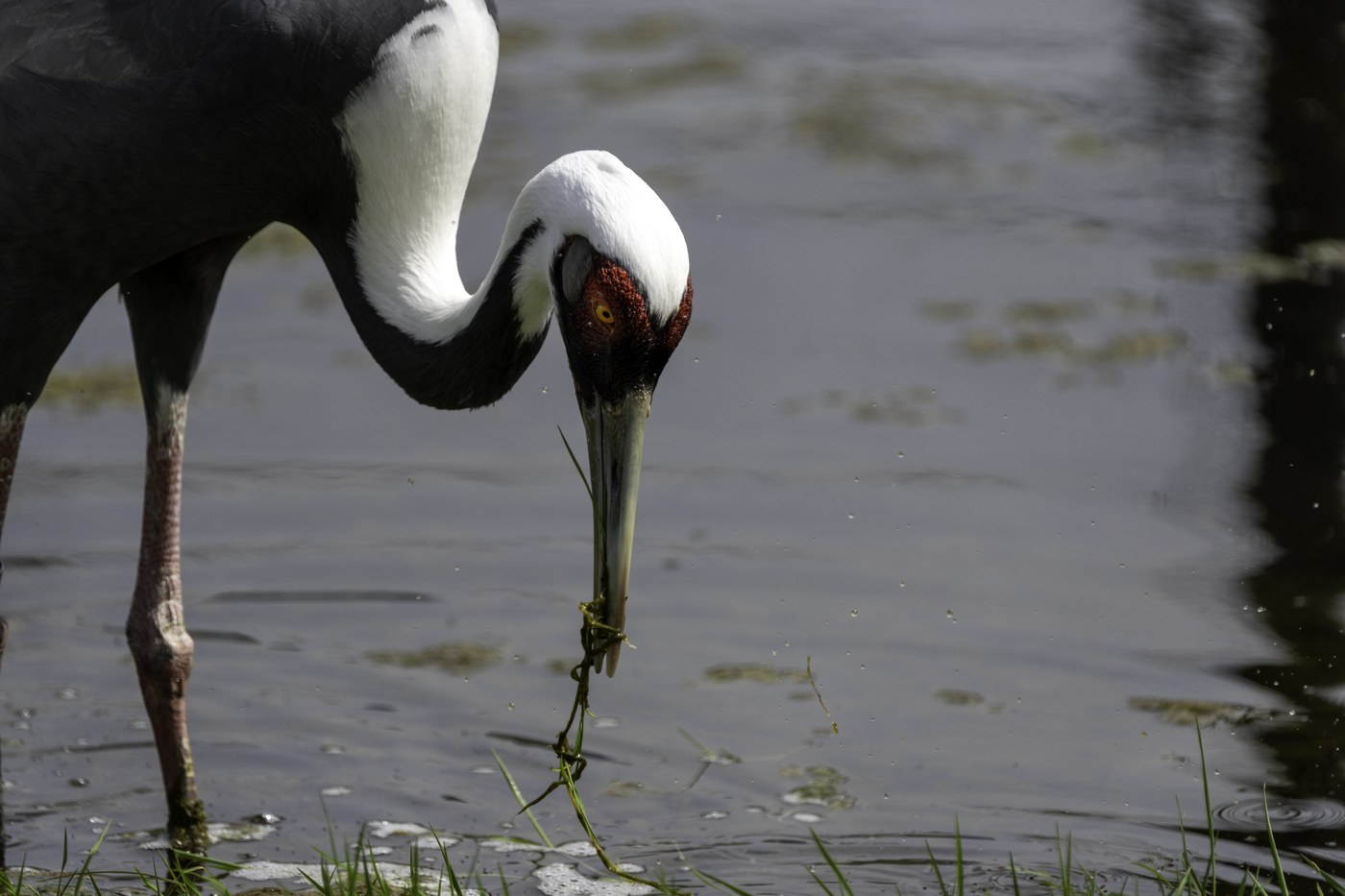
Key Field Marks
- Size & shape: A large crane, standing about 130 cm (51 in) tall, with long legs, a long neck, and the elegant upright posture typical of cranes.
- Head and neck: Red bare skin around the eye, a whitish forehead and throat, and a distinctive broad white stripe running down the back of the neck, contrasting with a darker gray foreneck.
- Body: Overall slate-gray plumage with a darker gray, almost blackish, primaries and secondaries visible in flight.
- Legs: Pinkish to reddish legs, distinctive among gray-bodied cranes.
- Bill: Yellowish-green, relatively long and straight.
Similar Species
- Sarus Crane: Overall grayer with an all-red head and upper neck (no white nape stripe), and found in South and Southeast Asia rather than the White-naped Crane's East Asian range.
- Common Crane: Has a black-and-white head/neck pattern with a red crown patch but a mostly black neck, lacking the white nape stripe and pink legs of White-naped Crane.
- Hooded Crane: Much smaller, with an all-white head and neck contrasting with a dark gray body, quite different overall pattern.
Behavior
- Forages by probing and picking at wetlands, grasslands, and agricultural fields for roots, tubers, grain, and small animals.
- Performs elaborate dancing displays involving bowing, leaping, and calling, especially during courtship.
- Migrates in flocks, often flying in V-formation between breeding and wintering grounds.
Habitat & Range
- Breeds in wetlands and grasslands of Mongolia, northeastern China, and far eastern Russia.
- Winters primarily in South Korea's Demilitarized Zone area, Japan (notably Izumi), and parts of eastern China, using wetlands, rice paddies, and river floodplains.
- A globally vulnerable species due to wetland habitat loss along its migratory and wintering range.
Voice
- Gives loud, far-carrying trumpeting calls, often in duet between paired birds, typical of the resonant vocalizations produced by cranes' elongated tracheas.
Seasonal Notes
- Best looked for on wintering grounds in South Korea and Japan from late autumn through early spring, where flocks can gather in impressive numbers at traditional sites.
- On breeding grounds in Mongolia and northeastern China, pairs are more dispersed and territorial during the spring and summer breeding season.
Frequently asked questions
What is the most distinctive feature of the White-naped Crane?
A broad white stripe running down the back of the neck, combined with red facial skin and pinkish legs, set against gray body plumage.
How does the White-naped Crane differ from the Sarus Crane?
Sarus Crane has an entirely red head and upper neck with no white nape stripe, and occurs in South and Southeast Asia rather than East Asia.
Where is the best place to see White-naped Cranes in winter?
Traditional wintering sites in South Korea and Izumi, Japan, host large concentrations from late autumn through early spring.
Is the White-naped Crane endangered?
It is considered globally vulnerable, primarily due to loss and degradation of wetland habitat across its breeding, migration, and wintering range.
What does the White-naped Crane eat?
A varied diet of roots, tubers, grain, and small animals obtained by probing and picking in wetlands and agricultural fields.