
White Ibis Identification Guide
A familiar all-white American wading bird with a long, decurved orange-red bill and matching legs, often seen probing lawns and marshes in noisy flocks.
Read the full White Ibis encyclopedia entry →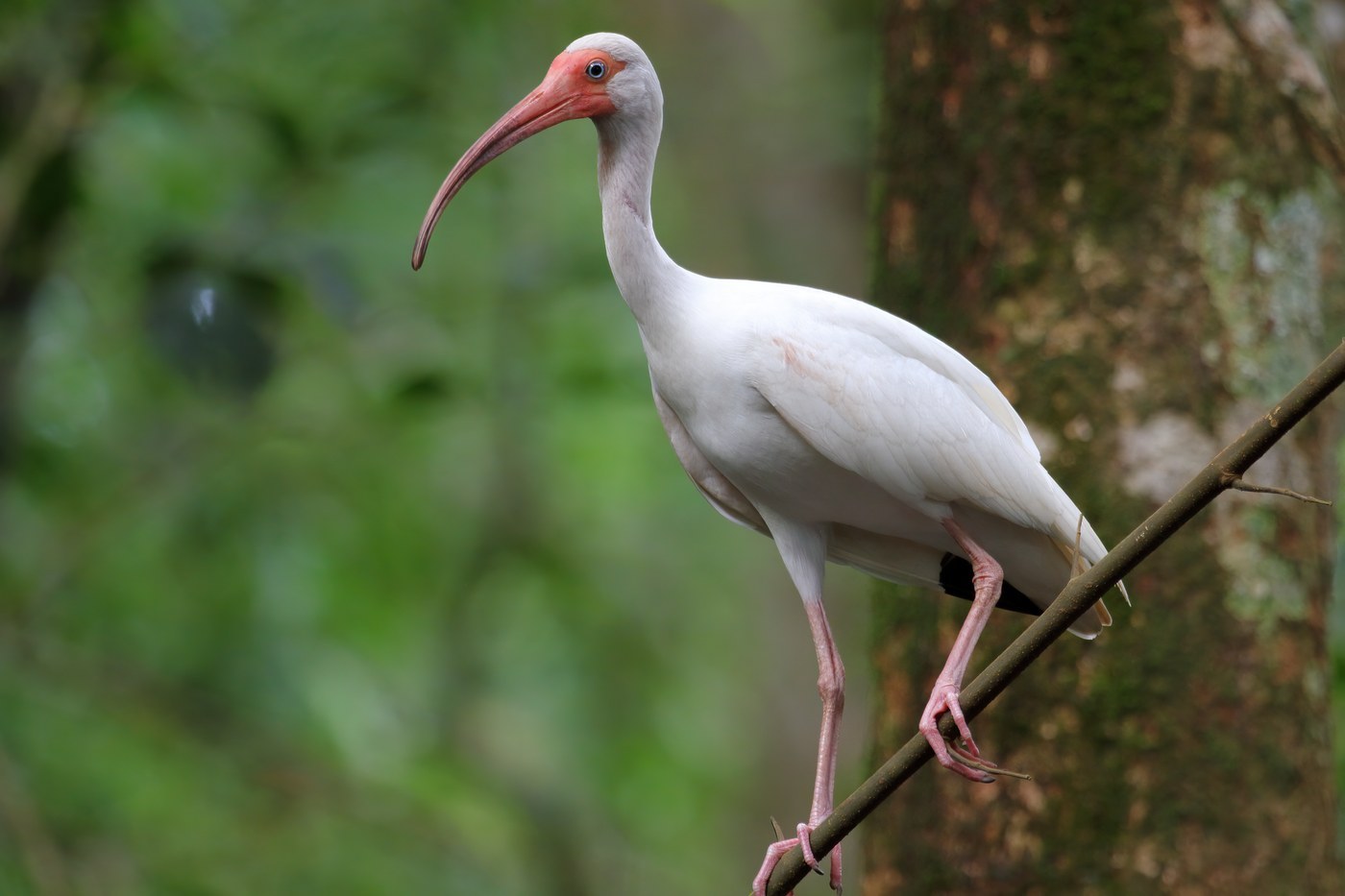
Key Field Marks
- Size & shape: A medium-large wading bird, about 56-68 cm (22-27 in) long, with a long, strongly downcurved bill and long legs typical of ibises.
- Adult plumage: Entirely white body with black wingtips visible only in flight; at rest, the bird appears completely white.
- Bill and legs: Bright orange-red to pinkish-red bill and legs in adults, intensifying to deep red/pink during breeding season, along with bare facial skin of the same color.
- Juveniles: Mostly brown above with a white belly and rump, and a duller, pinkish-brown bill; gradually molt to full white adult plumage over about two years.
Similar Species
- Snowy Egret: All white but has a slender straight black bill and yellow feet, quite different from the ibis's long curved orange bill.
- Great Egret: Much larger, with a straight yellow bill, not decurved.
- Wood Stork: Larger, with a heavy down-curved bill but a dark, unfeathered head and neck, and black flight feathers/tail visible in flight, unlike the ibis's mostly white wings with only black tips.
- Juvenile White Ibis vs. juvenile Glossy/White-faced Ibis: Juvenile White Ibis has a white belly and rump contrasting with brown upperparts, unlike the more uniformly dark juveniles of Glossy or White-faced Ibis.
Behavior
- Forages by probing in shallow water, mud, and even lawns with its long bill, feeling for crustaceans, insects, and other invertebrates rather than relying on sight alone.
- Highly social, feeding, roosting, and nesting in large flocks and colonies, often alongside herons, egrets, and spoonbills.
- Adaptable to urban and suburban settings, frequently seen foraging on golf courses, parks, and residential lawns in Florida and along the Gulf Coast.
Habitat & Range
- Common throughout the southeastern United States, especially Florida, the Gulf Coast, and the Atlantic coastal plain, as well as the Caribbean, Mexico, and parts of Central America.
- Uses coastal marshes, mangroves, freshwater wetlands, flooded fields, and increasingly urban green spaces.
Voice
- Generally quiet, but gives low, grunting or honking notes especially at breeding colonies and in flight.
Seasonal Notes
- Largely resident in the core of its range, though northern populations may shift south in winter.
- Breeding colonies are active in spring and summer, when adults show their most vivid red bill, legs, and facial skin coloration.
Frequently asked questions
How can I tell a White Ibis from a Snowy Egret?
White Ibis has a long, strongly downcurved orange-red bill, while Snowy Egret has a straight, slender black bill and yellow feet.
Why do some 'White Ibis' I see look brown?
Those are juveniles, which are brown above with a white belly and rump; they gain full white adult plumage over about two years.
Where are White Ibis most commonly seen?
They are especially common and conspicuous in Florida and along the Gulf Coast, often foraging on lawns, golf courses, and in marshes.
What does the White Ibis eat?
Mainly crustaceans such as crayfish, along with insects and other small invertebrates, located by probing with its bill.
Does the White Ibis have black on its wings?
Yes, adults show black wingtips visible in flight, though the bird appears entirely white when perched or standing.