
White-headed Woodpecker Identification Guide
A distinctive black-bodied woodpecker of western pine forests, instantly recognizable by its entirely white head and, in males, a small red patch on the nape.
Read the full White-headed Woodpecker encyclopedia entry →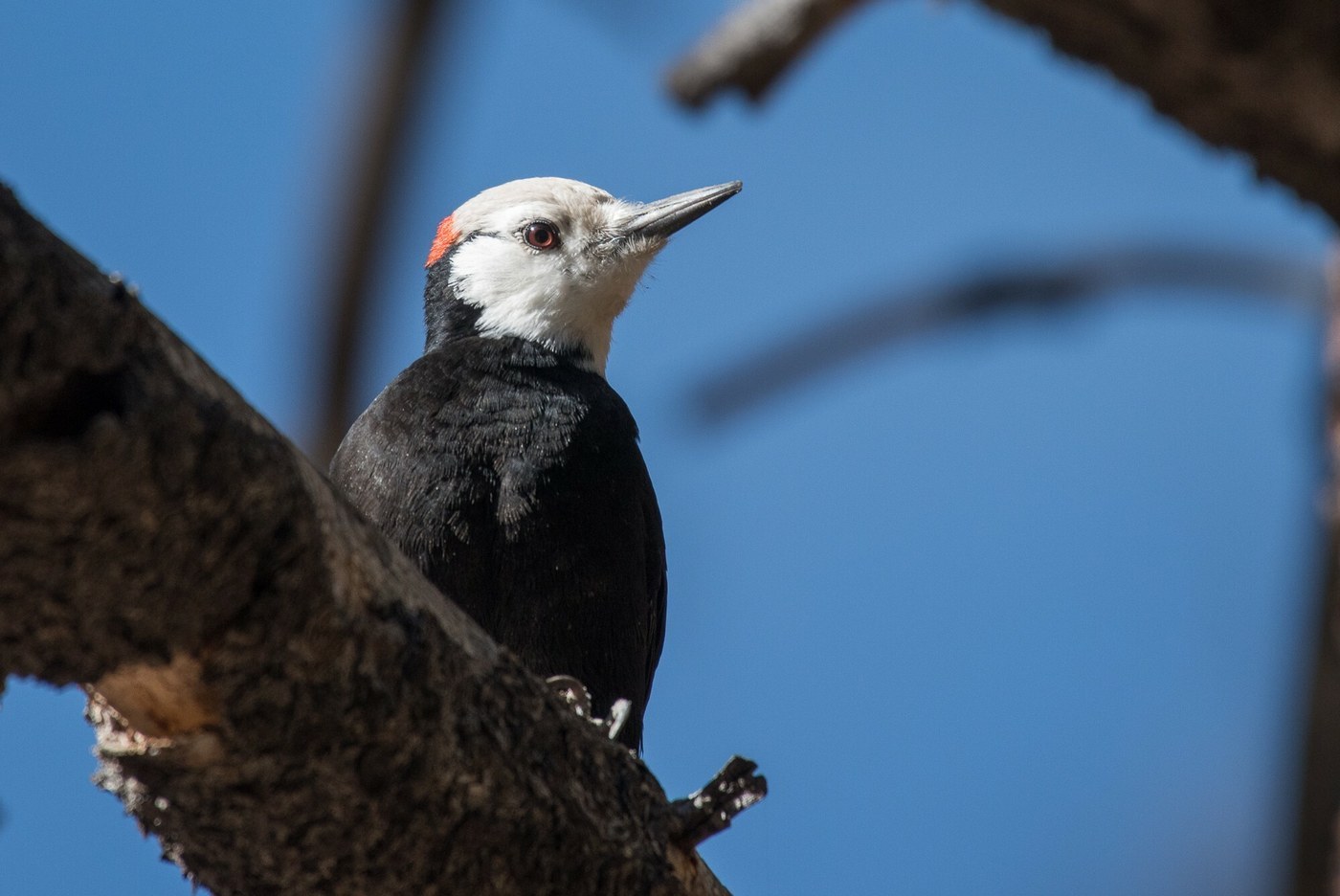
Key Field Marks
- Size & shape: A medium-sized woodpecker, about 20-23 cm (8-9 in), with the stout, straight bill and stiff-tailed posture typical of woodpeckers.
- Head: Entirely clean white head, unmarked by any dark stripes, unique among North American woodpeckers.
- Body: Glossy black overall body plumage.
- Wings: Small white patch at the base of the primaries, visible as a flash in flight or when the wing is folded.
- Sex differences: Males show a small red patch on the nape/rear crown; females lack any red and have an entirely white head.
Similar Species
- No other North American woodpecker has an entirely white head combined with an otherwise black body, making this species essentially unmistakable within its range.
- Leucistic or partially white-headed individuals of other woodpecker species are exceedingly rare and would lack the clean white wing patch and correct habitat/range context.
Behavior
- Forages distinctively by flaking bark off of pine cones and trunks rather than excavating deeply, often clinging to cone clusters to extract seeds.
- Frequently forages lower on tree trunks or on fallen logs compared to many other woodpeckers.
- Non-migratory and often remains on territory year-round, closely tied to mature pine forest.
Habitat & Range
- Resident of montane pine forests in the western United States, especially areas dominated by ponderosa pine, Jeffrey pine, and sugar pine, from Washington and Oregon south through California and into the Sierra Nevada and parts of Idaho and Nevada.
- Strongly associated with open, mature pine forest with large cone-bearing trees; less common in dense, young, or mixed forest lacking large pines.
Voice
- Calls include a sharp "peek" or "pitik" note, similar in quality to calls of other Picoides-type woodpeckers but often given singly or in short series.
- Drumming is a relatively soft, steady roll compared to some larger woodpeckers.
Seasonal Notes
- Present year-round within its restricted range; look for it wherever mature, cone-bearing pines are abundant, particularly in old-growth or open, park-like pine stands.
- Because it depends on large pine cones for a major part of its diet, local abundance can track cone crop cycles from year to year.
Frequently asked questions
What makes the White-headed Woodpecker easy to identify?
It is the only North American woodpecker with an entirely white, unmarked head combined with a black body, making it essentially unmistakable.
How do I tell a male from a female White-headed Woodpecker?
Males have a small red patch on the nape; females lack any red and have a completely white head.
What habitat should I search for White-headed Woodpeckers?
Mature, open pine forests, especially those with ponderosa, Jeffrey, or sugar pine, in the mountains of the western United States.
What does the White-headed Woodpecker eat?
Pine seeds extracted from cones by flaking off bark and cone scales, along with insects found on bark and cones.
Does the White-headed Woodpecker migrate?
No, it is a non-migratory, resident species that stays on territory year-round within its pine forest range.