
White-faced Ibis Identification Guide
A glossy, dark reddish-bronze ibis of American wetlands, best distinguished from the similar Glossy Ibis by its reddish eye, pink facial skin, and red legs in breeding plumage.
Read the full White-faced Ibis encyclopedia entry →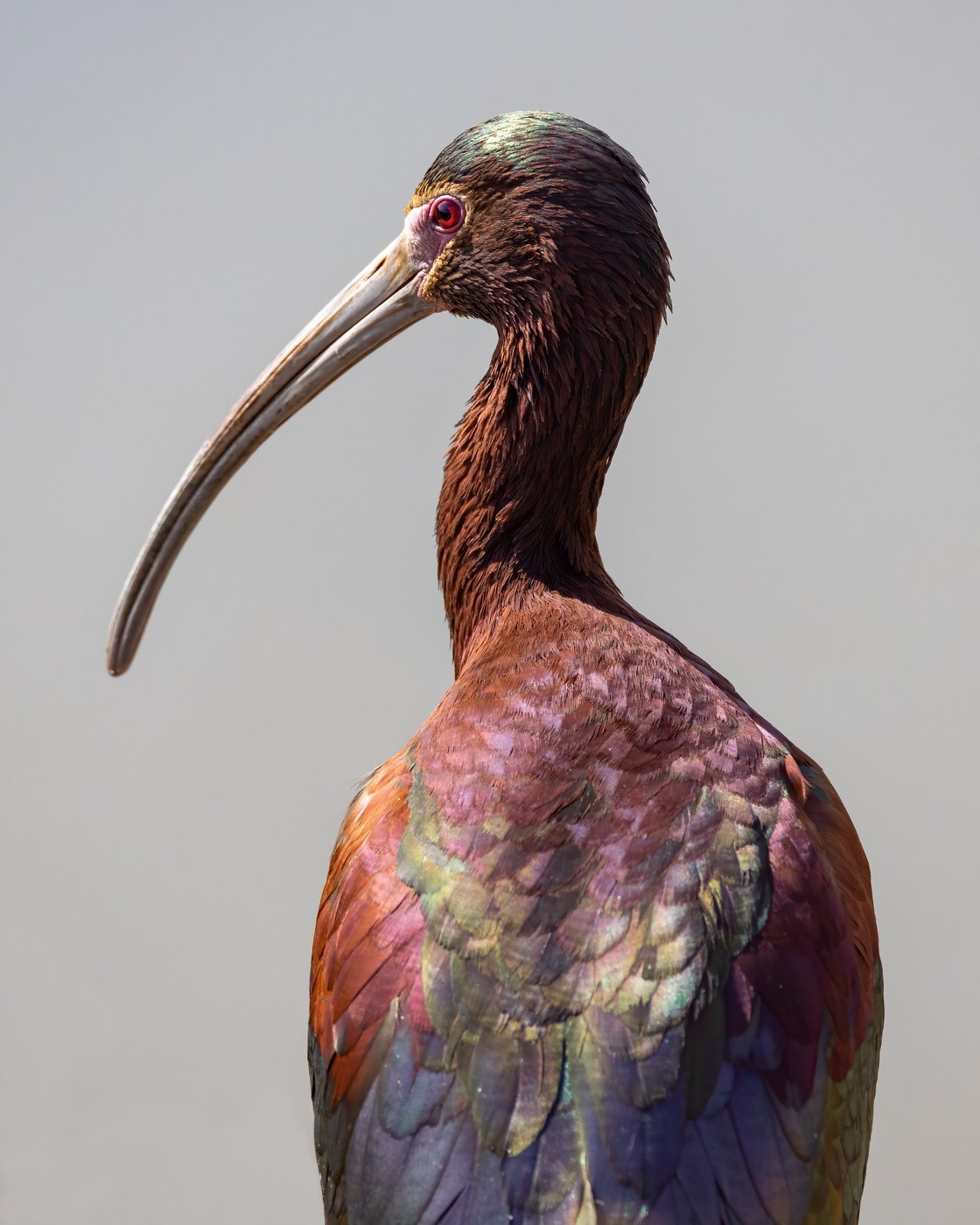
Key Field Marks
- Size & shape: A medium-large wading bird, about 46-56 cm (18-22 in) long, with a long, decurved bill and long legs, typical ibis proportions.
- Plumage: Rich, iridescent chestnut-maroon body with green and bronze-purple gloss on the wings and back, appearing dark at a distance but glowing with color in good light.
- Face: In breeding adults, a narrow band of pinkish-red bare skin borders the base of the bill and eye, edged by a thin white feathered border, giving the species its name.
- Eye and legs: Red or reddish-brown iris and reddish legs in breeding condition, becoming duller (dark eye, gray-brown legs) in non-breeding birds and juveniles.
- Bill: Long, downcurved, dull grayish-brown to pinkish.
Similar Species
- Glossy Ibis: Extremely similar; best separated in breeding plumage by facial skin color, blue-gray bordered by thin blue lines (not pink/red bordered by white) in Glossy Ibis, and by dark (not red) legs and a brown (not red) eye. Ranges overlap in the central and eastern U.S.
- White Ibis: Adult is entirely white with black wingtips and an orange-red bill and legs, very different from the dark plumage of White-faced Ibis; only immature White Ibis (brownish) could cause brief confusion, but it has a white belly and rump.
- Non-breeding/juvenile birds: Glossy and White-faced Ibis are notoriously difficult to separate outside breeding plumage; leg color, facial skin extent, and range/habitat are the best clues, and some individuals may not be safely identifiable.
Behavior
- Forages by probing mud and shallow water with its long bill, often wading in flocks in marshes and flooded fields.
- Highly social, roosting, foraging, and flying in tight flocks, often mixed with other ibis or wading bird species.
- Flies with neck and legs outstretched, alternating flaps and glides, often in coordinated flock formation.
Habitat & Range
- Breeds in freshwater marshes across the western United States, the Great Plains, and parts of the Great Basin and Central Valley, with additional populations in South America.
- Winters along the Gulf Coast, in California, Mexico, and Central America.
- Uses marshes, wet meadows, flooded agricultural fields (especially rice fields), and shallow lake margins.
Voice
- Generally quiet, but gives low, nasal, grunting or oinking calls, especially around breeding colonies.
Seasonal Notes
- Breeding plumage with the bright facial skin and red legs/eye is best seen in spring and early summer at nesting colonies.
- Outside the breeding season, plumage becomes duller and facial skin less colorful, making identification from Glossy Ibis more challenging; check range, as White-faced Ibis dominates in the west while Glossy Ibis is more common in the east.
Frequently asked questions
How do I tell White-faced Ibis from Glossy Ibis?
In breeding plumage, White-faced Ibis has pink-red facial skin bordered by white feathering, red legs, and a red eye, while Glossy Ibis has blue-gray facial skin bordered by thin blue lines, dark legs, and a brown eye.
Is it possible to reliably separate non-breeding White-faced and Glossy Ibis?
It can be very difficult; non-breeding and juvenile birds often require close study of leg color, facial skin pattern, and range, and some individuals remain unidentifiable to species in the field.
What habitat does the White-faced Ibis prefer?
Freshwater marshes, wet meadows, and flooded agricultural fields such as rice fields, primarily in the western United States.
Does the White-faced Ibis look black from a distance?
Yes, its glossy chestnut-and-green plumage can appear uniformly dark or blackish in poor light, with the iridescent colors only visible in good lighting.
When is the best time to see breeding-plumage White-faced Ibis?
Spring through early summer, when adults show their brightest facial skin color and red legs at breeding colonies.