
White-eyed Vireo Identification Guide
A small, feisty North American vireo of dense thickets, identified by its pale iris, yellow spectacles, and bold yellow wingbars.
Read the full White-eyed Vireo encyclopedia entry →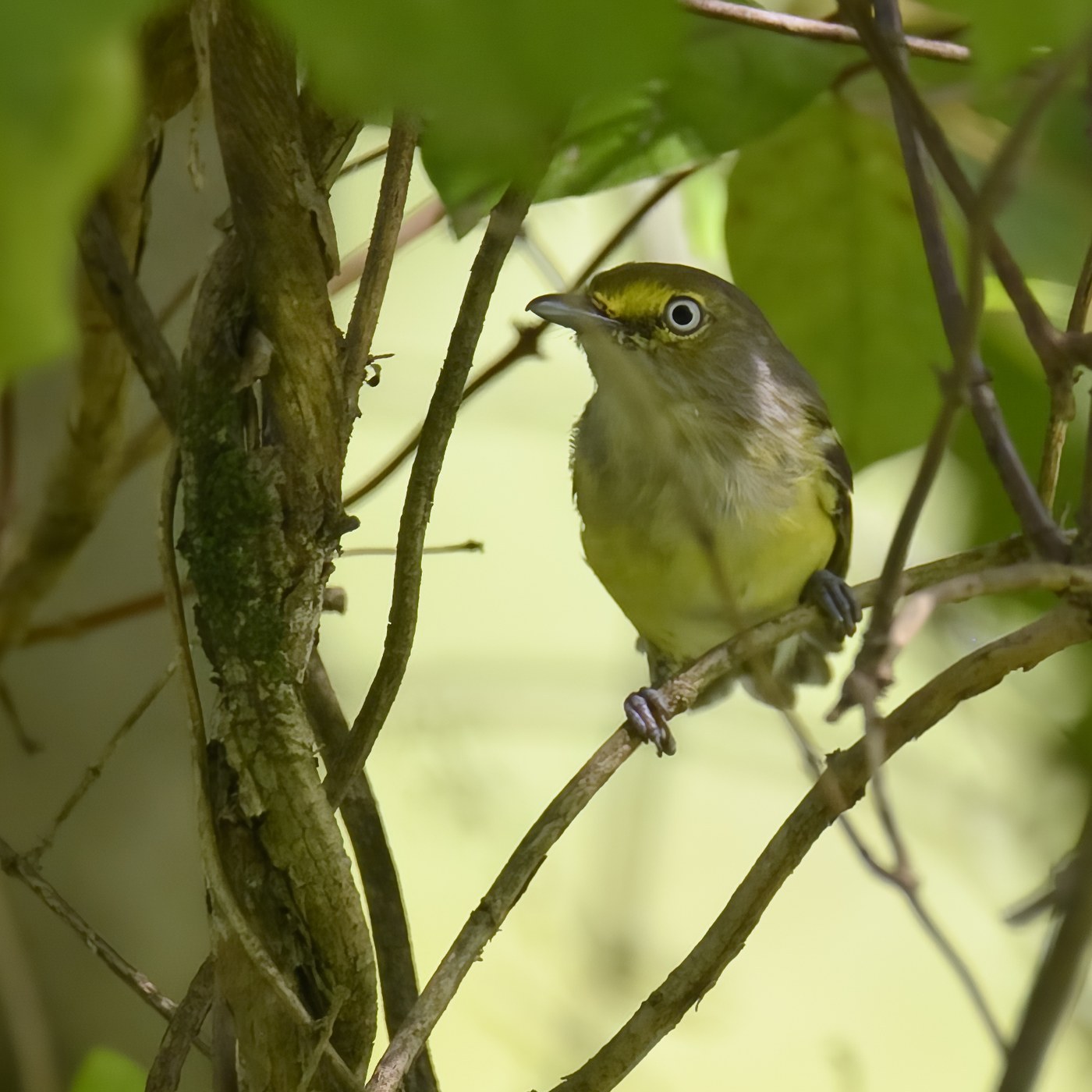
Key Field Marks
- Size & shape: A small, compact vireo about 12-13 cm (5 in) long, with a stout, slightly hooked bill and a relatively short tail.
- Eye: The namesake whitish-gray iris is distinctive in adults, standing out against the face, though it can be hard to see in poor light or on young birds (which have dark eyes).
- Face: Bright yellow "spectacles" formed by yellow lores and an eye-ring encircling the pale eye.
- Upperparts: Olive-green back and crown; two bold whitish to pale yellow wingbars on dark wings.
- Underparts: Whitish throat and belly with yellowish flanks and sides.
Similar Species
- Bell's Vireo: Duller overall, with a dark eye, weaker or single wingbar, and less contrasting spectacles; found in different, more arid brushy habitat in the west.
- Yellow-throated Vireo: Has a bright yellow throat and breast (not just flanks) and yellow spectacles, but lacks the pale eye and has a heavier build.
- Warbling Vireo: Lacks wingbars entirely, has a dark eye, and a plainer face pattern without yellow spectacles.
Behavior
- Skulking and often heard more than seen, staying low and hidden within dense tangles and thickets.
- Sings persistently, even during the heat of the day, often from cover.
- Aggressive and vocal when disturbed, giving a scolding, harsh chatter if an observer pishes or approaches a nest.
Habitat & Range
- Breeds across the eastern and southeastern United States, favoring overgrown fields, brushy edges, second-growth thickets, and shrubby wetland margins.
- Winters mainly in the Gulf Coast states, Mexico, Central America, and the Caribbean.
- Prefers dense, low, tangled vegetation rather than tall forest canopy.
Voice
- Song is a sharp, variable phrase often rendered as "chick-a-per-weeoo-chick," starting and ending with a distinctive sharp "chick" note.
- Known for incorporating mimicry of other bird species' calls into its song.
- Alarm call is a harsh, scolding mew or chatter.
Seasonal Notes
- Look and especially listen for this species in dense brush during the breeding season (spring through summer) across its eastern range.
- During migration and winter in the Gulf Coast and farther south, it remains a skulking thicket-dweller, best detected by voice.
Frequently asked questions
What is the most reliable way to identify a White-eyed Vireo?
Listen for its sharp, distinctive song starting and ending with a 'chick' note, and look for the pale (whitish) eye and bright yellow spectacles when visible.
How do White-eyed and Bell's Vireos differ?
White-eyed Vireo has a pale eye, bold double wingbars, and bright yellow spectacles, while Bell's Vireo is duller, has a dark eye, and weaker wingbars.
Why is the White-eyed Vireo hard to see?
It stays low in dense thickets and tangled brush, often remaining hidden even while singing loudly.
Do juvenile White-eyed Vireos have white eyes?
No, young birds have dark eyes; the pale iris develops as they mature.
Where should I look for White-eyed Vireos?
Overgrown fields, brushy forest edges, and dense second-growth thickets in the eastern and southeastern United States during the breeding season.