
White-eared Bulbul Identification Guide
A common Middle Eastern and South Asian bulbul with a black crested head, a bold white cheek patch, and bright yellow undertail coverts.
Read the full White-eared Bulbul encyclopedia entry →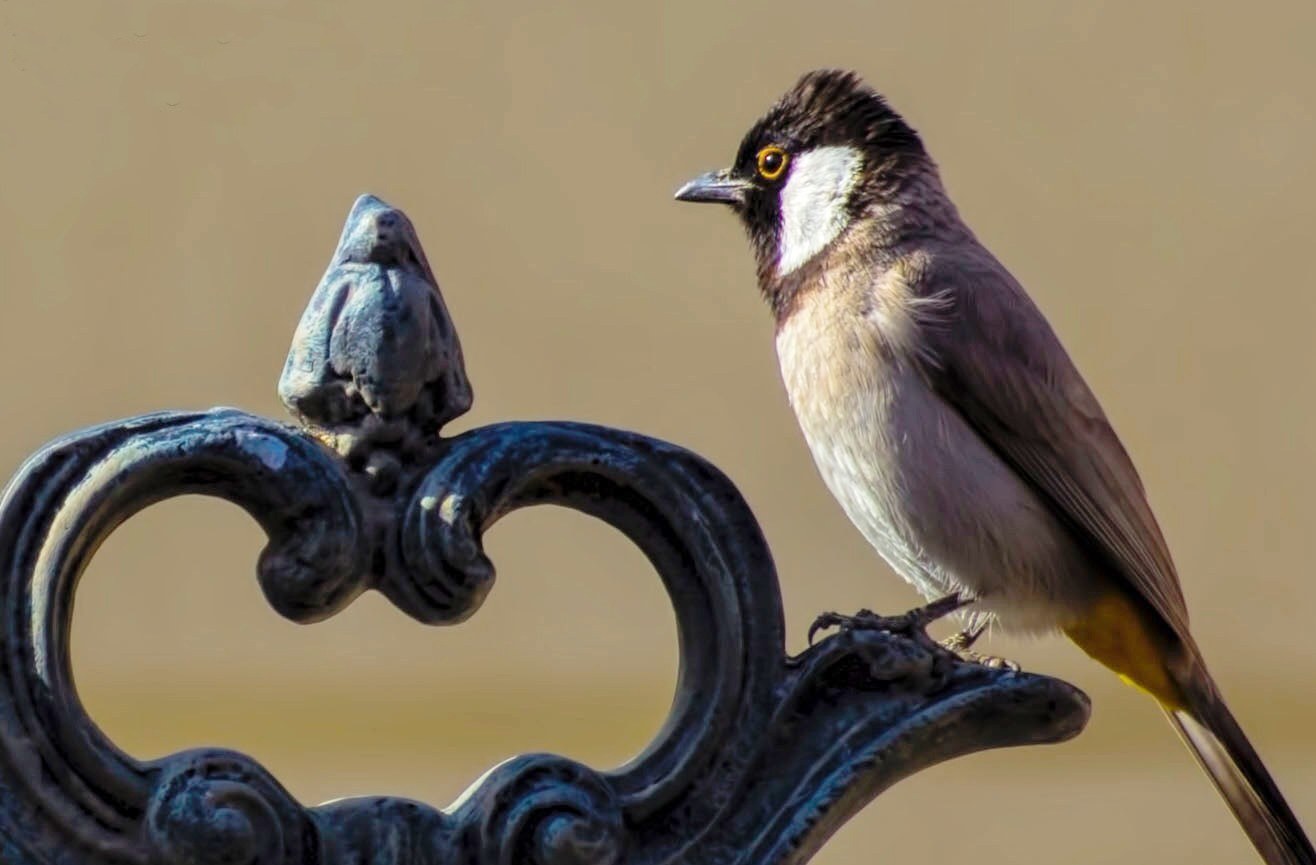
Key Field Marks
- Size & shape: A medium-sized songbird, about 18-20 cm (7-8 in), with a slight crest and a slender, slightly downcurved bill typical of bulbuls.
- Head: Glossy black cap and crest with a conspicuous white patch behind and below the eye (the "white ear"), which is the key diagnostic feature.
- Body: Grayish-brown upperparts and pale grayish underparts with fine dusky scaling on the breast.
- Undertail coverts: Bright yellow, obvious in flight or when the bird flicks its tail.
- Tail: Dark brown to blackish with a pale terminal band.
Similar Species
- Red-vented Bulbul: Has a white rump and red (not yellow) undertail coverts, and lacks the white ear patch; ranges overlap in parts of the Middle East where the two can occur together.
- Himalayan Bulbul (White-cheeked Bulbul): Very similar with a white cheek patch, but its undertail coverts are yellow as well; the two are considered closely related and separated largely by range, with White-eared Bulbul found farther west and south.
- White-spectacled Bulbul: Shows a white eye-ring rather than a solid white ear patch and lacks the black crest.
Behavior
- Bold, vocal, and highly conspicuous, often perching in the open on wires, shrubs, or treetops.
- Feeds on fruit, nectar, and insects, and readily visits gardens, parks, and feeders offering fruit.
- Frequently seen in pairs or small noisy groups, sometimes mobbing predators together.
Habitat & Range
- Native to the Arabian Peninsula, the Levant, Iraq, and Iran, extending into parts of Pakistan and northwestern India.
- Thrives in a wide range of habitats including gardens, oases, scrubland, agricultural areas, and urban parks; highly adaptable to human-altered landscapes.
- A common and familiar garden bird throughout much of its range.
Voice
- Song is a cheerful, bubbly series of whistled notes, often delivered from an exposed perch.
- Calls include chattering and scolding notes used in alarm or contact.
Seasonal Notes
- Non-migratory and present year-round throughout its range; pairs often hold territory across seasons.
- Breeding activity, including nest-building and courtship feeding, can be observed for much of the year in warmer parts of its range.
Frequently asked questions
What is the single best field mark for White-eared Bulbul?
A solid white patch on the cheek/ear coverts contrasting with the glossy black cap, combined with bright yellow undertail coverts.
How do I separate White-eared Bulbul from Red-vented Bulbul?
Red-vented Bulbul lacks the white ear patch, has a white rump, and shows red rather than yellow undertail coverts.
Is the White-eared Bulbul found in gardens?
Yes, it is a very common and bold garden and park bird throughout the Middle East and parts of South Asia.
Does the White-eared Bulbul migrate?
No, it is largely resident and non-migratory across its range.
What does the White-eared Bulbul eat?
A mix of fruit, nectar, and insects, making it a frequent visitor to gardens with fruiting shrubs and trees.