
Whiskered Tern Identification Guide
A marsh tern with a short, only lightly forked tail, told from its relatives mainly by its dark gray underparts and white cheek in breeding plumage.
Read the full Whiskered Tern encyclopedia entry →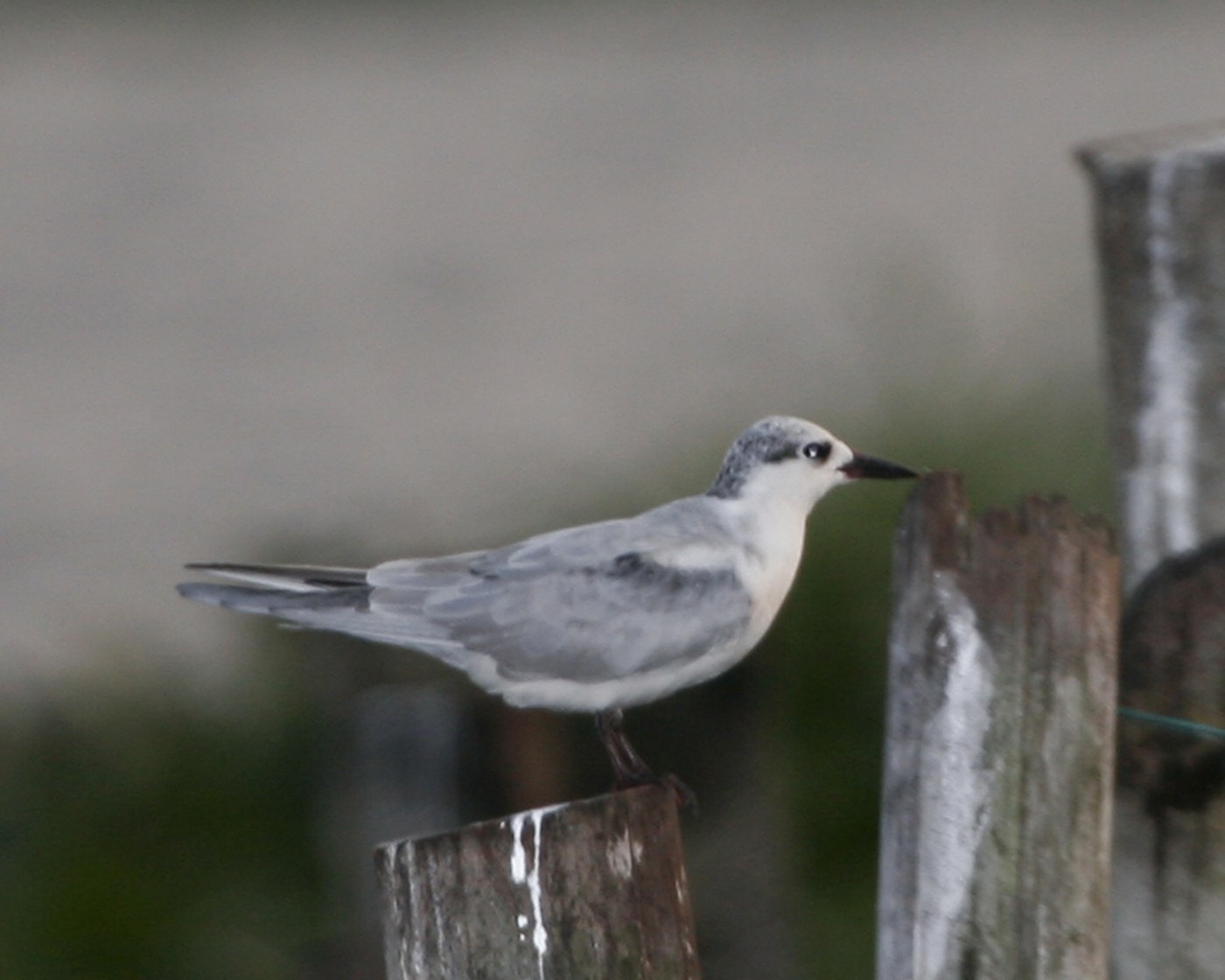
Key Field Marks
- Medium-sized marsh tern, about 24-29 cm (9.5-11.5 in), with a shorter, less deeply forked tail than typical sea terns, giving it a somewhat stockier silhouette.
- Breeding adult: black cap contrasting with a clean white cheek patch, dark slate-gray underparts, pale gray upperparts, and a red bill and legs.
- Nonbreeding birds show a white forehead and streaked crown, with paler overall plumage.
Separating It From Similar Species
- Black Tern: Smaller and darker overall in breeding plumage, with white undertail coverts that contrast against the dark belly, unlike the more uniformly dark underparts of Whiskered Tern.
- White-winged Tern (White-winged Black Tern): Breeding birds show blackish underwing coverts contrasting with a pale wing and a white tail, plus red legs; underpart color and tail contrast are the key separators from Whiskered Tern.
- Overall, underpart color/contrast and tail pattern are the most useful features for separating the three "marsh terns."
Habitat, Range & Season
- Breeds colonially on freshwater marshes, lakes, and flooded fields with emergent vegetation.
- Widely but patchily distributed across parts of Europe, Africa, Asia, and Australia; northern populations are migratory, wintering in Africa, southern Asia, and Australia.
- A casual vagrant well outside its normal range, including rare records in North America.
Voice
- Gives harsh, short calls such as a grating "kek" or "krekk," typically heard around breeding colonies or when foraging birds interact.
Behavior
- Feeds with a buoyant, dipping flight low over water, picking insects and small fish from the surface rather than plunge-diving like many sea terns.
- Often forages over marshes and flooded fields in loose groups, frequently hawking insects in the air as well.
Frequently asked questions
How is Whiskered Tern different from Black Tern?
Whiskered Tern has more uniformly dark gray underparts without the contrasting white undertail coverts that Black Tern shows, and it is slightly larger and paler overall.
What habitat does Whiskered Tern prefer?
Freshwater marshes, lakes, and flooded agricultural fields with emergent vegetation, rather than open ocean or coastline.
Does Whiskered Tern plunge-dive for fish like ocean terns?
No, it typically feeds with a light, dipping flight, picking insects and small fish from the water's surface rather than diving in.
Is Whiskered Tern found in North America?
It is only a casual vagrant there; its normal range covers parts of Europe, Africa, Asia, and Australia.