
Whiskered Screech-Owl Identification Guide
A tiny, eared owl of southwestern mountain oak woodlands, most reliably identified by its even, Morse-code-like song rather than by plumage.
Read the full Whiskered Screech-Owl encyclopedia entry →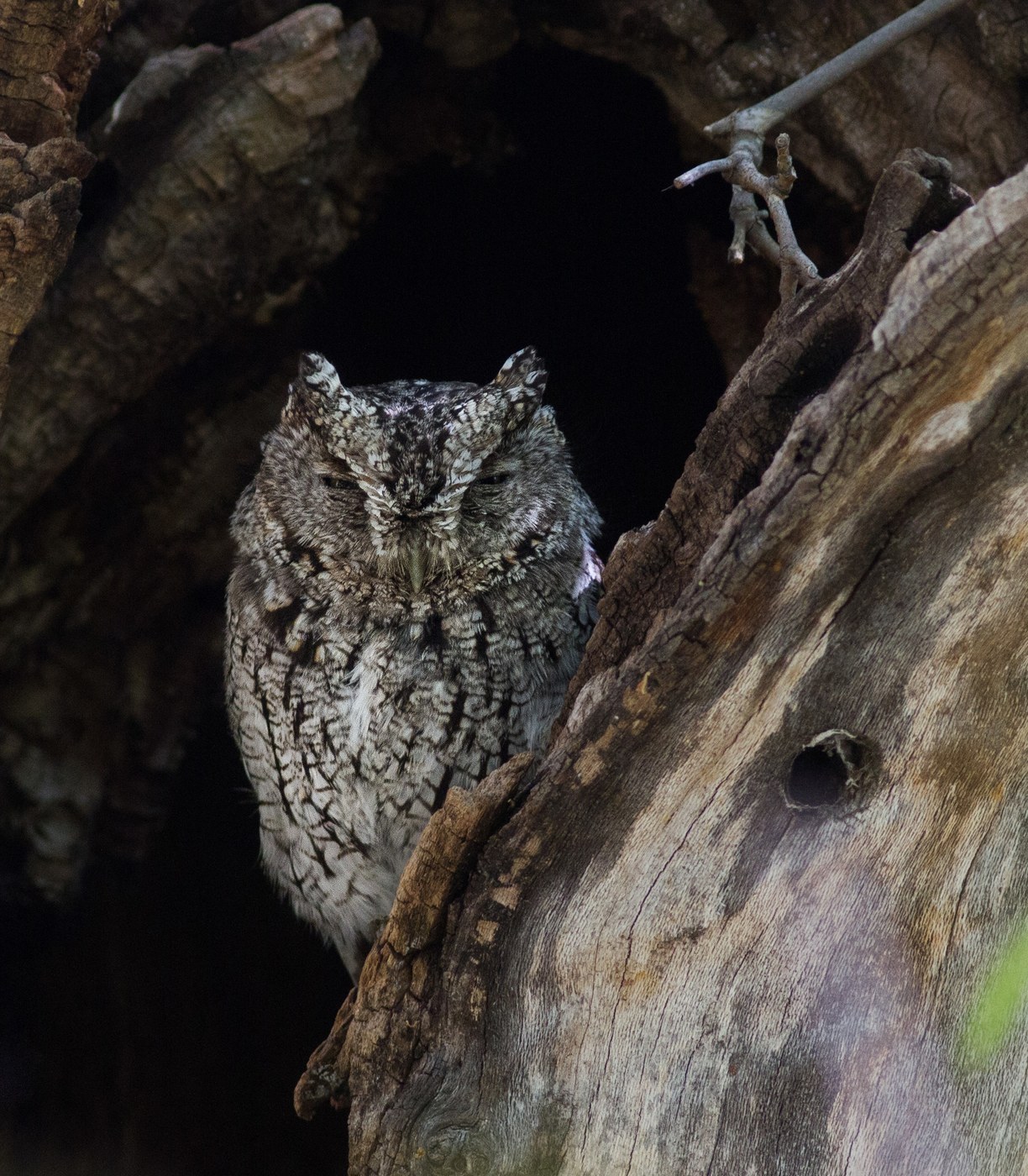
Key Field Marks
- Small owl, only about 17-19 cm (6.7-7.5 in), with prominent ear tufts and bright yellow eyes.
- Occurs in gray and brown color morphs, both finely marked with intricate vermiculations, streaks, and spots that provide excellent camouflage against bark.
- Very similar in size and shape to Western Screech-Owl, with subtle differences in facial disk pattern and toe/bill proportions that are difficult to use reliably in the field.
Separating It From Similar Species
- Western Screech-Owl: Larger on average, with slightly coarser plumage markings, but plumage overlap is significant. Voice is the most dependable difference - Western Screech-Owl gives an accelerating series of notes often likened to a "bouncing ball," while Whiskered Screech-Owl gives a steady, even-paced series.
- Habitat and elevation also help: Whiskered Screech-Owl favors higher-elevation oak and pine-oak woodland, while Western Screech-Owl occupies a broader range of lower desert and riparian habitats.
Habitat, Range & Season
- Found in mountain oak woodland, pine-oak woodland, and sycamore-lined canyons, typically between about 4,500 and 8,000 feet elevation.
- In the United States, restricted to "sky island" mountain ranges of southeastern Arizona and southwestern New Mexico; range extends south through the highlands of Mexico to Nicaragua.
- A year-round resident throughout its range, though it can be very difficult to detect outside the breeding season when it calls less frequently.
Voice
- Primary song is an even, unaccelerating series of short whistled notes, often described as sounding like Morse code, clearly different in rhythm from the accelerating "bouncing ball" song of Western Screech-Owl.
- Also gives a longer, more irregular secondary song used in pair communication.
Behavior
- Strictly nocturnal; roosts by day in dense foliage or tree cavities where it is extremely hard to spot.
- Feeds mainly on large insects such as moths, beetles, and crickets, hunting from a perch with short sallying flights.
- Best located after dark by listening for its distinctive even-paced song rather than by daytime searching.
Frequently asked questions
How do you tell Whiskered Screech-Owl from Western Screech-Owl?
Voice is the most reliable difference: Whiskered gives an even, steady-paced series of notes, while Western Screech-Owl's song accelerates like a bouncing ball. Elevation and habitat also help, since Whiskered favors higher oak woodland.
Where in the United States can I find Whiskered Screech-Owl?
It is restricted to mountain oak and pine-oak woodlands in southeastern Arizona and southwestern New Mexico, generally above about 4,500 feet.
Is Whiskered Screech-Owl active during the day?
No, it is strictly nocturnal and roosts hidden in dense foliage during the day, making it very difficult to see without listening for its nighttime song.
What does a Whiskered Screech-Owl eat?
Primarily large insects such as moths, beetles, and crickets, caught with short sallies from a perch.