
Western Wood-Pewee Identification Guide
A plain grayish-olive flycatcher of western woodlands best told from its near-identical eastern cousin by its harsh, burry call.
Read the full Western Wood-Pewee encyclopedia entry →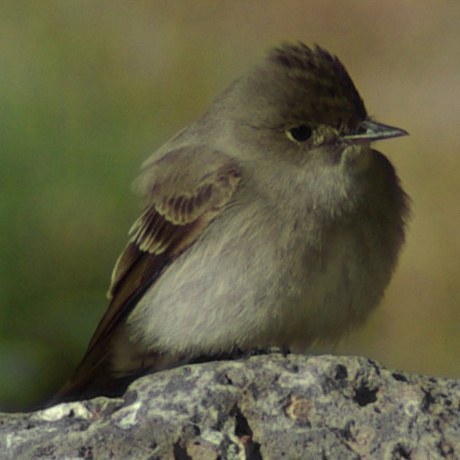
Key Field Marks
- Small flycatcher, about 14-15 cm (5.5-6 in), with a large peaked head and an upright, alert posture.
- Overall dusky olive-gray plumage, slightly paler on the throat and belly, with no strong contrast anywhere on the body.
- Two faint, dingy whitish-to-buffy wingbars; the eye-ring is weak or absent, giving the face a plain, unadorned look.
- Bill is fairly long and broad-based, dark above with a pale (orangish or yellowish) lower mandible.
- Long wingtips (primary projection) extend well past the base of the tail, a useful mark separating it from Empidonax flycatchers.
Separating It From Similar Species
- Eastern Wood-Pewee: Virtually identical in plumage. Voice is the most reliable clue - Western gives a harsh, descending, burry "peeer," while Eastern gives a clear, whistled "pee-a-wee." Range also helps, since the two species barely overlap except locally on the Great Plains.
- Empidonax flycatchers (e.g., Willow, Dusky, Hammond's): Smaller, shorter-winged, usually show a more obvious eye-ring, and habitually flick or bob the tail, which pewees do not do.
- Olive-sided Flycatcher: Noticeably larger and bulkier with a big-headed, "no-neck" look and dark sides that form a vested appearance; its song is a whistled "quick-three-beers."
Habitat, Range & Season
- Breeds in open coniferous and mixed woodlands, forest edges, canyons, and riparian corridors across western North America, from Alaska and western Canada south through the western U.S. into Mexico and Central America.
- Favors semi-open stands with scattered tall perches over dense unbroken forest.
- A long-distance migrant; winters in South America. In the breeding range it is present from about May through September.
Voice
- Song/call: a nasal, slightly buzzy, descending "peeer" or "pee-yee," often repeated persistently through the day, along with a short, rough "brrrt" call note.
- Voice is the single best field character when plumage and range are ambiguous.
Behavior
- A classic "sit-and-wait" flycatcher: perches on an exposed dead twig or snag, sallies out to catch flying insects, and typically returns to the same or a nearby perch.
- Often sings from a high, conspicuous perch throughout the breeding season, making it easier to detect by ear than by sight.
Frequently asked questions
What is the best way to tell a Western Wood-Pewee from an Eastern Wood-Pewee?
Voice is the most reliable clue: Western gives a harsh, burry, descending "peeer," while Eastern gives a clearer, whistled "pee-a-wee." Range also helps since the two overlap only narrowly.
Does the Western Wood-Pewee have an eye-ring like Empidonax flycatchers?
No, or only a very faint one. Its plain face without a bold eye-ring, combined with long primary projection, helps separate it from the smaller Empidonax species.
Where and when is the best time to see a Western Wood-Pewee?
Look in open coniferous or mixed woodlands and riparian edges across the western U.S. and western Canada from May through September, when birds are actively singing from exposed perches.
What does a Western Wood-Pewee eat and how does it hunt?
It is an aerial insectivore that perches on an exposed twig and sallies out to snatch flying insects, then typically returns to the same perch.