
Western Tanager Identification Guide
The Western Tanager is a strikingly colorful songbird of western coniferous forests, with breeding males showing a fiery orange-red head, lemon-yellow body, and black wings with bold white and yellow wing bars.
Read the full Western Tanager encyclopedia entry →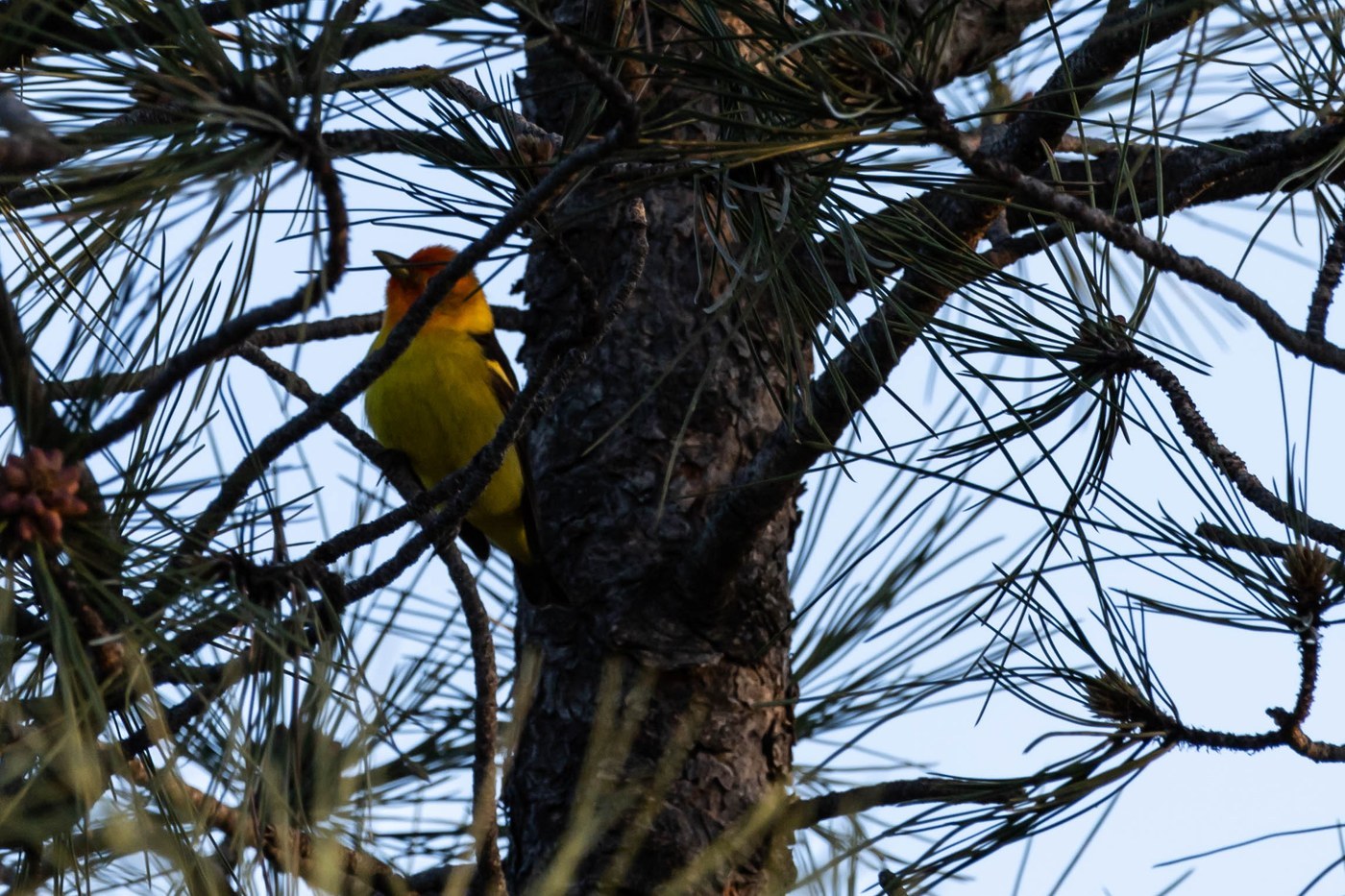
Key Field Marks
- Size and shape: A medium-sized, stocky songbird (about 18 cm) with a fairly large, conical, pale bill and a moderately short tail — a robust, thick-necked build typical of tanagers.
- Breeding male plumage: Unmistakable — a bright orange-red head (the red pigment is diet-derived and can vary from orange to deep red), lemon-yellow body, and jet-black back, wings, and tail. Wings show two bold wing bars, the upper one yellow and the lower one white.
- Female and nonbreeding male plumage: Much more subdued — olive-yellow overall with greyish upperparts, yellowish underparts, dark wings with two whitish-to-pale-yellow wing bars, and no red on the head. Nonbreeding males may retain some yellow-olive tones on the head rather than red.
- Bill: Notably large, thick, and pale horn-colored — heavier than most other yellow-and-black songbirds it might be confused with.
- Behavior: Often forages deliberately in the forest canopy for insects (sallying out for flying prey) and berries, frequently detected by voice before being seen; can also visit fruit or suet at feeders during migration.
Similar Species
- Scott's Oriole / orioles in general: Orioles are slimmer with longer, more pointed bills and different structure; male Western Tanager's stockier build and red head (in breeding plumage) are diagnostic.
- American Goldfinch (male, breeding): Much smaller, with a tiny conical bill, black cap (not a fully red head), and no red tones at all.
- Female/nonbreeding Western Tanager vs. Summer/Scarlet Tanager females: Ranges rarely overlap significantly, but Western Tanager shows crisper white wing bars and a slightly different overall tone; habitat and range are the best clues where ambiguity exists.
Where and When to Look
Breeds in open coniferous and mixed coniferous-deciduous forest across western North America, from southeastern Alaska and western Canada south through the Rocky Mountains and Pacific states into the highlands of Mexico. A long-distance migrant, wintering primarily from Mexico south to Costa Rica, it passes through lowland and desert habitats on migration, making spring and fall migration (April–May and August–September) prime times to spot it well outside typical breeding forest, including in yards and parks.
Voice
A husky, robin-like song of short, burry phrases, often rendered as "pit-er-ick, pit-er-ick," delivered from high in the canopy. The most distinctive call is a dry, rising "pit-er-ick" or "pri-tick" contact call, often the first clue to a bird's presence overhead.
Frequently asked questions
What does a male Western Tanager look like in breeding plumage?
A fiery orange-red head, lemon-yellow body, and black wings, back, and tail, with bold yellow and white wing bars.
How can I identify a female Western Tanager?
Look for an olive-yellow body, greyish upperparts, and dark wings with two pale wing bars — much duller than the male and lacking any red on the head.
Why do some male Western Tanagers show orange instead of red on the head?
The red head color comes from a rare carotenoid pigment obtained through diet (from certain insects), and its intensity can vary from yellow-orange to deep red depending on diet and individual variation.
What habitat should I search for breeding Western Tanagers?
Open coniferous and mixed forest in mountains and foothills across western North America.
What call helps locate a Western Tanager in the canopy?
A dry, rising 'pit-er-ick' contact call, often heard from high in the trees before the bird itself is spotted.