
Western Screech-Owl Identification Guide
The Western Screech-Owl is a small, well-camouflaged, ear-tufted owl of western North America, best identified by its mottled grey (or brown) bark-like plumage, yellow eyes, and its distinctive accelerating 'bouncing ball' trill.
Read the full Western Screech-Owl encyclopedia entry →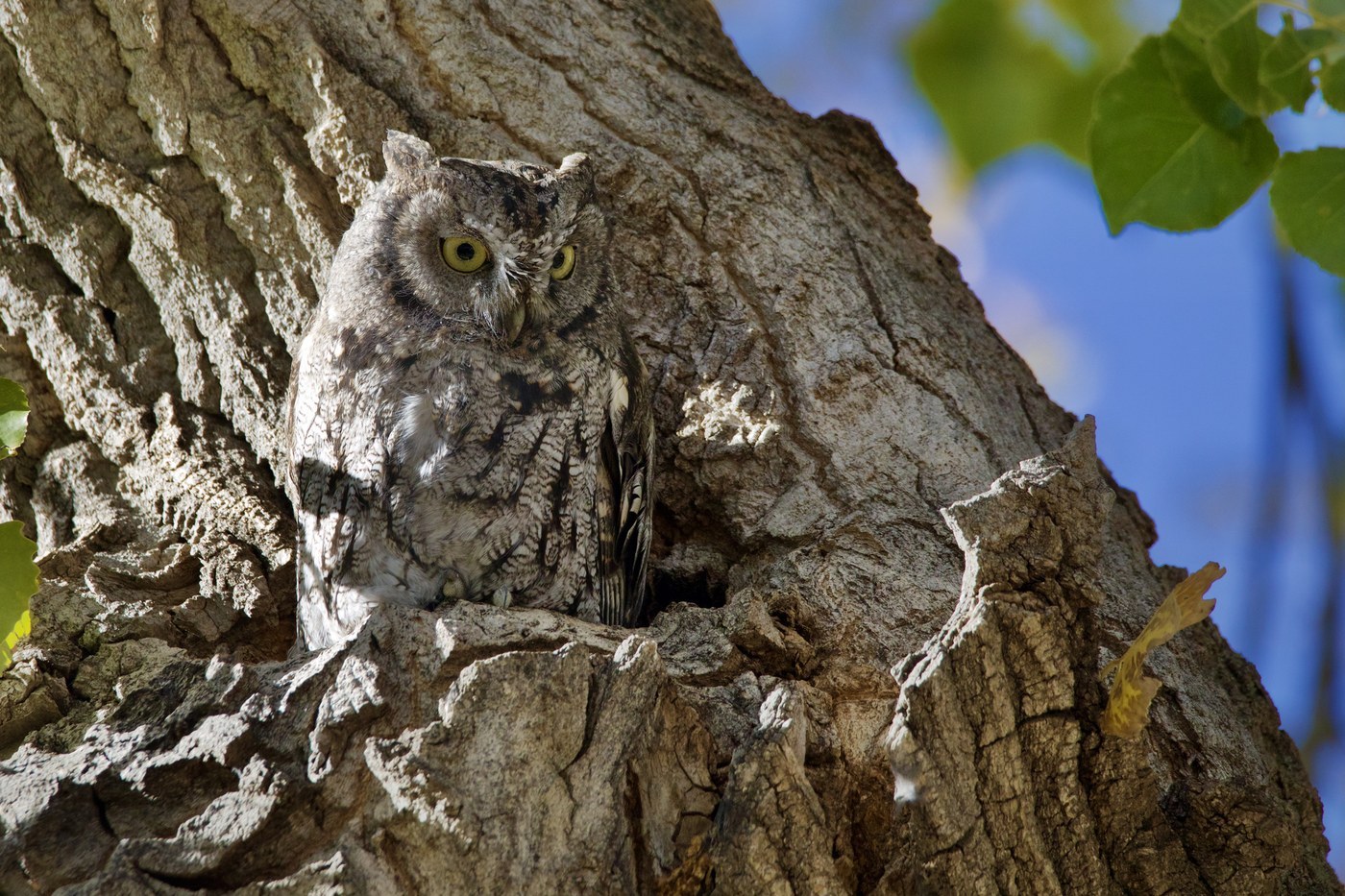
Key Field Marks
- Size and shape: A small owl (about 19–25 cm) with prominent pointed ear tufts, a compact, rounded body, and a large head — roughly the size and shape of an Eastern Screech-Owl but generally greyer overall.
- Plumage: Finely mottled and vermiculated grey-brown (some interior/desert populations more brownish), providing outstanding camouflage against tree bark — the bird often sits tight against a trunk cavity or branch, nearly invisible until it moves.
- Eyes: Bright yellow, a useful mark separating it at a glance from the dark-eyed Barn Owl and distinguishing it from the brown-eyed Flammulated Owl.
- Bill: Dark, mostly greenish-grey to blackish, contrasting with lighter facial disk feathering.
- Behavior: Strictly nocturnal, roosting by day in tree cavities or dense cover and becoming active at dusk. Often responds to imitations of its call, and can be located by mobbing songbirds during the day if a roost is disturbed.
Similar Species
- Eastern Screech-Owl: Ranges barely overlap (mainly in the Great Plains); Eastern often shows a rustier reddish morph not found in Western, and the two differ clearly in voice — Eastern gives a descending whinny and a level trill, unlike Western's accelerating "bouncing ball" trill.
- Flammulated Owl: Smaller, with dark (not yellow) eyes and much shorter, less obvious ear tufts; also more strictly a summer migrant tied to open pine forest, unlike the largely resident Western Screech-Owl.
- Whiskered Screech-Owl: Found only in a small range in the southwestern US (sky island mountains of Arizona/New Mexico); very similar in appearance, best separated by voice (a more irregular, morse-code-like series of notes) and higher-elevation pine-oak habitat.
Where and When to Look
Resident year-round across a broad swath of western North America, from southeastern Alaska and coastal British Columbia south through the western US into Mexico, occupying riparian woodland, desert washes with saguaro or mesquite, oak woodland, and suburban parks and yards with mature trees. Non-migratory, so present in the same territories throughout the year; most reliably detected after dark by listening for its call, especially on calm evenings in late winter and spring when territorial calling peaks.
Voice
A series of short whistled notes that accelerate in tempo without changing pitch much, often described as sounding like a bouncing ball coming to rest — quite distinct from the descending whinny of the Eastern Screech-Owl. Also gives a shorter double-trilled call used in pair communication.
Frequently asked questions
What is the best way to distinguish Western Screech-Owl from Eastern Screech-Owl by ear?
Western Screech-Owl gives an accelerating series of whistled notes on one pitch, likened to a bouncing ball, while Eastern Screech-Owl gives a descending whinny and a separate level trill.
What color are a Western Screech-Owl's eyes?
Bright yellow, which helps distinguish it from dark-eyed species like Barn Owl and Flammulated Owl.
What habitat does the Western Screech-Owl prefer?
A wide range of wooded habitats including riparian woodland, desert washes with cactus or mesquite, oak woodland, and shaded suburban parks and yards across western North America.
Is the Western Screech-Owl migratory?
No, it is a non-migratory year-round resident throughout its range.
How is a Western Screech-Owl best located in the field?
Most often by listening for its distinctive bouncing-ball trill after dark, or by watching for songbirds mobbing a daytime roost site in a tree cavity or dense foliage.