
Western Rosella Identification Guide
The Western Rosella is a small, brightly colored Australian parrot endemic to southwestern Western Australia, identified by its red head and underparts, yellow-green back scalloping, and blue cheek patch, with duller olive-green females.
Read the full Western Rosella encyclopedia entry →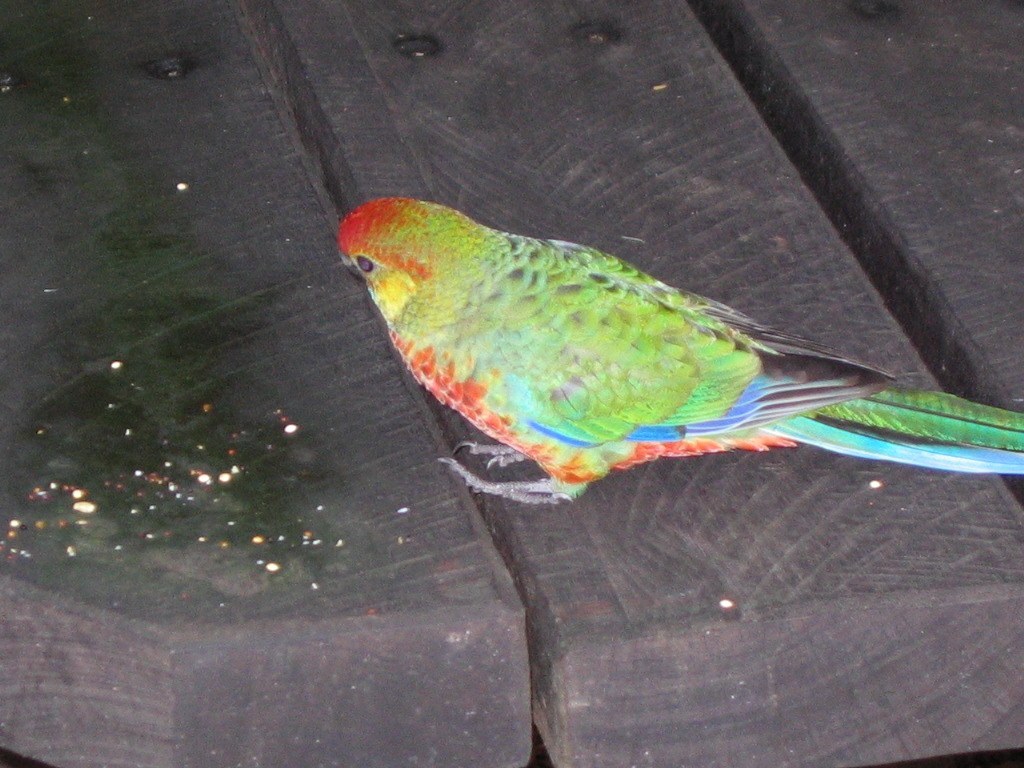
Key Field Marks
- Size and shape: The smallest of the rosellas, a compact, long-tailed parrot (around 25–29 cm including the graduated tail) with the typical rosella build — stocky body, rounded head, and a long, broad tail tapering to a point.
- Male plumage: Deep red head, neck, and underparts contrasting with a distinctive blue cheek patch, and a back scalloped in black feathers broadly edged with yellow-green, giving a scaly pattern. Wings show blue flight feathers and a blue shoulder patch. Tail is dark blue-green above.
- Female plumage: Much duller and more subdued than the male — mostly dull olive-green on the head and back with reduced red confined mostly to the forehead and underparts, and a smaller, less distinct cheek patch; juveniles resemble females.
- Bill: Small, pale horn-colored, typical parrot hook shape.
- Behavior: Usually seen in pairs or small family groups, feeding quietly on the ground or in low vegetation on seeds, fruits, and blossoms; often surprisingly unobtrusive despite bright plumage, freezing or slipping into cover when disturbed rather than flushing immediately.
Similar Species
- Eastern (Crimson/Adelaide/Green) Rosellas: Do not overlap in range with Western Rosella (which is endemic to southwestern Australia), so geography alone rules out confusion with eastern rosella forms.
- Red-capped Parrot: Shares some red plumage and range overlap, but has a distinctly elongated, protruding bill and lacks the rosella's scalloped back pattern and blue cheek patch.
- Australian Ringneck (Port Lincoln Parrot, in range areas): Green overall with a yellow band across the nape, quite different from the red-headed Western Rosella.
Where and When to Look
Endemic to the southwest corner of Western Australia, found in eucalypt woodland, farmland with remnant trees, orchards, and parks and gardens from around Perth south to the south coast. Non-migratory and present year-round, often visiting gardens and rural properties, especially where mature trees provide nesting hollows. Look for pairs feeding quietly on lawns, in orchards, or along woodland edges at any time of year.
Voice
A soft, quiet, low-pitched piping or trilling call, generally weaker and less strident than the calls of larger rosellas — often the first clue is a soft contact call between a feeding pair rather than a loud screech.
Frequently asked questions
Where is the Western Rosella found?
It is endemic to the southwestern corner of Western Australia, in eucalypt woodland, farmland, orchards, and gardens, and does not occur anywhere else in the world.
How do I tell a male from a female Western Rosella?
Males have a bright red head and underparts with a distinct blue cheek patch, while females are much duller olive-green with red largely restricted to the forehead.
What is the smallest rosella species?
The Western Rosella is the smallest of the Australian rosellas, at roughly 25–29 cm long including its tapered tail.
Could a Western Rosella be confused with a Red-capped Parrot?
Both share red plumage and range, but the Red-capped Parrot has a much longer, protruding bill and lacks the rosella's scalloped back pattern and blue cheek patch.
Is the Western Rosella often seen in gardens?
Yes, it readily visits orchards, farmland, and gardens with mature trees, especially where nesting hollows are available.