
Western Capercaillie Identification Guide
The Western Capercaillie is a massive, turkey-sized grouse of Eurasian conifer forests, identified by the male's huge dark body, fanned tail, and pale bill contrasted with the much smaller, camouflaged brown female.
Read the full Western Capercaillie encyclopedia entry →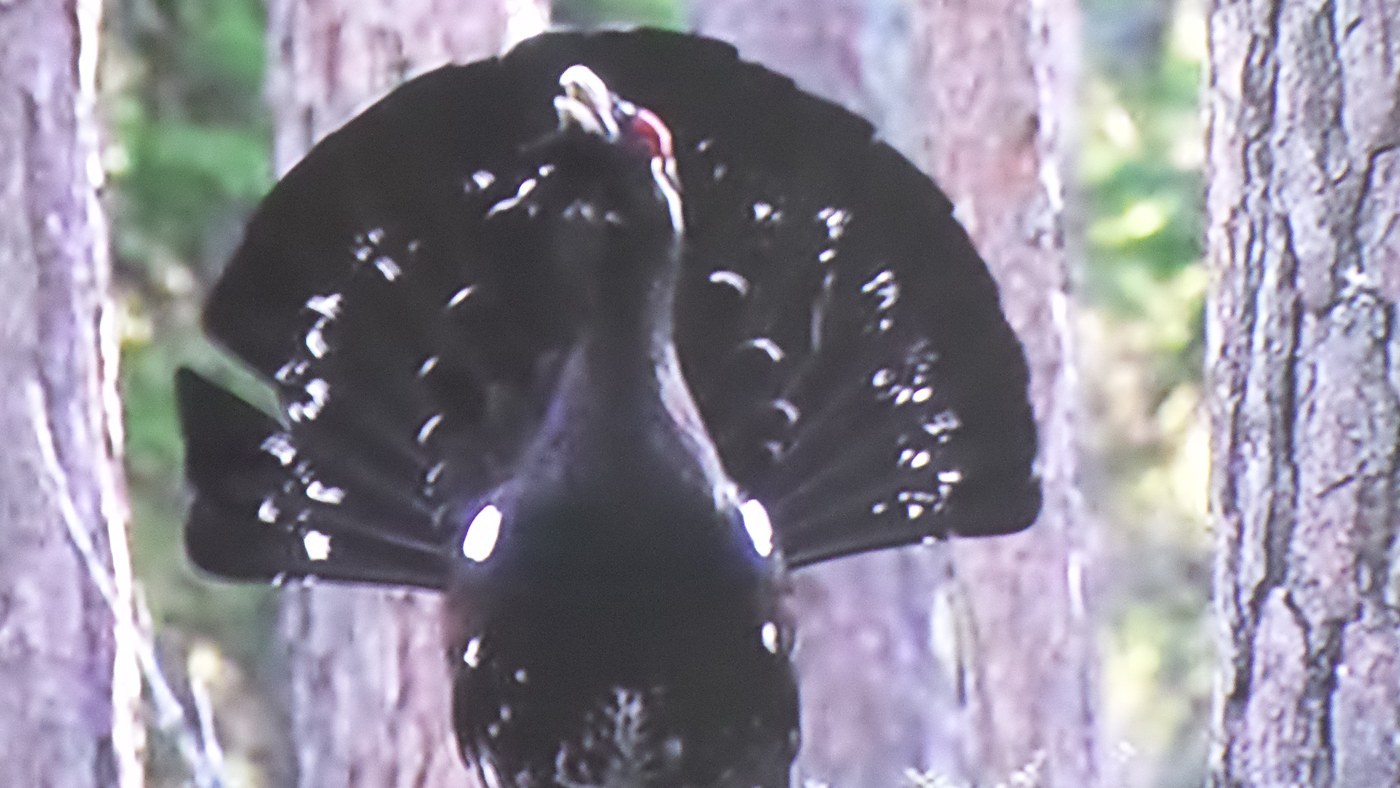
Key Field Marks
- Size and shape: The largest grouse in the world. Males are enormous (up to 90 cm / 4.5 kg), with a bulky, barrel-shaped body, thick neck, and a broad, fan-shaped tail often held cocked upward when displaying. Females are roughly half the male's bulk (turkey- to large-chicken sized).
- Male plumage: Dark slate-grey head and neck, a blackish body with a glossy greenish sheen on the breast, brown wings, and a black tail marked with white spots, usually fanned during display. A small red wattle of bare skin sits above the eye.
- Female plumage: Strongly mottled rufous-brown and black, with a warm orange-buff patch on the breast — excellent camouflage against forest floor and bark. Much smaller and shorter-tailed than the male.
- Bill: Pale ivory-white, notably large and hooked-looking, standing out against the male's dark plumage — one of the best marks at a distance.
- Legs/feet: Legs feathered down to the toes (typical grouse adaptation to cold), feet large for walking on snow.
- Behavior: Shy and secretive outside the breeding season, usually seen walking or flushing explosively from the forest floor with loud wingbeats. Males perform a dramatic lek display at dawn in spring, strutting with tail fanned, wings drooped, and head thrown back while giving a bizarre popping-and-scraping song.
Similar Species
- Black Grouse (male): Smaller, has a lyre-shaped (forked) tail rather than a fan, and lacks the capercaillie's massive bulk and pale bill.
- Female Capercaillie vs. female Black Grouse: The capercaillie female is larger, more rufous on the breast, and has a more rounded (not notched) tail tip.
- Hazel Grouse: Much smaller, greyer, with a distinct black throat patch (male) and a shorter crest — no confusion at close range given the capercaillie's far greater bulk.
Where and When to Look
Resident year-round in mature coniferous and mixed boreal forest across Scandinavia, the Alps, the Pyrenees, the Carpathians, and Russia, with a relict, endangered population in Scotland. It favors old-growth pine forest with a well-developed bilberry understory. Leks (communal display grounds) are used at dawn from late March through May, the best and most predictable time to see displaying males, though disturbance at leks should be avoided as the species is highly sensitive and declining across much of its range.
Voice
The male's lek song is unlike any other bird sound: a series of clicking notes accelerating into a cork-popping sound, followed by a wheezing, scraping "whetting" sound reminiscent of a knife being sharpened. Females give soft clucking contact calls. Both sexes give a loud, harsh alarm cackle when flushed.
Frequently asked questions
How can I tell a male from a female Western Capercaillie?
Males are dark, glossy black-grey with a pale bill and a broad fan-shaped tail; females are roughly half the size and mottled warm brown with an orange breast patch.
What's the easiest way to separate a Capercaillie from a Black Grouse?
Look at overall bulk and tail shape: the Capercaillie is much larger with a fan-shaped tail and pale bill, while the male Black Grouse is smaller with a lyre-shaped, forked tail.
When is the best time to see displaying Western Capercaillies?
At dawn during the lek season, roughly late March through May, when males gather at traditional display grounds in mature conifer forest.
What habitat should I search for Western Capercaillie?
Old-growth boreal or montane coniferous forest, especially pine woodland with a rich bilberry (blueberry) understory for cover and food.
Is the Western Capercaillie easy to see in the UK?
No — the Scottish population is small and declining, and birds are very shy; disturbance at leks is discouraged, so most reliable viewing is at managed hides or in larger continental populations.