
Wedge-tailed Eagle Identification Guide
The Wedge-tailed Eagle is Australia's largest raptor, identified by its huge size, distinctive long wedge-shaped tail, dark blackish-brown plumage, and fully feathered legs.
Read the full Wedge-tailed Eagle encyclopedia entry →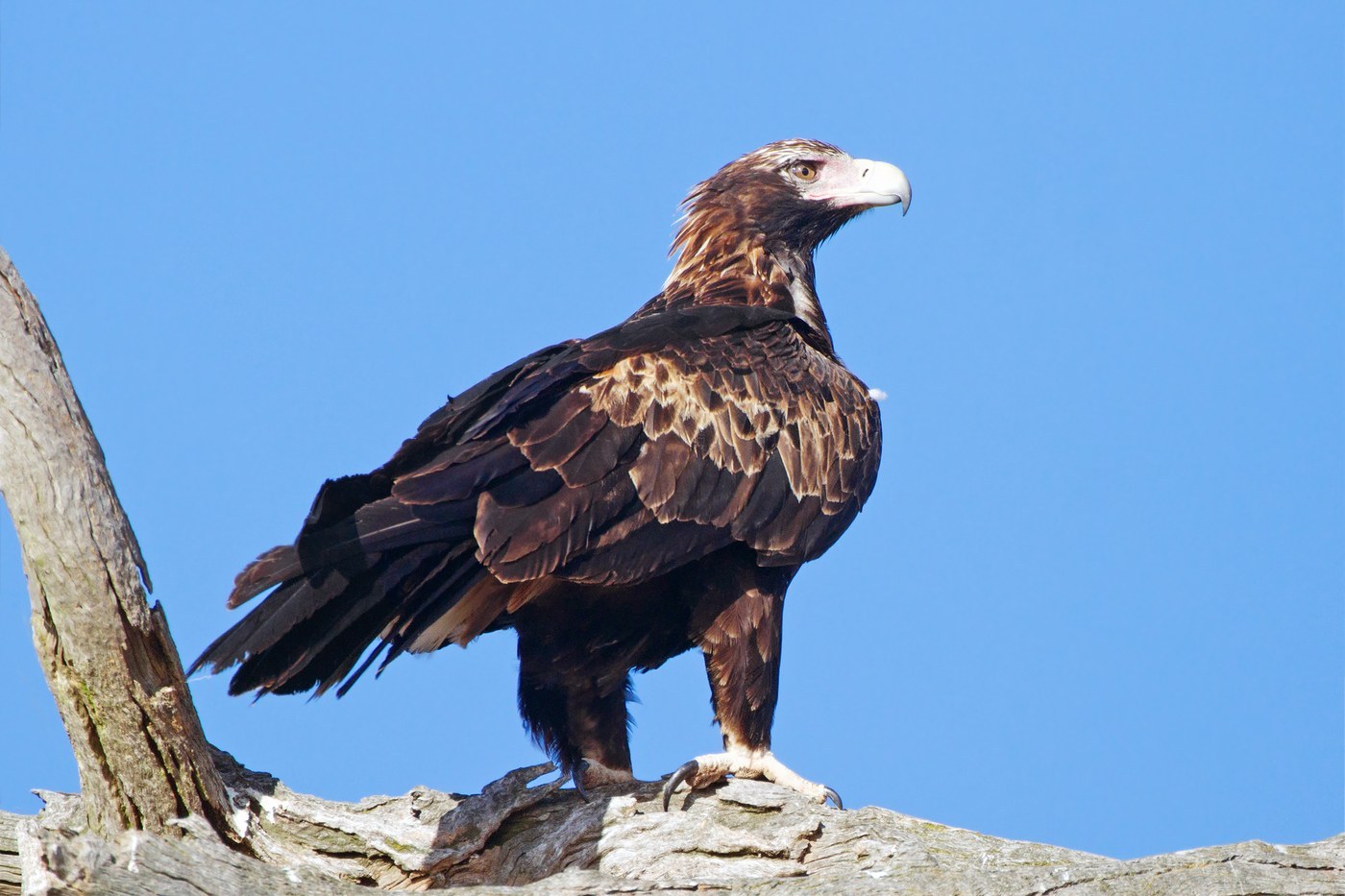
Key Field Marks
- Size and shape: Australia's largest bird of prey, with a wingspan up to about 2.3 m. In flight, shows long, broad, "fingered" wingtips and a long, unmistakably diamond/wedge-shaped tail — the defining feature of the species.
- Plumage: Adults are dark blackish-brown overall, appearing almost black at a distance, with paler golden-brown feathering on the nape and hackles.
- Legs: Fully feathered down to the toes, typical of true (Aquila) eagles.
- Juveniles/immatures: Much paler rufous-brown, gradually darkening with each molt over roughly a decade until reaching full adult darkness.
- Flight: Soars with wings held in a shallow V (dihedral), often at great height, riding thermals for long periods.
Separating It From Similar Species
- Whistling Kite / Black Kite: Both are considerably smaller with rounded or shallowly forked tails, not the long wedge shape, and lighter, more buoyant flight.
- Little Eagle: Much smaller, with a shorter, squarer tail and different underwing pattern.
- Black-breasted Buzzard: Smaller, with a rounder tail and different wing markings (pale "windows" near the wingtips). Overall, sheer size combined with the long wedge-shaped tail makes adult Wedge-tailed Eagles hard to mistake once seen well.
Habitat, Range & Season
Found throughout mainland Australia and Tasmania across almost every habitat type — open woodland, arid interior country, forest edges, farmland, and even semi-desert. Frequently seen soaring at height or perched on roadside poles and trees, and is a regular scavenger at roadkill along highways. Largely sedentary, with some local and altitudinal movements.
Voice
Relatively quiet away from the nest. Gives thin, high-pitched whistling or yelping calls, most often around the nest site or in territorial interactions.
Frequently asked questions
What is the single best way to identify a Wedge-tailed Eagle?
Its long, distinctly wedge/diamond-shaped tail is diagnostic and separates it from every other Australian raptor, combined with its very large size.
How can I tell a young Wedge-tailed Eagle from an adult?
Juveniles and immatures are much paler rufous-brown, gradually darkening to blackish-brown as they mature over roughly ten years.
Where in Australia can I see Wedge-tailed Eagles?
Almost anywhere on the mainland and in Tasmania, across open woodland, arid country, farmland, and forest edges — they're often seen soaring high or perched near roadside carrion.
How does Wedge-tailed Eagle differ from Whistling Kite?
Wedge-tailed Eagle is much larger with a long wedge-shaped tail, while Whistling Kite is smaller with a rounded tail and lighter, more buoyant flight.