
Water Rail Identification Guide
The Water Rail is a secretive, chicken-sized Old World rail identified by its long red bill, gray face and breast, barred flanks, and pig-like squealing calls from dense reedbeds.
Read the full Water Rail encyclopedia entry →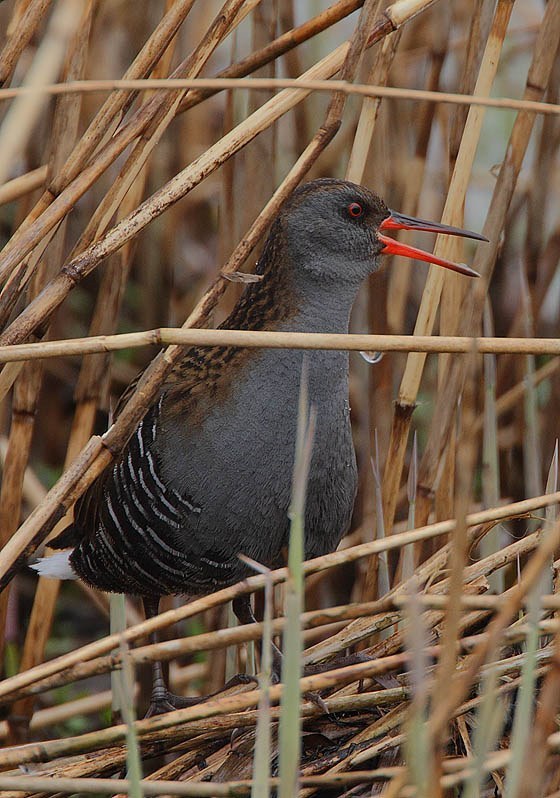
Key Field Marks
- Size and shape: About the size of a small moorhen but laterally flattened ("thin as a rail") to slip through dense reed stems; roughly 23-28 cm long.
- Bill: Long, slightly downcurved, bright red-orange with a darker culmen — the single best field mark.
- Plumage: Slate-gray face, throat, and breast; upperparts brown, heavily streaked black; flanks strikingly barred black-and-white.
- Tail and legs: Short tail, often cocked and flicked to reveal white/buff undertail coverts; legs pinkish-brown with long toes for walking over soft mud and vegetation.
Separating It From Similar Species
- Moorhen and Coot: Both are larger, uniformly dark waterbirds with short stubby bills (red-and-yellow for Moorhen, white for Coot) rather than a long red bill, and they swim in open water more readily than the skulking Water Rail.
- Spotted Crake: Smaller, with a short yellow bill (with red base) and heavily spotted/speckled plumage overall, lacking the barred flanks and plain gray underparts of Water Rail.
- Corncrake: Buffier, shorter-billed, and found in dry grassland/hayfields rather than wetland cover.
Behavior & Habitat
Extremely secretive, spending most of its time hidden within dense reedbeds, sedge, and waterside vegetation, only occasionally stepping into the open at the water's edge, often at dawn or dusk. Favors reedbeds, fens, marshes, wet ditches, and overgrown pond margins with year-round water and thick cover.
Range & Season
Widespread across Europe and temperate Asia. Resident in milder western and southern areas; northern and eastern populations are migratory, moving south and often turning up on small, unlikely patches of wet cover on migration.
Voice
Far more often heard than seen. Its signature call — known as "sharming" — is a bizarre pig-like squealing and grunting duet, often given at night. The contact call is a sharp, explosive "kip."
Frequently asked questions
How do I identify a Water Rail if I can't see it well?
Listen for its distinctive call — a strange pig-like squealing and grunting known as 'sharming,' often given from deep within reedbeds, especially at dawn, dusk, or night.
What is the best physical field mark for Water Rail?
The long, slightly downcurved, bright red-orange bill is the most reliable mark, combined with gray underparts and bold black-and-white barred flanks.
Where should I look for Water Rail?
Search dense reedbeds, fens, marshes, and overgrown wet ditches — it rarely ventures into open water and prefers thick waterside cover.
Is Water Rail the same as a Moorhen?
No. Moorhen is larger, swims in open water, and has a short red-and-yellow bill, while Water Rail is smaller, secretive, and has a long red bill with barred flanks.