
Wandering Albatross Identification Guide
The Wandering Albatross is the largest flying seabird on Earth, identified by its enormous white body, black-and-white wings, and pink bill, gliding for hours without a wingbeat over the Southern Ocean.
Read the full Wandering Albatross encyclopedia entry →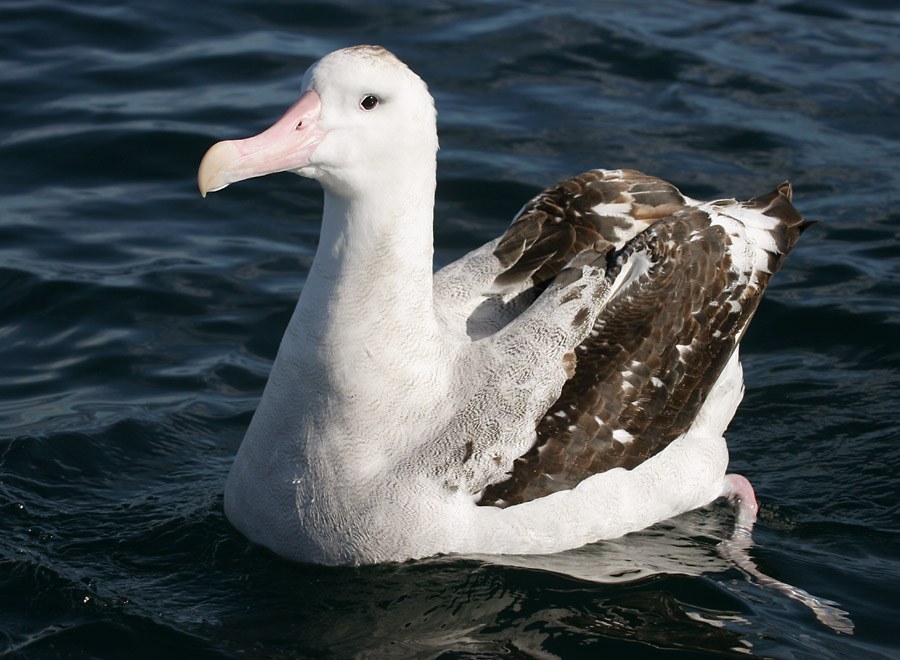
Key Field Marks
- Size and shape: The largest wingspan of any living bird, averaging around 3.1 m (10 ft) and reaching up to 3.5 m in the biggest males. Long, narrow, stiffly held wings and a heavy, barrel-shaped body.
- Bill: Massive, hook-tipped, pale pink bill with a pale bluish tip and visible tubenose ridge on top.
- Legs and feet: Pale pink, usually tucked and barely visible in flight.
- Plumage and age progression: Juveniles are almost entirely chocolate-brown with a white face mask. With each molt cycle (over roughly 10-20+ years) they whiten progressively — first the back and underparts, then the wings — until very old adults are almost pure white with only black wingtips and a thin dark trailing edge.
Separating It From Similar Species
- Royal Albatrosses (Southern/Northern): Royals show a black cutting edge (a thin dark line) along the upper mandible, which Wandering Albatross lacks. Southern Royal Albatross also typically has a black leading edge on the upperwing that Wandering Albatross adults lack once whitened.
- Mollymawks (Black-browed, Grey-headed, etc.): All are noticeably smaller with dark upperwings and dark caps/eyebrows; Wandering Albatross dwarfs them and, except in young dark-plumaged birds, shows far more white in the body.
- Younger dark birds: Can be confused with juvenile Royal Albatrosses, but Wandering juveniles have a solid brown cap and white face, and the underwing pattern differs subtly (more extensively dark-tipped in Wandering).
Behavior
Rarely flaps; uses dynamic soaring to exploit wind gradients over waves, covering huge distances with almost no energy expenditure. Regularly follows fishing vessels and ships for scraps and offal.
Habitat, Range & Season
Entirely pelagic outside the breeding season, circumnavigating the Southern Ocean between roughly 30°S and 60°S. Breeds on remote subantarctic islands — South Georgia, the Crozet and Kerguelen Islands, Prince Edward Islands, and Macquarie Island — nesting on open, tussock-covered ground. Because chick-rearing takes about a year, most pairs breed only every second year.
Voice
Essentially silent at sea. At breeding colonies, birds engage in loud bill-clattering, braying, and groaning during elaborate courtship "sky-pointing" and mutual displays.
Frequently asked questions
How can I tell a Wandering Albatross from a Royal Albatross?
Look at the bill: Royal Albatrosses show a thin black line (the cutting edge) along the upper mandible that Wandering Albatross lacks. Wing pattern and molt stage also help, but the bill mark is the most reliable field feature.
Why do Wandering Albatrosses look so different from bird to bird?
Plumage whitens with age. Juveniles are dark chocolate-brown with a white face, and birds become progressively whiter over one to two decades, so you can roughly age an individual by how much white it shows.
Where is the best place to see a Wandering Albatross?
They are pelagic and circle the Southern Ocean, so pelagic boat trips off South Africa, New Zealand, southern Australia, or South America, and visits to breeding islands like South Georgia, offer the best chances.
Do Wandering Albatrosses flap their wings much?
Very rarely. They use dynamic soaring, riding wind gradients above the waves, which lets them glide for hours or even days with minimal flapping.