
Vulturine Guineafowl Identification Guide
A striking, highly social African guineafowl with a bare blue head, long black-and-white striped neck hackles, and a cobalt-blue breast.
Read the full Vulturine Guineafowl encyclopedia entry →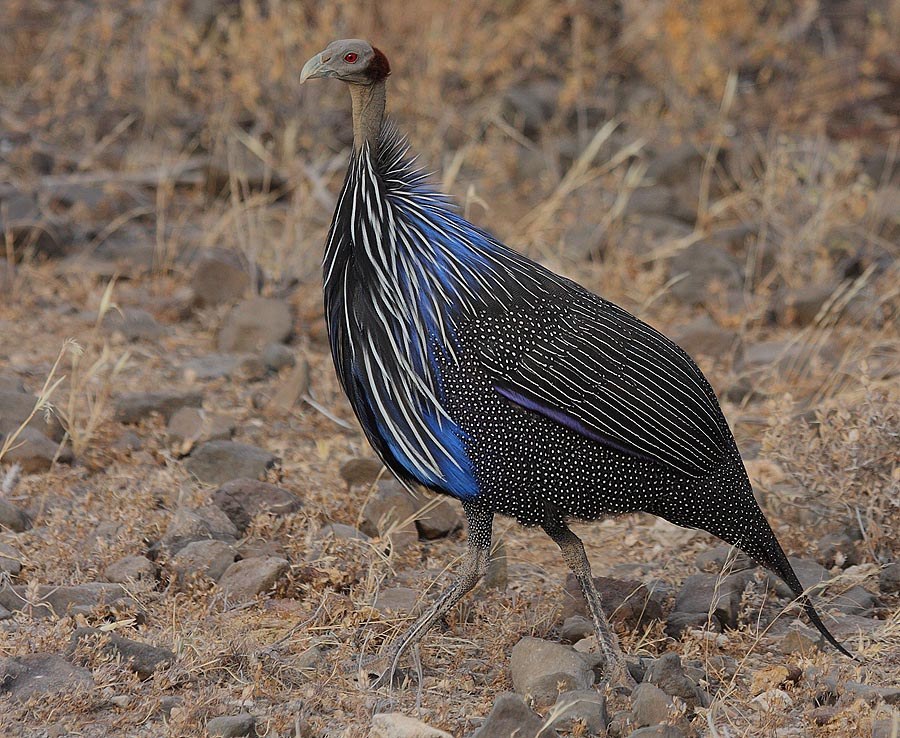
Key Field Marks
- Size & shape: A large, long-necked guineafowl, taller and more slender-necked than other guineafowl species, giving it a somewhat vulture-like silhouette when the neck is extended — the source of its name.
- Head: Bare, brightly colored blue skin on the head and upper neck, without the bony casque found on some other guineafowl.
- Neck & underparts: Long, narrow, black-and-white striped hackle feathers drape down from the neck onto a striking cobalt-blue breast.
- Body: Back and wings covered in dense, intricately spangled black-and-white spotted plumage over a dark base.
- Eyes: Red eyes stand out against the blue facial skin.
- Behavior: Highly social and strongly terrestrial, moving in large flocks across open ground, running rather than flying when disturbed and only flying short distances when pressed.
Separating Vulturine Guineafowl from Similar Species
- Helmeted Guineafowl: Has a bony casque (helmet) atop the head and lacks the cobalt-blue breast and long striped neck hackles, appearing overall grayer and more uniformly spotted.
- Silhouette: The long, bare, vulture-like neck combined with vivid blue breast coloring makes Vulturine Guineafowl unmistakable where the two species overlap.
Where & When to See One
A resident, non-migratory species restricted to dry thorn scrub, semi-arid savanna, and acacia country of East Africa, including Kenya, southern Ethiopia, Somalia, and parts of Tanzania and Uganda. Found year-round in its arid range, often in large, cohesive flocks that forage on the ground for seeds, insects, and plant material, sheltering in dense thorn thickets at night.
Voice
Loud, harsh cackling and chattering calls, often given by multiple birds within a flock simultaneously, helping to keep the tightly bonded group in contact while foraging across open ground.
Frequently asked questions
What is the easiest way to identify a Vulturine Guineafowl?
Look for a bare blue head and neck, long black-and-white striped neck hackles, and a striking cobalt-blue breast, unlike any other guineafowl.
How is Vulturine Guineafowl different from Helmeted Guineafowl?
Helmeted Guineafowl has a bony casque on its head and lacks the blue breast and long striped neck hackles that define Vulturine Guineafowl.
What habitat does Vulturine Guineafowl prefer?
Dry thorn scrub and semi-arid savanna in East Africa, including Kenya, southern Ethiopia, Somalia, Tanzania, and Uganda.
Is the Vulturine Guineafowl social?
Yes, it is highly social, typically found in large, cohesive flocks that forage and roost together on the ground in arid, thorny habitat.